
ENDANGERED SPECIES ACT OVERREACHES HUMAN RIGHTS

The Endangered Species Act Turns 40

A Statement by Rob Rivett, President, Pacific Legal Foundation

This year the Endangered Species Act turns 40. President Richard Nixon, on December 28, 1973, signed into law one of the nation’s most powerful environmental laws.  The law vested authority in the U.S. Fish and Wildlife Service and the National Oceanic and Atmospheric Administration to enforce a wave of new regulations, and create a new relationship between homo sapiens and other species.
Soon after its passage, the U.S. Supreme Court declared it the most comprehensive law ever passed for the protection of species and that ESA enforcement must occur “whatever the cost.”  Federal officials have used their power under the Act to regulate private property as if it were public land.
The degree to which the ESA has been successful is a matter of debate.  Of the estimated $3 billion of taxpayer funds necessary to fund the annual operation of the ESA, less than 1 percent of the species in North America have been recovered out of more than 1,400 that have been listed.  One undebatable fact is the law has created a flood of lawsuits, those filed to seek government acts, and those filed to limit them.
Since its founding in 1973 — the same year the Endangered Species Act (ESA) was enacted — Pacific Legal Foundation has been America’s watchdog in the courts to check and reverse government abuse of this and other environmental laws.
PLF has enough experience with the ESA to know that a well-intentioned law can completely turn the tables on common sense, sound science, and the fundamental freedoms of people.  PLF believes in responsible stewardship of our land, water, and air for the benefit of people, the environment, and the species that inhabit it.  The trouble comes when a law designed to help species harms the people who care for the environment — including farmers, ranchers, and foresters — those living and working in America’s “environment.”
The protection of the environment is only one of many competing and important social values in America.  In an orderly society, no single value can be exalted “whatever the cost.”  Environmental laws can and must be administered so as to safeguard, and not thwart, fundamental human needs and rights.  Therefore, Pacific Legal Foundation has assumed a leading role in protecting constitutionally established limits on governmental power and ensuring individual freedom.
Nearly 40 years after its enactment, the Federal Endangered Species Act remains one of the nation’s most potent threats to our constitutionally protected property rights.  Crafted by the Congress with the noble goal of saving species from extinction, and helping them to return to health, the law today has led to controversy and regulatory creep across our nation’s landscape.
Because Pacific Legal Foundation supports a balanced approach to environmental regulations — like the ESA, we’re taking the opportunity in 2013 to examine aspects of the law, with particular emphasis on past and current cases we’ve litigated.
During the course of the year, this landing page will feature PLF opinion articles, videos, podcasts, and news and information about current PLF cases.

Whether you are part of the “regulated community” or just a concerned citizen who values liberty and a thriving environment, I invite you to check in regularly on this page to see our latest postings and to give us your feedback.
Of course, as a nonprofit legal charity, Pacific Legal Foundation welcomes your charitable donations.
If you believe, as we do, that in protecting our nation’s environment, our constitutional rights should not be threatened or endangered by government agencies and activist groups, I invite you to become a supporter of PLF’s legal program.
2021-05-12T11:06:03-07:00August 22nd, 2013|

ANOTHER BIOLOGICAL OPINION CHALLENGE

New Biological Opinion for Yuba River Dams!

According to the Association of California Water Agencies, a federal court ordered a new biological opinion (BiOp) for Daguerre Point and Englebright Dams this week.
U.S. District Court Judge Morrison C. England set a May 12, 2014 due date for the National Marine Fisheries Service (NMFS) to issue a new biological opinion, and told the federal government to not utilize the existing 2012 BiOp in the preparation of the new opinion or in any Federal Energy Regulatory Commission relicensing processes for the two dams.
Yuba County Water Agency, Nevada Irrigation District, Pacific Gas & Electric and other plaintiffs challenged the 2012 BiOp, which identified dam removal and other fish passage improvements as the preferred approaches to improve conditions for spring run Chinook salmon, steelhead and green sturgeon.


The local water agencies argued that fish passage improvements or dam removal would negatively impact water deliveries and hydropower generation, and imperil the award-winning Lower Yuba River Accord, a regional agreement benefitting agriculture and fisheries. Furthermore, the plaintiffs said the 2012 BiOp was flawed and violated key elements of the Federal Endangered Species Act and the Administrative Procedures Act.


England issued a stay of proceedings until the new biological opinion is done, and he denied a related lawsuit from a local environmental group seeking enforcement of the 2012 BiOp. He also ordered the Army Corps of Engineers, which maintains the two dams, to continue taking steps to improve fish habitat on the river.
2021-05-12T11:06:03-07:00August 17th, 2013|

Blue Prune Drop

Blue Prune Drop and Leaf Scorch in Glenn and Tehama Counties

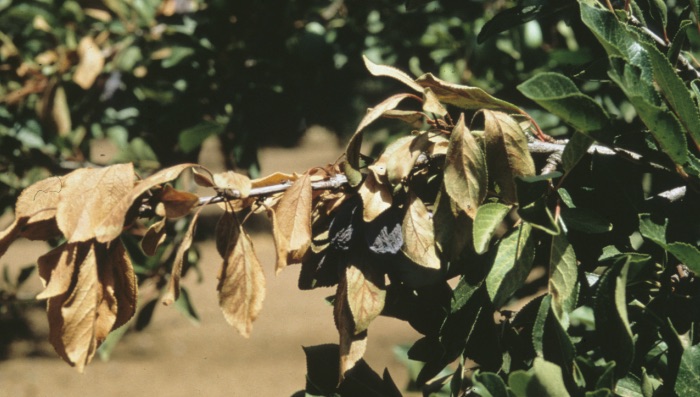
According to Bill Krueger UC farm advisor emeritus, Glenn County and Richard Buchner UC farm advisor, Tehama County, overheated prunes are succumbing to pressure due to high temperatures over the last few weeks. Blue prune drop and, in some cases, an associated leaf scorch, often develops following the rapid onset of high temperatures as occurred in June of this year.
Damaged prunes color prematurely (turn blue) and usually drop from the tree. The sun-exposed fruits on the top or south side of the tree are more likely to be affected by becoming sunken or flattened. Leaf scorch and dieback may develop in leaves and twigs near the damaged fruit. When damaged leaves dry, the veins may be a darker brown than the rest of the leaf.
Blue prune  drop is associated with heat stress. Excessive heat results in damage to the fruit that is thought to produce a toxin which is transported to spurs, leaves and shoots resulting in the leaf scorch symptoms. Leaf scorch symptoms are always associated with damaged prunes. They do not occur in areas of the tree with no fruit or on young trees without a crop. Anything affecting fruit temperature can have an effect. This would include:
1. Irrigation – Drop and particularly scorch are generally more severe on shallow soils with limited water holding capacity or in orchards toward the end of their irrigation cycle at the onset of heat. Adequate soil moisture insures maximum evapotranspiration and cooling of the plant.
2. Tree Position or Fruit Location – Leaf scorch is usually worse on overheated border trees, or on the south side of individual trees with greater sun exposure.
3. Cultural Practices – Blue prune appears to be less severe in orchards with cover crops than in clean tilled or drip irrigated orchards. Transpiration from an adequately irrigated cover crop should contribute to orchard cooling. In addition, a vegetated orchard floor reflects less sunlight than dead vegetation or bare ground.
4. Nutrition – While blue prune and leaf scorch does not appear to be directly related to potassium deficiency, anything adversely affecting tree health and condition could contribute to higher fruit temperatures. Adequate tree nitrogen levels promote vegetative growth that shades fruit from direct sunlight.
Krueger and Buchner report they have no sure ways of preventing blue prune drop and the associated leaf scorch. However, you can reduce the risk by making sure trees are healthy, vigorous and well supplied with water. Because the damage is caused by heat and not a disease, it should not continue to expand in the tree. Damaged wood should be pruned out during the dormant season.
Source: University of California Division of Agriculture and Natural Resources Cooperative Extension 

2016-05-31T19:47:14-07:00July 4th, 2013|
Go to Top