‘To-do list’ on food safety grows longer for feds

Source: Benjamin Goad; The Hill

The largest food safety overhaul in generations is being starved of funding needed to enforce a host of new regulations for factories, farms and importers, safety advocates warn.

The 2010 Food Safety Modernization Act (FSMA) was billed as creating a fundamental shift in the way government protects the nation’s food supply against the threat of food-borne illness.

But despite bipartisan and industry support for the program, only a fraction of the funding needed to implement and enforce it has materialized. Now, with most fiscal 2015 funding issues likely in limbo until after the midterm elections, uncertainty remains.Without additional funding, priorities of the ambitious initiative could fall short, public interest groups fear.

“They’re just not going to make enough of a dent in their to-do list,” said Sandra Eskin, director of food safety at The Pew Charitable Trusts. “They’re going to be really strapped to effectively enforce it.”

The Food and Drug Administration in January of last year began rolling out the first of seven draft rules in support of the FSMA, the biggest food safety update in 70 years.

The rules add a slate of standards for the agriculture industry and food manufactures, and create third-party audits and a new supplier verification program to prevent contaminated foods from entering the country.

Together, the rules are meant to replace a decades-old system built to respond to illness outbreaks with one set up to prevent them through better practices at production plants, warehouses and farms.

The rule-making process has been fraught with delays, as the FDA grapples with a litany of questions about how to impose the regulations. The agency has been forced to revise and re-propose some of the rules in response to industry concerns.

The FDA’s failure to meet a July 2012 deadline under the law drew a lawsuit from food safety advocates and a subsequent federal court order requiring the agency to complete all final regulations under the FSMA by mid-2015.

But merely putting the rules in place is one matter; creating a system to enforce them is another.

During budget hearings this year, Michael Taylor, the FDA’s first ever deputy commissioner for foods, made clear that current funding levels would be insufficient.

“Simply put, we cannot achieve our objective of a safer food supply without a significant increase in resources,” he told members of the House Energy and Commerce Committee.

Upon approval of the FSMA in 2010, the nonpartisan Congressional Budget Office estimated the FDA would need an additional $583 million over five years to carry out its new mission.

Following boosts totaling just under $100 million in fiscal 2011 and 2012, the administration estimated last May that an additional $400 million to $450 million would be required “to make FSMA a fully successful initiative.”

Since then, the funding allocated to the effort has been much less than requested, thanks to budget cuts and competing priorities. An omnibus funding bill for fiscal 2013 included $40 million for food safety, but that total was reduced to $37 million by sequester-related cuts.

A fiscal 2014 omnibus passed in January added $53 million more. As of Tuesday, the agency said an additional $362 million to $412 million was needed.

Spending bills now pending in both chambers of Congress contain increases of around $25 million, sowing angst among groups who say funding is required to fully implement the law.

Even business groups with reservations about the new restrictions support additional funding, which they view as bringing certainty to the industry.

“In order to keep consumer confidence in the safety of America’s food supply high and to reduce the number of foodborne illnesses, it is important that FDA also have the infrastructure in place to implement FSMA once the rules are finalized and after the appropriate compliance period ends,” a coalition of major businesses including Wal-Mart, General Mills and Coca-Cola wrote in a letter to congressional appropriators.

Specifically, the groups are calling for funding to retain and hire additional scientific experts, modernize the FDA’s information technology and increase food safety inspections to meet the targets set out in the law.

Sophia Kruszewski, a policy specialist at the National Sustainable Agriculture Coalition, said the group is worried that a lack of funding would imperil programs authorized by the law to help farmers and other food producers come into compliance.

“Funding will be critical because so much of what proper implementation of FSMA is gong to require is training,” Kruszewski said. “It’s hard to know where all the money is going to come from.”

The Obama administration has proposed new user fees to help meet the funding goals. The president’s 2014 budget request calls for a new registration fee for domestic and foreign food facilities that are required to register with FDA. The fee would have yielded an estimated $59 million this year.

A second fee on imports would have brought in $166 million, according to estimates.

Congress, however, has not approved legislation establishing the fees, which industry groups have denounced as a “food tax.”

In prodding Congress to direct more money to the safety effort, public interest groups say the cost of inaction could be made clear in the event of a major illness outbreak.

There have been 26 multi-state outbreaks of food-borne illness since Obama signed the FSMA into law, according to a Pew analysis.

Food safety advocates say they are trying to raise the public profile of an issue that affects all Americans.

“Every time they sit down for a meal, they want to know that the government is doing to make sure their food is safe,” Eskin said.

2016-05-31T19:33:27-07:00September 4th, 2014|

Slant Well to Address Water Shortage Without Harming Environment

By Valerie King; National Driller*

History is unfolding along the coast of California, according to Dennis Williams, president of GEOSCIENCE Support Services Inc.

His groundwater consulting firm has designed something like 1,000 municipal water supply wells in almost 40 years. But those were typical wells, vertical wells. What he’s working on now he’s only done once before.

“Necessity is the mother of invention,” he said, alluding to a well technology his firm is designing for California’s Monterey Peninsula. It’s called a slant well or subsurface intake, and while the technology has been used in Europe and tested in the United States, he says it’s still a very rare method.

“The evolution of the subsurface slant well technology,” as Williams calls it, is an outcome of California state regulators and environmental groups that prefer an environmentally friendly approach to desalination. Their goal is to avoid harming marine life like more traditional ocean pipelines tend to.

The slant well will be drilled close to the coastline at a diagonal and collect enough ocean water to produce about 100 million gallons of drinkable water daily.

That’s what California American Water hopes, according to Rich Svindland, vice president of engineering. California American Water is a subsidiary of American Water Works Company Inc., the largest publicly traded U.S. water and wastewater utility company. They proposed the idea after California ordered reductions to the Monterey Peninsula’s current water sources, a local river and aquifer that are expected to lose more than half of their current supply in the next decade.

“The idea is that we’re trying to launch a well field out under the ocean floor to basically ensure that we capture ocean water as opposed to inland ground freshwater,” Svindland said. The local groundwater basin he’s referring to is protected and cannot be exported to residents across the peninsula.

*This article was originally published in National Driller, Copyright 2014.  The entire article can be found at National Driller.

2016-05-31T19:33:27-07:00September 3rd, 2014|

Total Produce Buys into California Avocado Deal

Source: Fresh Fruit Portal

Irish multinational Total Produce (T70.IR) has acquired a 45% interest in Californian avocado company Eco Farms, with options to buy further shares in the future to gain a majority holding.

The company took the opportunity to make the announcement in its interim results for the first half of 2014, although the acquisition took place after that period.

The move builds on the company’s North American operations where it holds a stake in Vancouver-based Oppenheimer Group, and more recently on a 50% purchase of Dutch soft fruit company All Seasons Fruit (ASF).

Chairman Carl McCann highlighted a “robust” performance for the half with adjusted EBITDA only 2.7% lower year-on-year at €38.1 million (US$50 million), which is notable given the previous period’s results included almost four months of sales before Total Produce divested its stake in the Capespan Group.

On a like-for-like basis, revenue was down 1.7% at €1.59 billion (US$2.09 billion).

The bulk of the company’s decline in profitability can be explained by a 14.4% drop in adjusted EBITA in the Eurozone, due mainly to a warmer spring which drove up domestic produce volumes and pushed down average prices.

Profit was up slightly for Total Produce’s Northern European and International (North America, India) businesses, and rose significantly at a rate of 30.6% in the U.K.

“The results were assisted by the 4.4% strengthening of Sterling in the period which lead to higher translated Euro amounts and the positive impact of acquisitions completed in December 2013,” McCann said.

“On a like-for-like basis excluding currency translation and acquisitions, revenue was back c.3% with decreases in average prices offset by some volume increases.”

The executive added the group continued to monitor developments relating to Russia’s ban on produce from the European Union, but expectations were that the sanctions would not materially impact the company.

“During August, in an unexpected development, Russia introduced sanctions banning the import of certain origins of fruits and vegetables, including the EU for a period of 12 months,” McCann said.

“Total Produce does not have any operations in Russia and whilst the Group’s sales to Russia are modest at less than 2% of total revenue, there may be an impact on prices due to excess supply in Europe.”

2016-05-31T19:33:28-07:00September 2nd, 2014|

California Grown gets new chairwoman

By Mike Hornick; The Packer

Cherie Watte, executive director of the California Asparagus Commission, is the new board chairwoman of California Grown, succeeding Kasey Cronquist, chief executive officer of the California Cut Flower Commission.

The Buy California Marketing Agreement manages the California Grown campaign.

Executive committee members on the California Grown board include vice chair Spencer Halsey, associate director of the California Association of Gardens and Nurseries; and secretary treasurer Karla Stockli, chief executive officer of the California Fig Advisory Board.

Before becoming executive director of the California Asparagus Commission, Watte was director of international trade policy at the California Department of Food and Agriculture. She was also appointed manager of the department’s agricultural export program by then-Gov. Pete Wilson.

Prior to her CDFA appointment, Watte was the director of national affairs and research for the California Farm Bureau Federation. Other roles included legislative assistant to congressman Tony Coelho on the U.S. House of Representatives committee on agriculture. She is a former member of the U.S. Department of Agriculture’s agricultural trade advisory committee on fruits and vegetables.

“(Cherie) knows firsthand what it takes to be an active farmer in California, since she is the fourth generation of her family to farm in the Imperial Valley,” Nick Matteis, executive director of California Grown, said in a news release.

“We have a lot going on with consumer promotions and newly formed retail and foodservice partnerships,” Watte said. “Farmers and ranchers in California face many challenges, and this program is a bright spot for them.”

Cronquist guided the campaign through the revamping of its promotions program and membership expansion.

2016-05-31T19:33:28-07:00September 2nd, 2014|

Californian kiwifruit industry forecasts good fruit quality

Source: Fresh Fruit Portal

The upcoming season looks as though it should be a relatively positive one for Californian kiwifruit growers, with normal production, good fruit quality, and strong domestic market conditions.

California Kiwifruit Administrative Committee assistant director Nick Matteis said that as of the board’s latest meeting in July, the industry was anticipating a production of around 6.8 – 7 million seven-pound tray equivalents.

“That’s about average, based on producing acreage and what our growers are able to get produced per acre. It’s about a normal size crop, and the distribution of sizes will be pretty normal as well,” Matteis told www.freshfruitportal.com.

“It’s not lopsided towards larger sizes necessarily nor smaller sizes – there should be a good variation in size profile. The quality looks to be good as well, though at this juncture of course we still have a month and a half of growing season left.”

The board of directors will hold another meeting in September to take one last look at the estimates and see if anything dramatic has occurred.

Matteis said although it didn’t sound like growers have had serious problems with the state-wide drought, he could not be sure due to the vast area they covered.

“It’s hard to generalize how people are going to be affected because we have growing regions closer to the northern area and some further to the south with a couple of hundred miles in between,” he said.

“Most folks are pumping groundwater because there’s zero allocation from the state and federal water resources departments.

“So I think everybody’s going to make it just fine this year – I guess I could summate – but there is some pretty significant groundwater pumping that’s going on now to keep flows where they need to be to get to harvest.”

He added demand looked like it would be strong going into the season, with the first harvest expected to take place around six or seven days earlier than last year.

“Probably at the end of September we’ll start seeing some of the first fruit harvested, but the harvest being in full swing is usually around the first or second week of October,” Matteis said.

“The actual harvest will go till the end of November and then the marketing season will run from October all the way to April.”

Generally around 70-75% of the fruit is sold to the North America market, with Canada and Mexico being the two biggest importers.

2016-05-31T19:33:28-07:00September 1st, 2014|

Ag Alert update: Milk-pricing bill withdrawn

Source: Ag Alert

California Department of Food and Agriculture Secretary Karen Ross announced Wednesday that milk-pricing legislation will not be pursued during this legislative session.

In a statement, she acknowledged that timing on Assembly Bill 2730 “was not ideal,” but that she was “compelled to see if we could get something done this year.”

“Since the August 13th Task Force meeting, a tremendous amount of progress has been made, but not enough,” she said.

Ross did not say whether the department will pursue reform legislation again next year or discuss the future role of the Dairy Task Force.

Watch for further coverage in the Sept. 3 issue of Ag Alert. 

2016-05-31T19:33:28-07:00September 1st, 2014|

Commentary: Russian ban shows the folly of using food as a weapon

By Stewart Truelsen; AgAlert

We can only guess how the decision was made for Russia to ban food imports from most of the Western world, but perhaps it went something like this: President Vladimir Putin was sitting with some of his old pals from his KGB days. Putin was desperate for a way to retaliate against the West for its economic sanctions leveled against Russia for intervening to help the rebels in Ukraine. He asked for suggestions.

“Why not a boycott of their food?” suggested a former Soviet general, remembering the grain embargoes of the 1980s. “The Americans, they hate food boycotts and embargoes.”

That much is true—American farmers and ranchers hate the use of food as a weapon. In January 1980, President Jimmy Carter announced a U.S. embargo of grain and oilseed shipments to the Soviet Union because of its invasion of Afghanistan. The American Farm Bureau Federation thought it was unwise to single out American farmers by using food as a weapon of foreign policy. If sanctions were needed, AFBF preferred they be across the board, not just on food.

The grain embargo of 1980 proved to be a failure. It stimulated more grain and oilseed production in South America to fill the void left by the U.S. Fifteen months later, when President Reagan ended the Carter embargo, it had cost American farmers around $1 billion in lost export business.

This time, the biggest losers will not be American farmers.

“This is clearly a political move,” said AFBF President Bob Stallman of Putin’s ban on food imports. “It is unfortunate that the biggest losers will be the Russian consumers, who will pay more for their food now as well as in the long run.”

The old Soviet Union was dependent on American grain and oilseeds in the 1970s and ’80s, to make up for harvest shortfalls that were common under the communist system. Beginning in the 2000s, the three major grain-producing regions of the former USSR—Russia, Ukraine and Kazakhstan—became major grain exporters.

In 2013, Russia was the 20th largest market for U.S. agricultural and related product exports, accounting for less than 1 percent of total U.S. agricultural exports. Approximately 55 percent of these export products will be affected by the ban.

(For California, Russia ranked as the 15th largest export market in 2012, with shipments totaling $144.7 million, or about 1 percent of the state’s total agricultural exports. Almond shipments accounted for roughly 70 percent of the Russian purchases, but the Almond Board of California estimated Russia represented only about 3 percent of the export market for California almonds.)

Neither side, therefore, is as dependent on the other as they were in the past. Soviet grain deals once provided a huge stimulus to the American grain market. Nothing like that exists between Russia and the U.S. On the other hand, Europe supplies 40 percent of Russia’s agricultural market and will feel the sanctions more.

The idea to use food as a weapon is a bad one. American farmers could have told Putin that. Whoever suggested it to him should be put on the next train to Siberia. The Russian people have been turned into unwilling locavores, having to rely much more on locally produced food and paying more for it.


2016-05-31T19:33:28-07:00August 29th, 2014|

US rice farmers see opportunity in China – from the Los Angeles Times

By David Pierson

Gregg Yielding was given a quixotic task: travel to China and determine if consumers there would be willing to eat American rice.

So he set up tables at some of the most popular supermarkets in southern China, hung American flags and began dishing out steamy samples of rice from Arkansas and California.

“At first they’d say, ‘There’s rice in the U.S.?” said Yielding, head of emerging markets for the U.S. Rice Producers Assn., a Houston-based trade group. “And we’d have to show them a map to explain that it’s grown in California and the South. Then they’d try it, and they would really like it.”

Chinese importers, distributors and grocery chains lined up. Selling U.S. rice to China seemed like a slam-dunk. But eight years after Yielding’s first venture on behalf of the U.S. industry, not a single shipment of American rice has officially made it into Chinese hands.

That won’t happen until the two countries agree on a so-called phytosanitary protocol, which determines the necessary steps U.S. rice exporters must take to mitigate pests such as insects. The disagreement highlights the growing pressure on U.S. agricultural producers to either accommodate China or risk being shut out of the world’s largest emerging consumer market.

That might not have mattered a decade ago when U.S. farmers could rely on domestic buyers or traditional foreign markets such as Mexico and Canada. Today, China’s swelling appetite for food is touching agribusiness everywhere and forcing companies to choose whether to adapt.

Those that comply are seeing dividends. American agricultural exports to China rose to a record $25.8 billion last year from $5 billion a decade earlier.

Until a few years ago, no one would have considered exporting much rice to China, the world’s largest producer and consumer of the grain.

Tim Johnson, president and chief executive of the California Rice Commission, called it “the ultimate example of selling ice to the Eskimos.”

But starting in 2012, China went on a spree, scooping up millions of tons of the grain from countries such as Vietnam, Pakistan and India. China is now on pace to import a record 3.4 million tons of rice this year — six times more than it did in 2011, according to the U.S. Department of Agriculture.

Other industries remain shut out. The U.S. beef industry is still trying to overturn a 2003 ban on American cattle over mad cow disease. Starting late last year, nearly a million tons of U.S. corn have been rejected at Chinese ports because of inclusion of an unapproved genetically modified strain. And some American pork imports were halted this month over fears they contained traces of ractopamine.

“Demand is growing so quickly in China for so many food products — and with so many places to get them from — China can pick and choose,” said Jim Harkness, a senior advisor on China for the Institute of Agriculture and Trade Policy in Minneapolis. “From a U.S. perspective, it looks like the Chinese are being picky and erecting non-tariff barriers for political reasons. But I think from the Chinese perspective, the U.S. is an outlier in some cases. Ractopamine is banned in over 100 countries.”

In addition to China, the European Union and Russia also ban the additive. It’s deemed a risk to people with cardiovascular problems.

While other products struggle to win access, the U.S. rice growers are hopeful that officials in Washington and Beijing can come to terms as early as next year. If they do, analysts estimate, U.S. rice exports to China could reach several hundred million dollars a year. That would make China a top buyer of the American grain, on par with Mexico and Japan.

Though it produces only 2% of the world’s rice, the U.S. accounts for nearly 10% of the rice traded globally — enough to make it the fifth-biggest exporter. About half the rice grown in the U.S. ends up abroad. Still, rice consumption in China is so high the country could eat through America’s annual production in 17 days.

The growing Chinese appetite for imported rice may partly reflect surging food demand, analysts said. But it’s mostly driven by arbitrage, as government policies have kept domestic rice prices high to protect Chinese farmers. Rice mills in China decided it was cheaper to buy foreign supplies.

American rice producers can’t meet that sort of mass demand — nor do they want to. Their interest is in selling packaged rice to China to fill a high-end niche. The rice producers association’s survey of Chinese consumers buttressed that idea. Despite the concerns of Chinese regulators, shoppers in China overwhelmingly perceived U.S. rice as a safe alternative in a country hit by myriad food safety scandals.

Josh Sheppard, a fourth-generation rice grower in Biggs, Calif., about 60 miles north of Sacramento, said he’d welcome Chinese buyers because they probably would pay more for his grains than U.S. customers — much the way Japanese buyers currently do. That’s especially important now when drought has cut rice acreage in the state by 25%.

The cooperative is managed by Stuart Hoetger, co-founder of Stogan Group, an agricultural consulting firm in Chico, Calif.  Hoetger has arranged a partnership between the rice growers and Chinese food and agriculture conglomerate Wufeng.

Medium grain rice known as Calrose grown by the cooperative is being shipped in limited quantities to Chinese ports, where Wufeng is redirecting it to customers in small markets such as the Solomon Islands, the idea being Hoetger and his growers will be ready to ship to China shortly after a trade agreement is finalized.

“If China asks for something, you do it,” Hoetger said. “You ask any farmer that’s sold to China in the last few years and they’ll tell you they’ve made a lot of money.”


2016-05-31T19:33:28-07:00August 29th, 2014|

Drought lessons from a sheep rancher

Source: Brad Hooker, UC Davis

While a severe drought continues to devastate California agriculture, one sheep rancher in Oroville has found a centuries-old solution at the bottom of his wood stove — and researchers at UC Davis are paying attention.

After dumping ash from a weekend cookout in his backyard, Mel Thompson noticed the grass grew a little better. On the advice of Glenn Nader, a UC Cooperative Extension farm advisor based in Yuba City, Thompson took the initiative to research wood ash on his own, going as far as to establish a connection with an Oroville-based energy plant 20 minutes away, which was paying millions to deliver wood ash to the landfill.

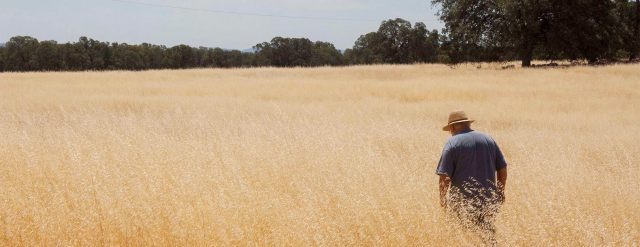
Today, the difference in growth from that wood ash can be seen in two adjoining pastures on Thompson’s foothill ranch. One layered in ash three years ago has chest-high grass despite the drought, while the untreated pasture has considerably shorter ground cover.

While the benefits of supplementing crops with ash have long been known, the UC Davis researchers were interested in specifically how it was altering the soil composition to promote plant growth and how it could help other ranchers in this Northern California region.

“It has improved our feed production significantly,” says Thompson. “With that, in conjunction with fencing and the rotational grazing, we seem to be doing OK through this drought period.”

Ken Tate, a plant sciences professor and a Cooperative Extension rangeland watershed specialist, recently surveyed more than 500 ranchers and says Thompson falls into the roughly 5 percent of California ranchers practicing these types of strategies in hopes of gaining more productivity from their land.

“Mel is what we call an early adopter, someone who has a large toolbox and a lot of information that he makes use of,” Tate says. “He’s an innovator and experimenter in the industry.”

2016-05-31T19:33:28-07:00August 28th, 2014|

Fire recovery brings progress, frustration

By Kate Campbell; Ag Alert

Wildfire recovery has become a disturbingly common part of managing California’s 33 million acres of forestland, while firefighting costs run far ahead of the ability to prevent fires. During a tour of areas damaged a year ago in the nearly 260,000-acre Rim Fire, experts outlined the cleanup work accomplished so far and the continuing recovery efforts on both private and public lands.

Registered professional forester Mike Albrecht told California members of the Society of American Foresters during last week’s tour that his crews immediately went to work helping clean and salvage what they could from the fire.

But forest managers estimate about 2.5 million tons of biomass remains dead or dying in the Stanislaus National Forest. At this point, they report local lumber mills are full with salvage logs, biomass plants can’t handle any more fire debris for power generation and environmental restrictions prevent burning charred timber and slash.

Forest roads remain unstable, they said, and drainage infrastructure has been destroyed or is too small to handle increased runoff, especially if there’s a heavy winter. Watersheds are vulnerable to erosion; the raw landscape is susceptible to infestation by invasive plants; wildlife habitat is in shreds.

Forest cleanup on the magnitude of the Rim Fire is slow, costly and dangerous, said Albrecht, who is president of Sierra Resource Management, which specializes in forest thinning.

He said his message is simple: “If we unite, we can do better by the forest.”

Nearly 60 percent of California’s forests are government-owned, with about 40 percent in private ownership.

“The difference between public and private wildfire recovery is very frustrating,” said Tuolumne County cattle rancher and county supervisor Sherri Brennan. “There are laws that tie the hands of government forest managers, compared to what can be done on private lands.”

From a county perspective, she said experts are saying that probably only about 25 percent of the burned timber in the Stanislaus National Forest will be salvaged because of regulatory constraints. It’s expected that litigation by environmental groups will further slow cleanup and restoration efforts, while driving up recovery costs.

“We’re sitting on 2.5 million tons of charred biomass,” Brennan said, referring to burned timber and brush. “Right now, I don’t know how the problem will be handled.”

For its part, the U.S. Forest Service said it has worked during the past year to put together an environmental impact statement that covers timber salvage efforts in the Rim Fire burn. Officials said they expect the final environmental document to be signed this week, so salvage work can begin this fall.

Meanwhile, U.S. Agriculture Secretary Tom Vilsack released a new report that shows the cost of fighting forest fires has rapidly increased during the last 20 years. Because of inadequate and uneven funding, agencies have been “borrowing” money from programs intended to better manage forest fuel loads.

Vilsack joined a rising chorus—including the California Farm Bureau Federation, the Nature Conservancy and the Western Governors Association—in calling on Congress to allow an existing disaster fund to help cover the costs of fighting catastrophic fires.

Pending legislation—The Wildfire Disaster Funding Act—would address these problems by funding a portion of federal wildfire suppression costs through an approach similar to other predictable disasters, allowing more reliable funding for wildfire-prevention programs.

In addition to finding more rational ways to fund skyrocketing costs for fighting wildfires, forestry managers advocate changes in the way both public and private lands are being managed, using current research to adjust methods.

During the tour of the Rim Fire area, Dan Tomascheski, vice president of Sierra Pacific Industries—which lost about 16,000 acres of timber during the Rim Fire—said a number of new forest management practices, some relatively inexpensive, could help protect forestland in the future.

“We’ve found the practice we call ‘contour tilling’ on flat-to-moderate slopes reduces erosion rates from winter storms,” Tomascheski said.

“There’s nothing more important than high-quality water for those who rely on Sierra watersheds,” he stressed. “But while there’s a lot of focus on water quality and reducing sediment, there hasn’t been much discussion of post-fire effects on water yield.”

Forest researchers report that long-dry creeks in the Rim Fire burn area are carrying water again, even in one of the most severe droughts in state history. Studies show shrubs and brush use three times as much water as an area reforested with trees.

In Shasta County, which has had a series of lightning-sparked wildfires during the past several weeks, rancher and county supervisor Pam Giacomini said a community forum on recovery made it clear that salvaging trees and getting them marketed has to be a top priority for cleanup.

“Experts say they (the burned trees) need to be marketed this year,” Giacomini said, so the land can be cleared in order to begin reforestation efforts.

“The state seed bank is getting pretty low and we need to get our order in this fall, so we have what we need to begin replanting in the spring,” she said.

2016-05-31T19:33:29-07:00August 27th, 2014|
Go to Top