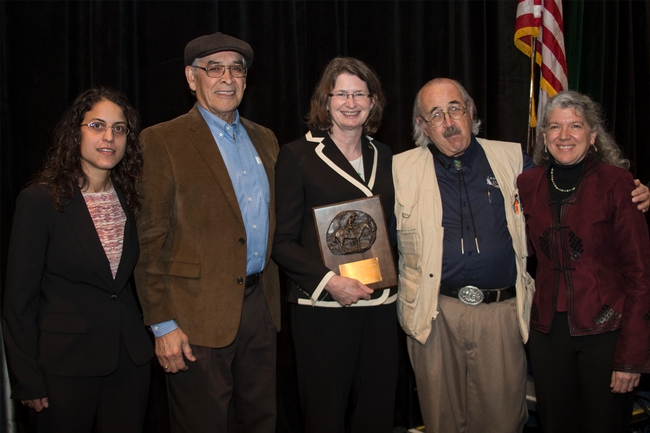
Allen-Diaz honored by range management professionals

The Society for Range Management bestowed its highest honor, the Frederick G. Renner Award, on Barbara Allen-Diaz, UC vice president for the Division of Agriculture and Natural Resources at the society’s annual meeting today (Feb. 2) in Sacramento. A tremendous milestone, Allen-Diaz is the first female SRM member to receive the award in the society’s 68-year history.

The premier award is given annually to SRM members who have sustained accomplishments or contributions to rangeland management during the last ten years.

“Barbara has a record of outstanding research productivity that has affected the understanding and management of California rangelands and has had global impacts,” said Amy Ganguli, assistant professor of range science at New Mexico State University.

“Barbara is also a well-regarded educator who has mentored several graduate students and young professionals who are making significant contributions to rangeland and natural resource management,” said Ganguli, who, along with Fee Busby, Utah State University wildland resources professor, nominated her for the award.

This is not the first time Allen-Diaz has been recognized by her peers for her research on the effects of livestock grazing on natural resources, oak woodlands and ecosystems of the Sierra Nevada. The national society honored her with its Outstanding Achievement Award in 2001, and the following year the California chapter named her Range Manager of the Year.

In 2007, Allen-Diaz was among 2,000 scientists recognized for their work on the Intergovernmental Panel on Climate Change when the Nobel Peace Prize was awarded jointly to the IPCC and Vice President Al Gore. Allen-Diaz’s contributions focused on the effects of climate change on rangeland species and landscapes. She has authored more than 170 research articles and presentations. She has been an active member of the Society for Range Management, serving on its board of directors and on various government panels.

Allen-Diaz, who has served as UC ANR’s vice president since 2011, is also a tenured UC Berkeley faculty member in the College of Natural Resources and currently holds the prestigious Russell Rustici Chair in Rangeland Management. She has been with the University of California since 1986.  She earned her bachelor’s, master’s and doctoral degrees at UC Berkeley.
2016-05-31T19:30:32-07:00February 3rd, 2015|

CDFA Announces Dates for PD/GWSS Winegrape Grower Referendum

The California Department of Food and Agriculture (CDFA) has announced important dates for this year’s vote on the continuation of the statewide Pierce’s Disease and Glassy-Winged Sharpshooter (PD/GWSS) winegrape assessment.

Current plans call for the ballots to be mailed to California’s winegrape growers on or about March 30, 2015. The ballots will be due back 30 days after mailing, although this date can be extended. The results of the vote will be announced about two weeks after the voting period concludes.

Since 2001, the PD/GWSS assessment has been one of the primary sources of funding for research on PD and its primary vector, the glassy-winged sharpshooter. In 2010 winegrape growers voted to not only continue the assessment but authorized the PD/GWSS Board to spend assessment funds for research and outreach on other pests and diseases that are serious threats to California winegrapes. Since then, the Board has designated the European grapevine moth, red blotch, vine mealybug, and brown marmorated stink bug as serious threats to winegrapes.

Growers (whether individuals or companies) who paid the assessment on grapes grown in 2014 are eligible to vote. Accordingly, growers will receive a ballot for each of the separate legal entities they represent.  Growers are urged to verify that the number of ballots they receive is correct and report any discrepancies to CDFA. Winegrape growers with any questions about the assessment can contact the CDFA Pierce’s Disease Control Program at (916) 900-5024. Questions about the referendum (including the number of ballots you received) should be directed to the CDFA Marketing Branch at (916) 900-5018.

The PD/GWSS winegrape assessment was established in July 2001 to support scientific research to find solutions to Pierce’s disease. The PD/GWSS Board, composed of winegrape growers, advises CDFA on the use of the assessment.

Pierce’s disease has no known cure and, left unchecked, could be devastating to the winegrape industry. A study released in 2009 by the Wine Institute and the California Association of Winegrape Growers estimated the total annual economic impact of California’s winegrape industry at $62 billion within the state and $122 billion nationally.

2016-05-31T19:30:32-07:00February 3rd, 2015|

NASA satellite mission to help farmers and water managers

By Edward Ortiz; The Sacramento Bee

A NASA satellite being launched into space will measure moisture in the top layer of soil, including soil on California farm fields far below.

The Soil Moisture Active Passive project is expected to provide crucial information to Central Valley farmers and water resource managers dealing with the multiyear drought. The mission, which was due to launch Thursday but scrubbed by NASA because of a weather pattern, will begin a three-year mission after liftoff from Vandenberg Air Force Base aboard a Delta II rocket.

The soil moisture information gleaned from the mission can be used by farmers to decide when to plant and harvest crops, said Narendra Das, project leader at NASA’s Jet Propulsion Laboratory, which is running the SMAP mission.

“This information will be a great tool for agriculture,” said rice farmer Charley Mathews Jr. Mathews owns a 700-acre rice farm in Marysville. He is an avid believer that more data can help his farming operation.

“For rice growing, it may help is preparing our rice fields,” he said of SMAP. “There are time periods when we prepare the soil or when we have rainfall events, and that is when we want to get our timing right.”

The 128-pound SMAP satellite will map soil moisture globally every two to three days. The SMAP data will be gleaned from space, using radar, with the use of a 19-foot antenna – the largest rotating antenna of its kind ever deployed by NASA.

It will take measurements 1 inch deep. The soil moisture it estimates will be matched to other data to provide accurate information on how much water is in the soil.

Only a tiny percentage of Earth’s total water is lodged in the top layer of soil. However, the water within that tiny layer plays an important role in moving water, carbon and heat between land and atmosphere.

The mission is the latest Earth-looking satellite effort at NASA, an effort that began in 1972 with the launch of the Landsat I.

The mission is the final of a recent slate of five Earth satellite missions to be launched by NASA within the past 11 months that began with the launch of the Global Precipitation Measurement Core Observatory satellite. Each mission is culling data at never-before-attempted resolutions.

NASA said it has partnered with a large California grower, Paramount Farms, on sampling studies and airborne experiments on the run-up to the launch.

Paramount Farms, based in Kern County, is one of the world’s largest growers and processors of almonds and pistachios. Paramount Farms declined to comment on its work with NASA.

Predicting floods and suggesting improved water usage may ultimately be another benefit of the SMAP mission, said Robert Hartman, acting director with the National Oceanic and Atmospheric Administration’s California Nevada River Forecast Center.

That entity runs climate models for California, Nevada and Southern Oregon. “Once we understand what the data represents and what they mean, it may help us with runoff models,” Hartman said.

Hartman said it remains to be seen how accurate the data from SMAP will be – especially from heavily forested environments. In other areas it may help assess how much moisture exists in a given watershed, especially prior to the onset of winter storms.

“In the fall we’re sensitive to how ready the watershed is to respond to the season’s first rain,” Hartman said. “It can also help us in the period between winter storms when there has been a substantial dry period.”

NASA has also been working with the California Department of Water Resources and expects the department will use the SMAP data to run its water use models.

The DWP is allowing the use of 40 soil sensor stations throughout the state for the SMAP mission. The sensors will help NASA calibrate the SMAP satellite measurements, said Jeanine Jones, DWP interstate resources manager.

Jones said it remains to be seen how useful the data will be to the department’s water management aims.

“Currently in the water supply and flood control business, most agencies do not use soil moisture information,” Jones said. “There are no applications for that kind of data yet. We’ll see if this mission will be the impetus to develop applications for it.”

2016-05-31T19:30:32-07:00February 2nd, 2015|

California State Fair announces first Extra Virgin Olive Oil Competition

Source: CDFA

The California State Fair is expanding its commercial competitions for 2015 to include a competition for extra virgin olive oil. Of all the olive oil produced in the United States, California produces 99 percent of it.

Extra virgin olive oils in more than 15 different classes and divisions, including blends and flavored olive oils will be judged during the competition. The entry deadline is April 1, 2015. The California State Fair Extra Virgin Olive Oil Competition is open only to California olive oil producers.

From July 10-26 the State Fair will feature a special California extra virgin olive oil exhibit with the award-winning extra virgin olive oils on display, interactive educational exhibits, free tastings and market research surveys.

On average, the world consumes approximately 2.25 million tons of olive oil each year and annual consumption in the United States has increased from 30 million gallons to nearly 70 million gallons a year over the last two decades.

Producers wishing to enter the Extra Virgin Olive Oil competition should visit CAStateFair.org to view the competition handbook for rules and entry information.

This project is supported by the Specialty Crop Block Grant Program, which is funded by the USDA and administered by CDFA. The goal of the project is to promote the awareness and availability of award-winning California extra virgin olive oils.

2016-05-31T19:30:33-07:00January 30th, 2015|

Brochures Provide Nitrogen Fertilization Guidelines

Over the past 20-plus years, California farmers have come to know CDFA’s Fertilizer Research and Education Program (FREP) office as a respected resource for the science of crop nutrients. Recently, through a joint project with UC Davis, FREP has completed its most ambitious effort yet – synthesizing years of research into an accessible online database and online crop fertilization guidelines designed for growers. That project is getting a boost from a new series of brochures debuting in 2015, each summarizing the online nitrogen fertilization guidelines for an important California crop.

The brochures lead growers through nitrogen fertilization needs for each of the major annual stages, from bloom in the spring to fruit development in the summer, and then post-harvest in the fall. Guidelines are also provided for fertilization of young trees. The brochures cover application timing and rates as well as guidance on uptake, leaf analyses and fertilizer types. Growers looking for additional details will find easy links in the brochures to supporting data and references online. The web site also includes guidelines for other essential nutrients including phosphorus and potassium.

These guidelines, both in the brochure format and on the web site, can give farmers important information to help with on-farm decisions. However, they are not intended to be a replacement for in-depth discussions with local farm advisors or fertilization experts about site-specific adjustments based on soil type, climate and crop management.

For more information, contact the CDFA Fertilizer Research and Education Program at (916) 900-5022 or frep@cdfa.ca.gov.

2016-05-31T19:30:33-07:00January 23rd, 2015|

USDA Proposes New Measures to Reduce Salmonella and Campylobacter in Poultry Products

The U.S. Department of Agriculture’s (USDA) Food Safety and Inspection Service (FSIS) proposed new federal standards to reduce Salmonella and Campylobacter in ground chicken and turkey products as well as raw chicken breasts, legs and wings. Development of these new standards is a major step in FSIS’ Salmonella Action Plan, launched in December 2013 to reduce Salmonella illnesses from meat and poultry products.

“Today, we are taking specific aim at making the poultry items that Americans most often purchase safer to eat,” said Agriculture Secretary Tom Vilsack. “This is a meaningful, targeted step that could prevent tens of thousands of illnesses each year.”

“These new standards, as well as improved testing patterns, will have a major impact on public health,” said USDA Deputy Under Secretary for Food Safety Al Almanza. “The proposed changes are another way we’re working to meet the ever-changing food safety landscape and better protect Americans from foodborne illness.”

“Getting more germs out of the chicken and turkey we eat is an important step in protecting people from foodborne illness,” said Robert V. Tauxe, MD, deputy director of the Division of Foodborne, Waterborne and Environmental Diseases at the Centers for Disease Control and Prevention. “I look forward to seeing fewer Americans get sick as a result of these proposed changes.”

A pathogen reduction performance standard is the measure that FSIS uses to assess the food safety performance of facilities that prepare meat and poultry products. By making the standards for ground poultry tougher to meet, ground poultry products nationwide will have less contamination and therefore result in fewer foodborne illnesses. FSIS implemented performance standards for whole chickens in 1996 but has since learned that Salmonella levels increase as chicken is further processed into parts. Poultry parts like breasts, wings and others represent 80 percent of the chicken available for Americans to purchase. By creating a standard for chicken parts, and by performing regulatory testing at a point closer to the final product, FSIS can greatly reduce consumer exposure to Salmonella and Campylobacter.

FSIS’ science-based risk assessment estimates that implementation of these standards would lead to an average of 50,000 prevented illnesses annually. FSIS intends to evaluate comments for 60 days and announce final standards and an implementation date this spring. The federal register notice is available on FSIS’ website at  http://www.fsis.usda.gov/wps/portal/fsis/topics/regulations/federal-register/federal-register-notices.

For chicken parts, ground chicken, and ground turkey, FSIS is proposing a pathogen reduction performance standard designed to achieve at least a 30 percent reduction in illnesses from Salmonella. For chicken parts, ground chicken, and ground turkey, FSIS is proposing a pathogen reduction performance standard designed to reduce illness from Campylobacter by at least 19 and as much as 37 percent.

FSIS plans to use routine sampling throughout the year rather than infrequently sampling on consecutive days to assess whether establishments’ processes are effectively addressing Salmonella and, where applicable, Campylobacter on poultry carcasses and other products derived from these carcasses.


2016-05-31T19:30:33-07:00January 22nd, 2015|

El Capitan Achievement Celebrated with California Sparkling Wine

Iron Horse Vineyards 2010 Ocean Reserve Blanc de Blancs

Iron Horse Vineyards 2010 Ocean Reserve Blanc de Blancs

Sonoma County native Kevin Jorgeson and his climbing partner Tommy Caldwell celebrated their achievement of scaling the Dawn Wall of El Capitan with California sparkling wine. Their feat has earned them admiration and cheers from all over the world, so it was only natural that they celebrate with a local delicious beverage.

The featured wine is the Ocean Reserve Blanc de Blanc from Iron Horse Vineyards – whose sales help promote the National Geographic’s Ocean Initiative. Joy Sterling, CEO of Iron Horse Vineyards, is also a member of the California State Board of Food and Agriculture.

According to the winery, in the spirit of supporting ocean conservancy, best food pairings focus on seafood, the beverage was deemed a “best choice” on the Monterey Bay Aquarium Seafood Watch® program. Iron Horse Vineyards is located in the gentle rolling hills of the Green Valley appellation within the Russian River Valley of Sonoma County, California.

2016-05-31T19:30:34-07:00January 21st, 2015|

California Projects in New USDA Regional Conservation Partnership Program

Agriculture Secretary Tom Vilsack has announced 115 high-impact projects across all 50 states and the Commonwealth of Puerto Rico will receive more than $370 million in federal funding as part of the new USDA Regional Conservation Partnership Program (RCPP).  In addition, these projects will leverage an estimated $400 million more in partner contributions—for a total of nearly $800 million—to improve the nation’s water quality, support wildlife habitat and enhance the environment.

“This is an entirely new approach to conservation efforts,” said Secretary Vilsack. “These partnerships empower communities to set priorities and lead the way on conservation efforts important for their region. They also encourage private sector investment so we can make an impact that’s well beyond what the Federal government could accomplish on its own.”

The RCPP competitively awards funds to conservation projects designed by local partners specifically for their region. Eligible partners include private companies, universities, non-profit organizations, local and tribal governments and others joining with agricultural and conservation organizations and producers to invest money, manpower and materials to their proposed initiatives.

Through the RCPP, partners propose conservation projects to improve soil health, water quality and water use efficiency, wildlife habitat, and other related natural resources on private lands.

Four of the selected projects are connected to California:

1) Expansion of Waterbird Habitat – The current sequence of events for rice production creates a situation where birds are frequently left with abrupt changes in habitat availability. The proposal extends the “watering” season of flooded rice fields beyond just the production phase and adds shallow water habitat in the winter/spring and fall months. This proposal supports the California Rice Commission in expanding the Waterbird Habitat Enhancement Program (WHEP) by 50 percent, thus enhancing the wildlife value of 165,000 acres of rice and the long term sustainability of rice agriculture.

2) Rice Stewardship Partnership – The Rice Stewardship Partnership, composed of Ducks Unlimited, the USA Rice Federation, and 44 collaborating partners, will assist up to 800 rice producers to address water quantity, water quality, and wildlife habitat across 380,000 acres in Mississippi, Arkansas, California, Louisiana, Missouri, and Texas.

3) Tricolored Blackbird Habitat – The Tricolored Blackbird once was abundant in California with a population in the millions. It now has an estimated 145,000 birds remaining statewide, and many predict that it is heading toward extinction. This proposal is a partnership between the dairy industry and conservation groups, with Audobon California as the lead partner, to address the factors that challenge California dairy farmers and threaten Tricolored Blackbirds, with the goal of finding a sustainable solution for management of colonies on farms and saving the Tricolored Blackbird from extinction.

4) Klamath-Rogue Woodland Health and Habitat Conservation – Many at-risk and listed species depend on quality oak woodlands that are threatened by conifer encroachment, densification, and severe wildfires in this project area, covering portions of Oregon and California. Working with landowners, including historically underserved producers, and using a sound, science-based approach, the partners will target 3,200 high-priority acres recently identified in a Conservation Implementation Strategy to preserve, enhance, and restore the structural diversity, ecological function, and overall health and persistence of oak habitats and their watersheds.

A complete list of the projects and their descriptions is available on the NRCS website.


2016-05-31T19:30:34-07:00January 15th, 2015|

Afghanistan vet presents flag at Jordan College Assembly

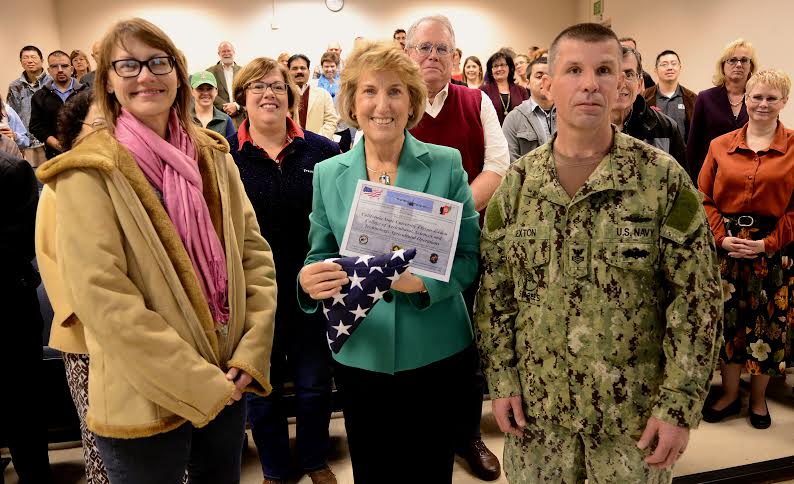
Fresno State mechanic Danny Sexton marked his return from an eight-month deployment to Afghanistan by presenting an American flag to the Jordan College of Agricultural Sciences and Technology Tuesday.

The 10th-year mechanic is based full-time out of the Ag Operations office and presented the 3×5 flag to his co-workers as a thank-you for their support while on active duty with the U.S. Navy last year.

The E6 Petty Officer 1st Class returned to Fresno in late November after an eight-month stint at Bagram Air Base near Charikar, Afghanistan as an equipment operator after two months of training in Kentucky, New Jersey and Virginia.

“Fresno State was very supportive and held my job while I’m gone,” Sexton said. “I wanted to give one of the flags we flew back to the College to show how much I appreciated their support.”

In Afghanistan, he served on the logistics task force for transportation, and his main duties involved moving cargo and soldiers to other nearby destinations. Vehicles are also at the core of his Fresno State duties as he maintains campus vehicles ranging in all sizes.

“I enjoy both jobs because I’ve always liked working on equipment,” Sexton said. “They are complimentary since I can fix things on campus job and operate machinery in the military. I can also use the other position’s skills when necessary without missing a beat.”

While away last year, he still kept in close contact with his family and friends through Facebook, cell phones, texting and mail, and watched his granddaughter grow up on Skype. He also tracked the Bulldogs football team online and emailed with co-workers to keep updated on office news.

He first enlisted in the Navy in 1986 after high school to follow the career path of an uncle who had also served in the military. That move began a 20-plus year stint that began with five years of active duty in Europe and Florida. After a 10-year break, he re-enlisted in July 2001 and has been a naval reservist ever since.

He has served two other 10-month deployments in Iraq (2003) and in Kuwait (2009-10). In those stints, he served as a heavy equipment operator in the construction battalion, and operated all types of equipment used to build or dig camps, roadways, level & clear land for buildings, dig trenches, and roll out/pave roads.

Navy training will continue to be an active part of his life with his once-a-month weekends of service and a two-week stint during the year. Down the road, he hopes to deploy again before he retires from the Navy.

When he returned home the day before Thanksgiving, it made the holidays even more special for his wife Kathy, stepson and granddaughter Victoria.

“My wife hadn’t planned on me being there for Thanksgiving so it was pretty special when I texted her a couple days before,” Sexton said. “She was a little shocked and went into overdrive to get everything ready for an early return. On that afternoon, she was worried nobody would be there when we arrived because our dogs had gotten out and she ran into some traffic problems. But it all turned out fine, and she was there with plenty of time with some of our friends and family, including my 14-month old granddaughter.”

2016-05-31T19:30:34-07:00January 14th, 2015|

USDA Observes Kick Off of the International Year of Soils

The U.S. Department of Agriculture (USDA) began its celebration of the International Year of Soils to highlight the importance of healthy soils for food security, ecosystem functions and resilient farms and ranches.

“Healthy soil is the foundation that ensures working farms and ranches become more productive, resilient to climate change and better prepared to meet the challenges of the 21st century,” Agriculture Secretary Tom Vilsack said during an event today at USDA headquarters. “We join the world in celebrating this living and life-giving resource.”

With an increasing global population, a shrinking agricultural land base, climate change and extreme weather events, the nations of the world are focusing their collective attention to the primary resource essential to food production-the soil. The United Nation’s Food and Agriculture Organization (FAO), working within the framework of the Global Soil Partnership, spearheaded the adoption of a resolution by the UN General Assembly designating 2015 as the International Year of Soils. The year of awareness aims to increase global understanding of the importance of soil for food security and essential ecosystem functions.

“Most people don’t realize that just beneath our feet lies a diverse, complex, life-giving ecosystem that sustains our entire existence,” said Jason Weller, chief of USDA’s Natural Resources Conservation Service (NRCS). “We are helping producers unlock the power of soil health as part of an important and very successful national campaign. Our campaign demonstrates our renewed commitment to soil conservation and soil health.”

NRCS is coordinating activities to mark USDA’s involvement in the International Year of Soils. Nearly 80 years ago, NRCS, formerly the Soil Conservation Service, was created to improve the health and sustainability of our nation’s soils. The agency’s original mission continues to this day – providing assistance to producers looking to improve the health of the soil on their land.

Conservation that works to improve soil health is one of the best tools NRCS has to help landowners face these impending challenges – and maintain and improve their productivity with the use of soil management systems that includes cover crops, conservation tillage and no-till and crop rotations. These systems reduce sediment loss from farms and ranches, buffer the effects of drought, flood and other severe weather; sequester carbon and create biodiversity in our rural landscape.

“International Year of Soils provides an opportunity for us to learn about the critical role soil conservation and improved soil health play in the economic and environmental sustainability of agriculture,” Weller said.

Working with the Soil Science Society of America (SSSA) and other partners, NRCS will be showcasing the importance of soil with monthly themes created by SSSA:

January: Soils Sustain Life

February: Soils Support Urban Life

March: Soils Support Agriculture

April: Soils Clean and Capture Water

May: Soils Support Buildings/Infrastructure

June: Soils Support Recreation

July: Soils Are Living

August: Soils Support Health

September: Soils Protect the Natural Environment

October: Soils and Products We Use

November: Soils and Climate

December: Soils, Culture and People

For more information, visit NRCS’s soil health webpage or the International Year of Soils webpage.

2016-05-31T19:30:35-07:00January 10th, 2015|
Go to Top