TV Campaign for ‘Grapes from California’ Kicks Off on Food Network

A new television campaign for ‘Grapes from California’ launched in June on the Food Network.

“These commercials showcase the natural beauty, easy versatility and great taste of California grapes while communicating the value of sharing life’s special moments with family and friends, and the care that growers put into growing,” said Kathleen Nave, president of the California Table Grape Commission.

One of the two new commercials has a grower theme and the other has a dinner party theme. Watch them here: www.grapesfromcalifornia.com.

These 30-second commercials, the first two of a planned series of six, are seen during shows like, “Trisha Yearwood’s Southern Kitchen,” “Sandra’s Money Saving Meals,” “Home for Dinner with Jamie Deen,” and “Diners, Drive-ins & Dives.”

The Grapes from California commercials will run through December and and will be used in future seasons.

2016-05-31T19:34:21-07:00June 26th, 2014|

America’s First Pear to Begin Harvest July 7

The first Bartlett pears of the season are set to harvest in California’s Sacramento River growing region July 7.

According to the official crop estimate set by the California Pear Advisory Board at its June 12th meeting, the state’s total crop of Bartlett pears is expected to be just over 2.6 million 36-pound packages, slightly down from the four-year average crop size of 2.9 million packages.

The majority of the state’s Bartletts, 1.5 million packages, will come from the early harvesting Delta River growing district, with harvest in Mendocino County expected on August 4 and on August 11 in Lake County.

California pear farmers are expecting an additional 550,000 packages of other pear varieties this season including 220,000 Golden Russet Bosc and 80,000 Starkcrimson along with smaller quantities of Bosc, Sunsprites, Comice, Forrelle, Seckel, French Butter and other red varieties.

In addition to setting its official crop estimate and harvest dates during its most recent Board meeting, the California Pear Advisory Board (CPAB) adopted a new brand positioning for Bartlett pears from California calling them “America’s First Pear.”

“We realized that Bartlett pears from California are unique because they have been produced in California since the very beginnings of the state’s commercial fruit industry dating all the way back to the California Gold Rush in the 1850s,” said Chris Zanobini, Executive Director of the CPAB.

“California Bartletts are also the very first pear of the season to be harvested in the U.S. each year and consumer research shows Bartlett pears are the first choice of consumers when it comes to selecting a flavorful pear variety.   The title of ‘America’s First Pear’ just seemed to be a good fit.”

Zanobini noted that CPAB has been working closely in its hometown of Sacramento, California to promote a locally-grown image and they have become a regular sponsor of the “America’s Farm to Fork Capital” program launched in the area in 2013.

The program promotes locally-grown agricultural products to Sacramento area consumers, retailers and restaurants. The concept of giving consumers locally-grown, sustainably-produced food is rapidly gaining in popularity throughout the country.

“California Bartlett pears fit a highly desirable image because they are produced by the kind of artisan farmers that today’s consumers want growing their food,” said Zanobini.

California Bartletts are grown by about 60 pear farming families, most of whom have been growing pears on the same land for generations. The average size of California Pear farm is 130 acres and the average age of the orchards are between 30 and 100 years.

“California Bartletts provide consumers with an heirloom experience because this is the same product people can find in their local farmers market. They have been sustainably-grown for over 100 years by smaller, family farmers who are trusted and safe,” said Zanobini.

The California pear industry’s claims about sustainability are not just marketing hype, but are backed by research. During the past three years, the CPAB has participated in a program with the independent sustainability program design firm, SureHarvest, to assess the level of sustainable farming practices utilized by farmers.

SureHarvest has found an exceptionally high level of adoption among California pear farmers of sustainable practices like non-chemical treatments for pests. According to the SureHarvest assessment, well over 90 percent of California pear farmers utilize practices like pheromone-mating disruption, scouting for pests and other Integrated Pest Management practices.

CPAB plans to launch an initial trade education effort this summer to communicate with grocery stores the benefits of selecting and staying with California Bartlett pears for the duration of the California pear season.

“This strategy allows retailers to maximize the pear category and to give consumers their favorite pear for longer,” explained Zanobini. “California pear farmers are confident we can work together with buyers to optimize their pear category profits.”

Zanobini noted the trade should look for new educational materials from CPAB along with some locally based innovative on-line consumer promotions beginning this season.

For more information, please visit www.calpear.com.


2016-05-31T19:34:21-07:00June 26th, 2014|

Cottage Food Industry on Growth Trend in California

A little more than a year ago, a California law went into effect that gave small farmers and even home gardeners a new opportunity to sell value-added products.

Shermain Hardesty_Page_1

Shermain Hardesty

The California Homemade Food Act permits individuals to produce certain types of cottage food in home kitchens to sell in limited quantities to the public.

That sounds simple, but like most laws, there are plenty of caveats. The legislation has stipulations about the types of foods allowable, registration, permits and labeling requirements.

UC Cooperative Extension has been helping farmers and home gardeners who produce fruits, vegetables, nuts, herbs, and honey take advantage of the new opportunity at workshops around the state, reported the Stockton Record.

Shermain Hardesty, UC Small Farm Program extension economist, is coordinating the project. Hardesty thinks that marketing may be the hardest part of creating a successful cottage food businesses for many farmers and other entrepreneurs.

At the workshops, Hardesty teaches the basic “Four P’s” of marketing: product, place, price and promotion.

2016-05-31T19:34:22-07:00June 25th, 2014|

$9 Per Hour Minimum Wage Starts Next Week

By Christine Souza; Ag Alert

Starting July 1, the California state minimum wage increases to $9 per hour, a hike that growers say will result in more challenges on the farm and higher costs overall.

Monterey County strawberry grower Ed Ortega said, “In agriculture, nobody can pay just minimum wage.

“People will find a job doing something else that is much easier work than working in agriculture for minimum wage. They’d rather go and flip burgers for nine bucks,” Ortega said. “Our work demands more than a minimum wage employee, so every time the minimum wage goes up, the whole ladder in our entire pay structure goes up. There’s no such thing as paying the bottom guy more and not the top guy. The whole ladder rises.”

California’s minimum wage increase to $9 per hour is a result of the passage of Assembly Bill 10 by Assemblyman Luis Alejo, D-Salinas, in 2013. AB 10 also provided for a second hike in the California minimum wage to $10 per hour on Jan. 1, 2016.

Bryan Little, California Farm Bureau Federation director of labor affairs and chief operating officer of the Farm Employers Labor Service, said raising California’s minimum wage might have happened through a ballot initiative had AB 10 not become law last year.

Proponents of increasing the minimum wage argue it is needed to reduce poverty, while business groups and those opposed believe raising the hourly minimum wage would increase business costs and jeopardize California’s economic recovery.

“The majority of farmers already pay their employees much higher than minimum wage, so when these changes occur, employees making more than minimum wage expect to stay that much ahead of the increased rate,” Little said. “In the short term, it will increase costs to employers, but the labor supply is tight right now, so workers are already able to demand fairly high wages, but the increase still impacts operating costs and business profitability.”

Phil Martin, professor of Agriculture Economics at the University of California, Davis, confirmed that higher minimum wages affect some employers and workers more than others.

“Most farm employers have a wage structure, with some employees earning the minimum wage and others more. If the minimum wage rises by $1 an hour, workers earning more than the minimum wage normally expect a similar increase in order to keep their status in the wage hierarchy,” Martin said. “Employers often respond to higher wages with productivity increasing steps, from providing tools that enable workers to work faster to harvesting fields and orchards less often.”

Martin added that fewer new immigrants have already put upward pressure on farm wages and encouraged more use of labor-saving and productivity-increasing machines.

The new minimum wage has triggered other wage concerns for agriculture employers, Little said.

“A number of other costs associated with employing people are tied to employee earnings, like Workers’ Compensation and Unemployment Insurance; the increase in the minimum wage will directly and immediately impact employers’ costs for that. Also, if farm employers augment their workforces by bringing in farm labor contractors, the farm labor contractor is likely to increase the price of the workers they provide to cover that minimum wage increase and related costs.”

Farm labor contractors can be more efficient, and employ people year-round and spread their employment costs across more jobs than a farmer who employs a small number of people can, Little added.

“Farmers face several challenges in 2014, including implementing the Affordable Care Act and dealing with the effects of the drought,” Martin said.

This season, when it comes to the availability of employees, Ortega said, he is again experiencing a shortage of workers.

“We are experiencing the normal shortage that we experienced last year, which is a pretty extreme shortage of labor. Those who have less of a crop to harvest have a more severe labor shortage than those who have a crop to harvest,” Ortega said.

Whether a farm will attract the workers that are needed, Ortega said, depends on the size of the ranch and whether there is enough work to keep employees working. Smaller farms will have more limited opportunities.

“Any farmer who is experiencing a decrease in the water supply will also be experiencing extreme pest pressures, and if you have increased pest pressure, it means higher cost to the farmer,” Ortega said. “It’s an exponential factor. It’s not just raise the minimum wage a dollar; the associated costs go a lot higher than that.”

California is one of 18 states and the District of Columbia that have minimum wages above the federal minimum of $7.25 an hour and California’s $10 minimum is likely to be among the highest in the nation in 2016. Washington currently has the nation’s highest state minimum wage at $9.19 an hour.

2016-05-31T19:34:22-07:00June 25th, 2014|

UC Gets FAA Clearance to Research Drone Use in Ag

A UC laboratory at the former Castle Air Force Base in Atwater received clearance from the Federal Aviation Administration to fly dones at the Merced County Radio Control Club’s field, reported Thaddeus Miller in the Merced Sun-Star.

The unmanned aircraft are part of a project funded by the UC Division of Agriculture and Natural Resources that aims to study the possible use remote controlled aerial imaging to provide real-time information to farmers about water use and crop health.

The project leader, David Doll, UC Cooperative Extension advisor in Merced County, has put together a project team that includes UC Merced professors and graduate students, and UCCE advisors and staff.

Drones are also known as unmanned aerial vehicles (UAVs). Doll believes small, basic UAVs can provide a platform for imaging hardware that can vastly improve crop surveillance to enhance water usage and pest control.

Doll’s project will test the potential of UAVs for water management and pest monitoring. He also plans to write a curriculum to extend information to farmers and demonstrate the use of small, remote controlled aerial vehicles as imaging platforms.

UC Merced also has other plans for using drone technology in research. They are seeking FAA approval to fly the aircraft over the university’s protected land, which includes 6,500 acres of grassland and vernal pools.

Dan Hirleman, dean of UC Merced’s School of Engineering, said the university’s use of drones and development of new technology could set it apart from other schools.

“We’re kind of at the ground zero for a lot of what’s going on in those areas,” he said. “It’s just a perfect fit with our sustainability theme and the application area.”

2016-05-31T19:34:22-07:00June 25th, 2014|

Could more dryland farming be in California’s future?

By Todd Fitchette; Farm Press Blog 

Slate.com’s “Thirsty West: The No-Water Way” is the latest in a string of popular press articles to suggest that California might be better off relying less on irrigated agriculture and more on dryland farming.

Generations ago, California settlers and residents established a system of water conveyance that allowed great cities like Los Angeles and San Francisco to be built and agriculture to flourish.

Modern irrigation paved the way for greater crop yields and the ability to feed a growing society that left the farm starting with the industrial revolution.

What would an article in the popular press be without a few gross misstatements, such as the oft-repeated meme that California agriculture uses 80 percent of the state’s water supply in an average year?

This is far from an average year. Still, agriculture typically uses about 43 percent of the water allotted while 46 percent is consumed by the environment. For California, that means much of that 46 percent is allowed to flow unimpeded to the Pacific Ocean.

Urban users consume the remaining 11 percent, according to the State of California.

With no surface water allotted to much of California agriculture this year, and the ever-shrinking ground water supplies, California agriculture will have a fraction of its typical annual supply of irrigation water for the few crops farmers can maintain.

We really do not know how much remains in underground aquifers, though it’s a safe bet to suggest “not enough.”

The premise behind dryland farming comes at a time when drought awareness has increased, though not entirely in practice as California lawns remain watered and cars are washed in driveways.

While dryland farming has its challenges, maybe it’s time for modern agriculture to consider the benefits of the water-thrifty practice and tackle the challenges with all the fervor of a sergeant told by his lieutenant “that can’t be done!”

While dryland farming is utilized to a small extent in California, its close cousin could be the no-till practices recommended by researchers Jeff Mitchell of the University of California.

Mitchell continually promotes the benefits of no-till and strip-till conservation practices that help hold in soil moisture and provide a host of other benefits to growers. He’ll readily admit there are challenges under California’s current farming systems.

While farmers elsewhere in the U.S. successfully employ the practice, California farmers seem reluctant to do the same.

Still, Mitchell works with California growers to employ conservation tillage practices that work and to transform machinery used in standard farming practices to achieve results.

Since Mitchell works with UC Cooperative Extension, his efforts move beyond the purely academic to the practical.

As California agriculture continues to seek ways to be as water thrifty as possible, and new technologies are developed to meet those ends, we need not be so quick to say “that won’t work” and instead embrace ideas that right now might only be a “what-if” conversation between a third-year undergrad and her college Ag professor.

2016-05-31T19:35:22-07:00June 24th, 2014|

Organic Versus Conventional Divide Not Helping Agriculture

By Todd Fitchette; Farm Press Blog

I’m sure there’s much more to this than meets the eye – there always is. To the not-so-casual observer, the recent petition by 20 organic farm and consumer groups related to the National Organic Standards Board (NOSB) seems a bit hypocritical.

PR Newswire is reporting that 20 groups petitioned USDA Secretary Tom Vilsack “to protect the authority and permanence of the NOSB,” whatever that means.

Folks are apparently upset that the NOSB, created by Congress in the 1990 farm bill, does not have dictatorial control over organic policy and federal law. Instead, its stated purpose is to advise the USDA. Good enough.

Apparently it’s not.

Organic proponents apparently want their own control of all things organic, absent the kind of oversight conventional farming has.

Two of the petitioners include the Center for Food Safety and “Beyond Pesticides.” While the center’s name sounds sublime enough, the other group’s politics are front and center in the title.

It would seem that this petition is less about an egregious act committed by the USDA and more about fear mongering.

Can’t we all just grow up and have an adult conversation about food policy in America without the fifth-grade accusations?

Maybe America’s agricultural self-sufficiency breeds these kinds of ad hominem attacks that paint conventional farmers as evil and organic farmers as lazy. Isn’t there room at the dinner table for everyone, regardless of their chosen diet and the amount of money they choose to pay for produce?

The organic food industry certainly has a place in America’s free market. If people value what organic growers produce, they’ll buy it, plain and simple.

If folks choose to buy produce and meat produced conventionally, after it has been subjected to government oversight and inspection, then maybe I’m not going to worry so much about the chemicals used to kill pests in the California-grown tomatoes that become my bottle of catsup.

What does it matter if my Iowa-grown corn has a Bt gene in it that helps resist pests? Does it taste good and can I get it for a reasonable price?

American agriculture has too few people involved in it anymore for groups to balkanize each other and argue over issues that are inconsequential in the grand scheme of things.

Right now, nearly a million acres of farmland in California is fallow since the water which could have been used to irrigate a portion of that land was allowed unobstructed access to the Pacific Ocean during a severe drought. This happened since agriculture is not as politically effective as its antagonists. It’s really that simple.

Maybe it’s time for a little national pride in the fact we can produce 100 percent of our food needs in this country since we are blessed with the soil and climate and the technology to achieve it.

It sure beats the alternative of having to import much of our food supply because we can’t grow it ourselves.

2016-05-31T19:35:22-07:00June 24th, 2014|

Monterey County Farm Bureau & Central Coast YF&R Scholarships for 2014

Monterey County Farm Bureau and Central Coast Young Farmers and Ranchers offer scholarships to high school seniors and college students for the 2014 – 2015 academic year.

Students must have attended and graduated from a Monterey County or San Benito County High School and plan to attend or are attending a university or community college majoring in an Agricultural curriculum.  Scholarship award amounts are dependent on the number of applications and amount of awards given.

2014 Scholarship Winners

Erica Bianchi is the recipient of a $1,500 scholarship from CC YF&R and $1,000 scholarship from American Ag Credit.  Erica is a graduate of San Benito High School and attends California State University, Fresno majoring in AgriBusiness.

Jimmy Goudge is the recipient of a $1,500 scholarship from CC YF&R and a $1,000 scholarship from American Ag Credit.  Jimmy is graduate of Anzar High School and attends Cal Poly San Luis Obispo majoring in Agricultural Systems Management.

Lauren Bellon is the recipient of a $1,250 scholarship from CC YF&R.  Lauren is a graduate of Anzar High School and attends Cal Poly San Luis Obispo majoring in Agricultural Science.

Heidi Morisoli is the recipient of a $750 scholarship from MCFB.  Heidi is a graduate of Salinas High School and plans to attend Cal Poly San Luis Obispo majoring in Agricultural Science.

Cecilia Krogsgaard-Sanchez is the recipient of a $750 scholarship from MCFB.  Cecilia is a graduate of Salinas High School and attends Cal Poly San Luis Obispo majoring in Animal Science.

Jorge (Ben) Gomez is the recipient of a $500 scholarship from MCFB.  Ben is a graduate of Salinas High School and plans to attend Cal Poly San Luis Obispo majoring in Ag Environmental Plant Science.

Karina Medrano is the recipient of a $500 scholarship from CC YF&R.  Karina is a graduate of Salinas High School and plans to attend Cuesta College (Ag major undeclared).

Lauren Ivey is the recipient of a $500 scholarship from CC YF&R.  Lauren is a graduate of Salinas High School and plans to attend Modesto Junior College majoring in Animal Science.

Justin Carroll is the recipient of a $500 scholarship from CC YF&R.  Justin is a graduate of Salinas High School and plans to attend Modesto Junior College (Ag major undeclared).

Justin Massa is the recipient of a $250 scholarship from CC YF&R.  Justin graduated from Soledad High School and plans to attend Hartnell College majoring in Food Safety.

MCFB and CC YF&R are pleased to award scholarships each year to deserving students who desire a career in food production or ranching.

Both organizations work hard to give back to the agricultural community through fundraisers, bar-b-ques and support of other agricultural non-profit organizations.

2016-05-31T19:35:23-07:00June 24th, 2014|

Food Market Maker Aims to Connect Farmers

Nationwide Online System now Live for Farmers to Connect to New Markets

Chantelle Hougland, Business Development and Communication Strategist for Riverside Research, talks about the Food Market Maker program and their efforts to build an electronic infrastructure that would connect farmers with viable new markets.

“Food Market Maker has been developed for the past 10 years. It’s been a group of organizations universities, state departments of agriculture, who all came together to create a system to connect everyone along the food value chain from the producer all the way to the buyer. And just recently what we’ve done is we have opened up the system to expand from just 20 states into all 50 states which also includes California,” said Hougland.

The Food Market Maker program hopes to aid in the expansion of quality-driven food value chains, by reaching out to not only farmers but other entities as well.

“We are also looking for affiliate organizations, organizations that serve food producers and the value chain to work with us, to reach out to producers, to get them into our system.” said Hougland.

Hougland goes on to explain why the Food Market Maker program is not only beneficial to farmers, but the entire industry as a whole. Even consumers.

“I think we can reduce waste, we can help facilitate new markets, where we’re connecting demand with supply. For example, producers what to know what buyers want to buy. They want to know whether growing organic or some other means is actually going to produce them more money for them in the end,” said Hougland.

“If we can make those connections on the behalf of the farmers with the buyers, and help them understand better what they are doing and how much they can get for what they are doing, we might be able to expand the variety of foods that are available to consumers, the quality of food that’s available to consumers , and the flavorful and goodness of the food that’s available, while supporting farmers as well,” Hougland added.

And how is this program being funded?

“Well right now Riverside Research is doing that for us, so its a free system and its open to use for anyone,” said Hougland.
For more information, head to the Food Market Maker Website.

2016-05-31T19:35:23-07:00June 23rd, 2014|

UC Davis Soil Symposium Showcases California Innovation

A big soil health symposium was held at UC Davis last week, and there was lot to learn for everyone in the industry.

Brian Leahy is Chief of the California Department  of Pesticide Regulation in Sacramento, which hosted the one day event. Leahy noted those in attendance were innovative and pioneering.

“In the room I think we had some of the most creative farmers, creative researchers, and creative private companies on the planet. These people are some the most amazing farmers that only California produces, and they were here I think as problem solvers. We know we need to understand soil better. What’s going on in the soil? And how do we work with it? said Leahy. “What we heard was a lot of  amazing activities that are taking place right now. Lot of great questions asked, its unbelievable the kind of research is going on. I think it was a very productive day.” he added.

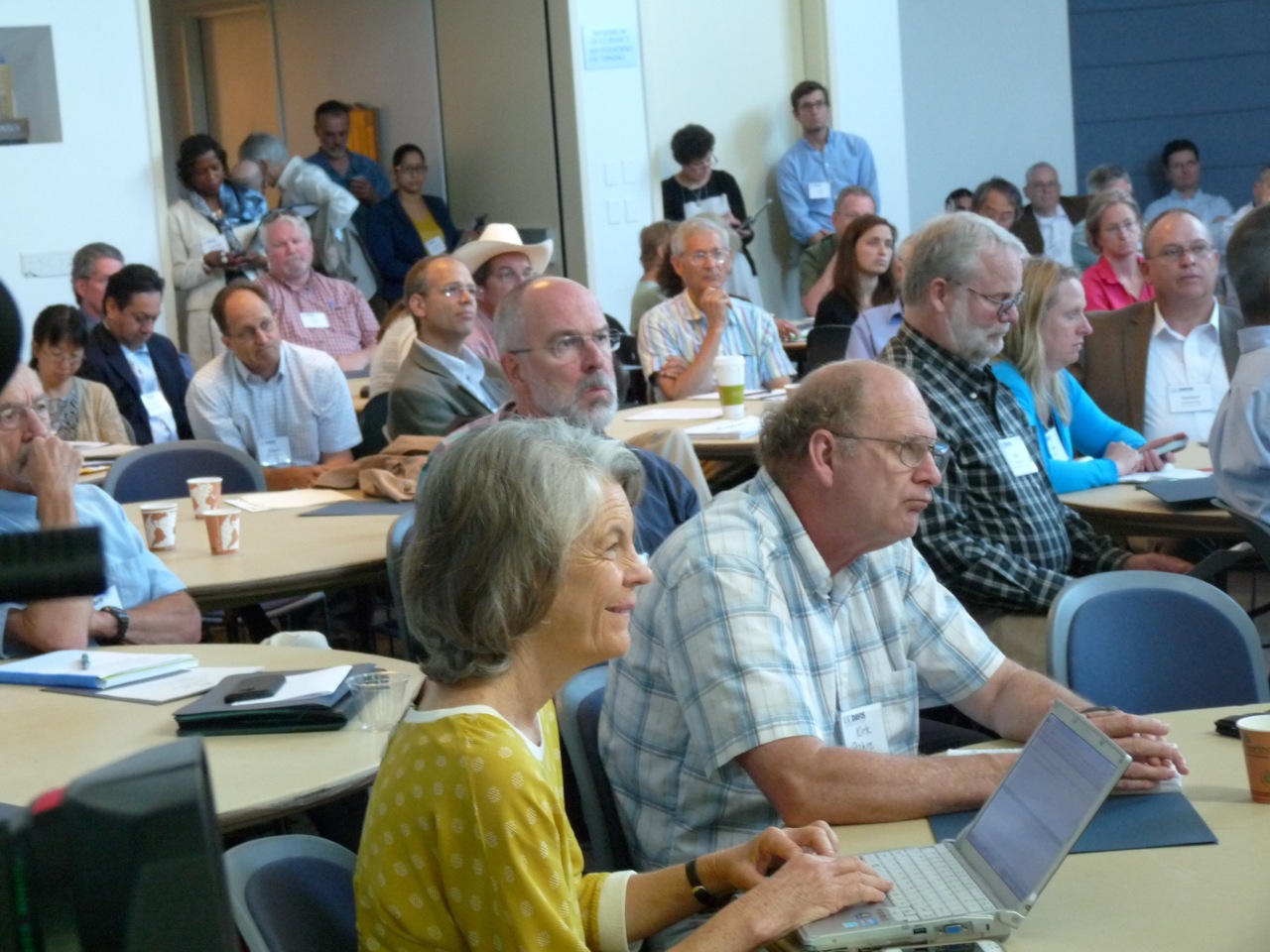
Brian Leahy (left) speaking with Malcolm Ricci, of Bolthouse Farms of Bakersfield.

Brian Leahy (left) speaking with Malcolm Ricci, of Bolthouse Farms of Bakersfield.

In those attending the symposium, also learned some things they didn’t know.

“And that was the goal, we were trying to figure out, how do we build the support to get long term sustainable funding to better understand soil health. You know understanding soil and what’s going on in soil life, its one of the last frontiers in how were going to make incredible progress in how we feed people, how we take care of the planet, and how we take care of each other. Just layering all the other amazing research going on right in plant genetics. and plants on top of soil its going to be another revolution. I heard Warren Buffett’s son called it the “Brown Revolution”. said Leahy.

And think of that really important topsoil, 1 and half feet around the planet, that supports us all.

“We heard from the Noble Foundation and the soil renaissance, its a national movement as well, where people are realizing that we have to take care of the soil and work with soil, to really take care of the human race, to feed us, clothed us, all of that. So there is a lot of promise here.” said Leahy.

2016-05-31T19:35:23-07:00June 23rd, 2014|
Go to Top