Crystal Creamery of Modesto Launches Campaign Against Theft of Milk Crates

Source: John Holland; Fresno Bee

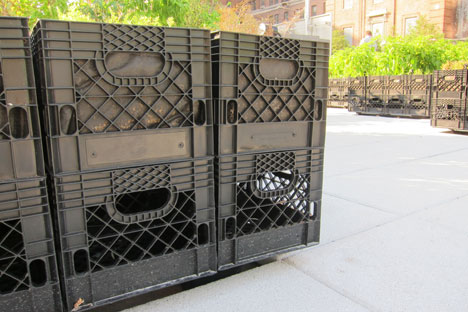
A Modesto-based dairy company has had enough of milk crate theft, which costs the U.S. industry an estimated $80 million a year.

Crystal Creamery, formerly known as Foster Farms Dairy, is working with law enforcement, grocers and other partners to combat the problem.

They are focusing mainly on large-scale thieves who try to sell the ground-up plastic to recyclers, although it’s also illegal to take a single crate for use as a toolbox or storage container.

“Milk crates have always disappeared, but in the last two or three years, the rate of disappearance is greater,” said Elliot Begoun, vice president of sales and marketing at Crystal.

He said the thefts have increased with the rising value of scrap plastic, which is based in part on the price of the petroleum used to make virgin plastic.

Begoun talked about the problem during an interview Tuesday at the Kansas Avenue headquarters of the company, still owned by the Foster family, which also is in the poultry business.

On a typical day, Crystal trucks haul about 60,000 crates filled with milk, sour cream and cottage cheese to grocery stores and food service customers from Bakersfield to the Oregon border. The drivers are supposed to bring back crates from previous deliveries, but they can be stolen if not secured at the customers’ locations, Begoun said.

Each time that happens, Crystal loses about $4, which is hard to take in an industry with tight profit margins, he said. Nationwide each year about 20 million crates are stolen, according to the International Dairy Foods Association.

Crystal is working with grocers on improved security, as well as with food banks, which sometimes get donations of dairy products in the crates.

The company also approached Stanislaus County Sheriff Adam Christianson. He said Tuesday that the crime is driven mainly by addicts looking for recycling income they can spend on drugs, similar to metal theft.

Christianson said he was surprised that the scrap value of plastic has risen so much. He noted other such commodities that are being stolen, such as used grease from restaurants, which rendering companies buy.

“Milk crates are no different,” the sheriff said. “It’s a material that can be recycled.”

Christianson said he is asking detectives to look into where the stolen crates are being ground up and recycled. They’re molded to include a warning against unauthorized use, and their distinctive appearance makes it hard to sell them intact.

The Institute of Scrap Recycling Industries warns member companies against accepting materials “that are clearly marked as property belonging to an entity other than the seller, such as beer kegs, milk crates and other marked materials.”

Crystal also is asking the public to resist the temptation to take a small number of crates for personal use. Begoun and Larry Diggory, director of food operations at the plant, said they have seen them used in retail displays, on the back of motorcycles and on plumbers’ trucks.

“What we’re trying to do is to create an awareness with the public that it’s theft and it’s a cost of business,” Begoun said.

 

2016-05-31T19:35:27-07:00June 10th, 2014|

California Milk Production in 2013

Sources: CDFA Dairy Marketing and Milk Pooling Branches

In 2013, 33 California counties recorded milk production, indicating that a total of 41.2 billion pounds were produced.

IMG_2709

This statistic represents a 1.3 percent decrease in overall milk production compared to that of 2012.

The top 10 milk producing counties were responsible for 94.9 percent of total California milk production; among the top three counties were Tulare, Merced and Stanislaus counties.

They alone were responsible for 52.9 percent of all the milk produced in California.

Fresno County showed the largest increase in milk production with a 2.02 percent increase, whereas, Southern California counties San Bernardino and Riverside showed the largest decrease.

Compared to 2012, milk production in San Bernardino went down 21.36 percent and decreased by 9.28 percent in Riverside, respectively.

2017-09-03T00:40:07-07:00March 5th, 2014|

Tulare County Ag Value Just Behind Fresno!

Tulare County 2012 Crop Report Production Value Up 10 Percent

Tulare County’s total gross production value for 2012 is $6.22 billion. The report, released today, showed an increase of  $581 million, or 10 percent above the 2011 value of $5.6 billion.
Dairy products continue to be the leading agricultural commodity in the County, with a total gross value of $1.8 billion, a decrease of 12 percent.
“Milk represents 29 percent of the total crop and livestock value for 2012,” said Marilyn Kinoshita, Tulare County Agricultural Commissioner. “Total milk production in Tulare County remained relatively stable,” she said. 

Possibly, if milk prices were a little higher during the year, Tulare County would have beat Fresno County for the first time!
“Livestock and Poultry’s gross value of $661 million represents an increase of 5.8 percent above 2011, mostly due to an increase in value for turkeys, cattle and calves,” noted Kinoshita.
Fruit and nut commodities were valued at $2.8 billion representing an increase of 29 percent. “The majority of this gain was the result of an excellent year for our grape category,” Kinoshita noted.
The total value of all field crops was $776 million, an increase of 24 percent from 2011. “Local demand for dairy feed continues to keep high values for our field crops. Nursery products were valued at $67 million, representing an increase of 2.5 percent over last year. “This minor increase is a reflection of the continued uncertainties in both the housing and agricultural markets,” Kinoshita explained.
Vegetable crops were valued at $20 million in 2012, representing a less than one percent increase.
“The 2012 report covers more than 120 different commodities, 43 of which have a gross value in excess of $1 million. Although individual commodities may experience difficulties from year to year, Tulare County continues to produce high-quality crops that provide food and fiber to more than 84 countries throughout the world,” said Kinoshita.
Kinoshita expressed appreciation to her staff, particularly Lea Pereira, Jacqui Balderas, and Dennis Haines for their contributions to the report.
2016-08-31T13:28:59-07:00July 23rd, 2013|
Go to Top