Could CDFA’s ACP Control Policy Devastate Our Citrus Industry Like Florida’s?

Citrus Industry is Fired Up Over Softened ACP Control Policy

By Patrick Cavanaugh


It seems that CDFA officials are giving up on controlling the Asian Citrus Psyllid (ACP) in Central California citrus growing areas! It sure looks like it.

Ever since the May 12 ACP trappings in the Lindsay area of Tulare County, there has been a major back-step in what has been an aggressive mandatory spray program to control any possible live psyllids within an 800-meter radius around the trap.

Now CDFA is suggesting that the spray programs should be voluntary and only 400 feet around the trap find.

According to Joel Nelsen, president of the Exeter-based California Citrus Mutual, “The conversation relative to the change in eradicating or treating for the ACP came about with a discussion between a few members of the scientific community and the department.”

“Frankly, the industry was unaware of this possible change in the program. When it was first released to the AG commissioner, it shocked everybody–is my understanding,” Nelsen said.

“And as a result, last Friday afternoon, the executive committee members from our pest and disease management committee had a very direct conversation with senior leadership of the CDFA. I understand that the conversation was extremely candid, somewhat emotional; if the industry to is going to be supporting a program to the tune of 15 million dollars, they want a say in how the program is run. And evidently, the Department of Agriculture is making some subjective decisions that we don’t believe are appropriate.”

“From my perspective, there were mistakes made at the onset of this program that we had to learn from; and if we don’t take seriously—psyllid control, psyllid control, psyllid control!—we’re going to end up in the same type of quandary that our colleagues in Florida, Texas, Mexico and even Brazil are in.

Too many psyllids, an endemic population, some of which will contract citrus greening disease and eventually contaminate citrus trees, could devastate central California’s $2 Billion industry. “If we even allow one psyllid to continue to foster a population, then we have failed at our effort. And so from the perspective of Citrus Mutual, we are in an eradication mode,” Nelsen said.

“We are in a position in which we can find isolated psyllids and treat, and we are in position where continuous trapping and tapping (with bats and trays in searching for psyllids) and intensive trapping is not finding an endemic population. So for the department to argue that the population is endemic, its a ‘what if’ scenario that we don’t think is appropriate.”

Nelsen said that the pushback by his pest and disease management committee might have made a difference. “I haven’t received anything, but I think that conversation last Friday afternoon yielded some intended results. There’s a reconsideration, and I give a lot of credit to the industry members who stood up the department; but until it happens, its not real,” he said.
2021-05-12T11:06:01-07:00June 3rd, 2014|

Secretary Ross Joins Elementary School Students to Experience Mobile Dairy Classroom

Source: Tammy Anderson-Wise, CEO Dairy Council of California

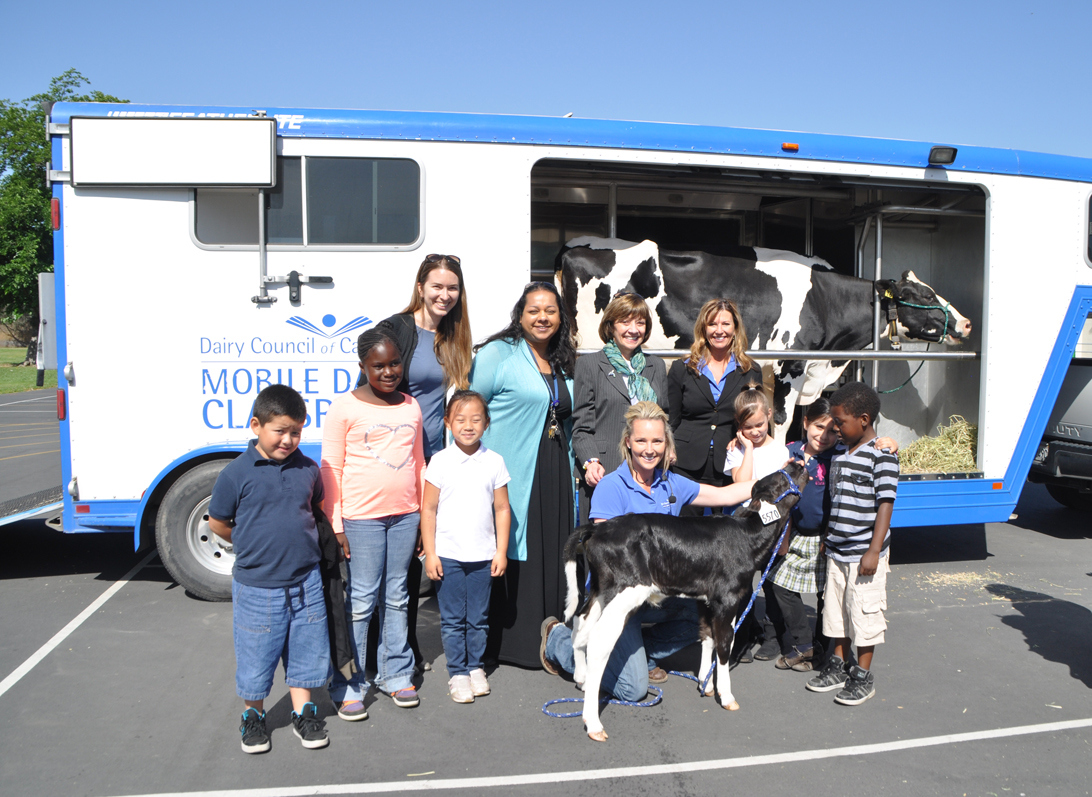
Earlier this month, CDFA Secretary Karen Ross joined students at Sacramento’s Pacific Elementary School for a visit from the Mobile Dairy Classroom, where an instructor shared fun facts like: cows have built-in fly swatters, and milk is warm when it comes out of the udder.

As the original farm to school program in California, Mobile Dairy Classroom has brought a bit of the dairy farm to schools across the state since the 1930s.

To help children better appreciate where their milk and milk products come from, the free assemblies provided by the Dairy Council of California teach children about agriculture and cows, healthy eating from all five food groups, and how to lead healthy, active lifestyles.

Mobile Dairy Classroom assemblies augment the Dairy Council of California’s classroom nutrition education lessons that are also free to schools as part of the dairy industry’s commitment to community health.

With six Mobile Dairy Classroom units across California, 400,000 students each year have the chance to make a personal connection with a cow and a calf, and better understand where their milk comes from.

Furthermore, the assemblies allow for a better appreciation for the role of the dairy farmer and milk processor in providing healthy food and why milk and milk products are an essential part of an overall balanced diet with foods from all five food groups.

2016-10-18T16:10:11-07:00May 20th, 2014|

Heat Illness Prevention: Warning for Farmworkers This Week

Heat Illness Prevention

Extreme Heat Wave Expected to Continue Throughout this Week


With really high temperatures throughout the Central Coast, Cal/OSHA will probably focus enforcement in coming days in these areas. Please remember the key points of compliance with the Heat Illness Prevention Standard:Heat Illness Prevention


* Water — 1 quart per worker per hour, with a plan for replenishment throughout the work shift


* Shade — enough for 25% of the crew working at the location; use of natural shade is acceptable if no shadow is cast; air-conditioned vehicles are acceptable; provided at all times when temperature exceeds 85 degrees


* Rest — allow workers to rest in shade if they feel the need for no less than 5 minutes


* Training — workers & supervisors must be trained about heat illness and emergency response procedures before being exposed to heat


* High-Heat Procedures — ensure effective communications in case of emergency; observe employees carefully for signs of heat illness; remind employees to drink water throughout the shift; closely supervise un-acclimatized employees for first 14 days of exposure to high heat

2017-05-04T16:51:11-07:00May 14th, 2014|

CENTER FOR LAND-BASED LEARNING CELEBRATES 20TH ANNIVERSARY

Happy 20th Anniversary!

CDFA Secretary Karen Ross reported TODAY, “I had the honor and pleasure to help celebrate the 20th anniversary of the Center for Land-Based Learning, a non-profit organization in Winters started by California State Board of Food and Agriculture president, Craig McNamara, and his wife, Julie, to help connect young people with nature and agriculture.”


“In the last two decades, the Center has become a force in this state for its extremely effective youth development and beginning farmer education,” Ross continued.  “I want to commend Craig for his vision, passion and commitment of resources to make the Center an entity that touches so many people in such positive ways and is absolutely contributing to a better future for California agriculture.”
 

“Happy 20th Anniversary, Center for Land-Based Learning!”

_______________________________________


The Center for Land-Based Learning strives to inspire and motivate people of all ages, especially youth, to promote a healthy interplay between agriculture, nature and society through their own actions and as leaders in their communities.


The Center for Land-Based Learning envisions a world where there is meaningful appreciation and respect for our natural environment and for the land that produces our food and sustains our quality of life.
2021-05-12T11:06:02-07:00October 26th, 2013|

Tulare County Ag Value Just Behind Fresno!

Tulare County 2012 Crop Report Production Value Up 10 Percent

Tulare County’s total gross production value for 2012 is $6.22 billion. The report, released today, showed an increase of  $581 million, or 10 percent above the 2011 value of $5.6 billion.
Dairy products continue to be the leading agricultural commodity in the County, with a total gross value of $1.8 billion, a decrease of 12 percent.
“Milk represents 29 percent of the total crop and livestock value for 2012,” said Marilyn Kinoshita, Tulare County Agricultural Commissioner. “Total milk production in Tulare County remained relatively stable,” she said. 

Possibly, if milk prices were a little higher during the year, Tulare County would have beat Fresno County for the first time!
“Livestock and Poultry’s gross value of $661 million represents an increase of 5.8 percent above 2011, mostly due to an increase in value for turkeys, cattle and calves,” noted Kinoshita.
Fruit and nut commodities were valued at $2.8 billion representing an increase of 29 percent. “The majority of this gain was the result of an excellent year for our grape category,” Kinoshita noted.
The total value of all field crops was $776 million, an increase of 24 percent from 2011. “Local demand for dairy feed continues to keep high values for our field crops. Nursery products were valued at $67 million, representing an increase of 2.5 percent over last year. “This minor increase is a reflection of the continued uncertainties in both the housing and agricultural markets,” Kinoshita explained.
Vegetable crops were valued at $20 million in 2012, representing a less than one percent increase.
“The 2012 report covers more than 120 different commodities, 43 of which have a gross value in excess of $1 million. Although individual commodities may experience difficulties from year to year, Tulare County continues to produce high-quality crops that provide food and fiber to more than 84 countries throughout the world,” said Kinoshita.
Kinoshita expressed appreciation to her staff, particularly Lea Pereira, Jacqui Balderas, and Dennis Haines for their contributions to the report.
2016-08-31T13:28:59-07:00July 23rd, 2013|
Go to Top