Farm to Food Bank Month

The following was written by Governor Brown…

California is America’s most robust and bountiful agricultural producer. With over 81,000 farms and approximately 400 crops, agriculture in the Golden State is responsible for feeding much of the nation and world.

As California’s economy recovers amidst one of the worst droughts on record, farmers and ranchers across the state are also doing their part to prevent the spread of hunger and expand access to affordable, nutritious food in their communities.

We owe those within the agricultural sector our gratitude during these challenging times. I urge all Californians to recognize the contributions of California’s agricultural community, as well as the food banks and partner organizations they work with to provide nourishment to the most vulnerable among us.

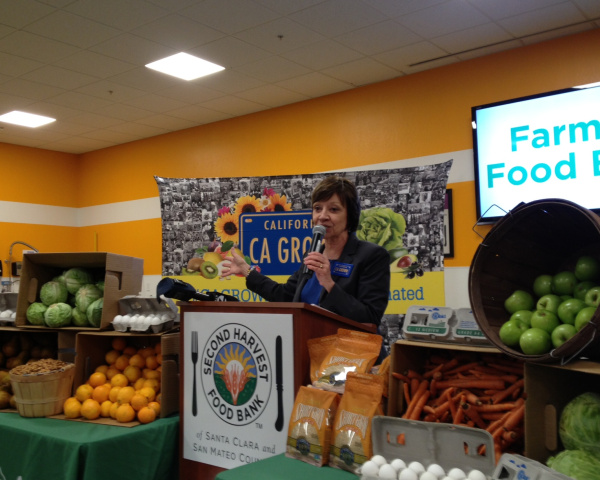
Farm to Food Bank Month


Celebrate Farm to Food Bank Month and team up with the California Association of Food Banks, the California Department of Food and Agriculture, & California Grown to help out! For more information http://www.cafoodbanks.org/ 


2016-05-31T19:32:12-07:00December 3rd, 2014|

State employees donate 13 tons in Turkey Drop, Set record at Sacramento Food Bank

By: Monique Bienvenue; California Ag Today Social Media Manager/Reporter 

A partnership between California state employees and the Sacramento Food Bank has helped produce a record number of turkey donations via the 2014  Turkey Drop. The food bank accepted more than 9,300 turkeys for needy families in the Turkey Drop, with 1,760 of them–more than 26,000 pounds (13 tons!)–provided by state employees.Sacramento Food Bank

The Turkey Drop is one element in the ongoing State Employees Food Drive. Other ways to contribute include a rice donation program and a continuing effort to collect canned food and other items. State offices throughout the region have staged colorful bins to make donations easy.

The Sacramento Food Bank is Sacramento County’s largest direct food bank provider feeding approximately 40,000 food-insecure individuals a month, including 15,000 children and 8,000 senior citizens. In 2013, the food bank distributed over 6.5 million pounds of food, including 2 million pounds of fresh California-grown fruits and vegetables.

December is Farm to Food Bank Month . Help increase farm to food bank donations to 200 million pounds annually by making a product donation or future donation pledge today – contact Steve Linkhart, California Association of Food Bank at (510) 350-9916.

2016-05-31T19:32:12-07:00December 2nd, 2014|

Mann’s Snap Pea Sensations Kits Wins Award

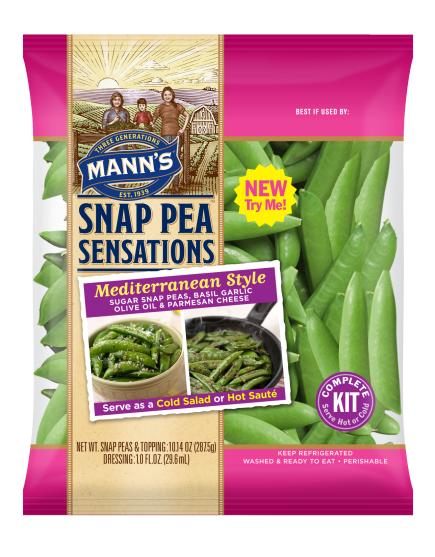
Mann’s Mediterranean Style Snap Pea Sensations™ Kit was named a Supermarket Star by Women’s Health Magazine and is featured in the November issue on newsstands now.

This is the second year in the row that a Mann product has been named a Supermarket Star by Women’s Health. The magazine is sold in the United States and Canada and has a circulation of 1.6 million. The magazine’s demographics match up well with Mann’s target market as the median reader age is 38, college educated and female.

“Mann’s snap peas outsell the competitors’ five to one; we know consumers love them and we also know time-starved parents are looking for creative and healthy meal solutions that are quick and easy to prepare for their families” said Kim St George, director of marketing and innovation. 

The kits are unique due their versatility—they can be prepared as a cold salad or a hot sauté; and served as a side dish, or as an entrée by adding protein.

“We’re very excited about these first-of-their-kind snap pea kits,” St George said. “There are no other vegetable kits on the market with this versatility.”

Mann’s 11-ounce Snap Pea Sensations kits are available in two flavors—Asian Sesame and Mediterranean Style. The Asian Sesame kit includes sesame seeds and an Asian-style dressing; the Mediterranean kit includes grated Parmesan cheese and a basil garlic-infused olive oil dressing. As with Mann’s value-added fresh-cut products, Snap Pea Sensations kits have a 16-day shelf life. The suggested retail price is $3.99 to $4.99.

Mann’s produced a video demonstrating the easy prep involved to produce a Snap Pea “Sensations” cold salad or sautéed dish.

Beginning Nov. 1, the company applied more than 125,000 instant redeemable coupons for $1 off purchase to packages of the Snap Pea Sensations kits throughout US and Canada. The offer will be good through December at stores nationwide.

For more information about Mann Packing, visit veggiesmadeeasy.com.

2016-05-31T19:32:13-07:00November 27th, 2014|

Farmers, Agriculture Technology Providers Reach Agreement on Big Data Privacy and Security Principles Expected to Accelerate Technology Adoption

By: Monique Bienvenue; Cal Ag Today Social Media Manager/Reporter

A coalition of major farm organizations and agriculture technology providers (ATPs) announced an agreement on data privacy and security principles that will encourage the use and development of a full range of innovative, technology-driven tools and services to boost the productivity, efficiency and profitability of American agriculture.

The coalition supporting the principles includes: American Farm Bureau Federation, American Soybean Association, Beck’s Hybrids, Dow AgroSciences LLC, DuPont Pioneer, John Deere, National Association of Wheat Growers, National Corn Growers Association, National Farmers Union, Raven Industries, The Climate Corporation – a division of Monsanto, and USA Rice Federation.

“The principles released today provide a measure of needed certainty to farmers regarding the protection of their data,” said American Farm Bureau President Bob Stallman. “Farmers using these technology-driven tools will help feed a growing world while also providing quantifiable environmental benefits. These principles are meant to be inclusive and we hope other farm organizations and ATPs join this collaborative effort in protecting farm-level data as well as educating farmers about this revolutionary technology.”

The principles promise to greatly accelerate the move to the next generation of agricultural data technology, which includes in-cab displays, mobile devices and wireless-enabled precision agriculture that has already begun to boost farm productivity across the United States.

Central to the effort surrounding the principles will be grower education initiatives that will include an easy-to-use transparency evaluation tool for farmers. The tool would allow farmers to compare and contrast specific issues within ATP contracts and to see how the contracts align with these agreed-upon principles, and how ATPs manage and use farmers’ data.

“The privacy and security principles that underpin these emerging technologies, whether related to how data is gathered, protected and shared, must be transparent and secure. On this matter, we all agree,” said Stallman. “Farmers are excited about this new technology front, which is why Farm Bureau asked these groups to come together and begin this collaborative dialogue.”

The principles cover a wide range of issues that must be addressed before most farmers will feel assured to share their private business information with data providers. Highlights include:

  • Ownership: The group believes that farmers own information generated on their farming operations. However, farming is complex and dynamic and it is the responsibility of the farmer to agree upon data use and sharing with the other stakeholders with an economic interest such as the tenant, landowner, cooperative, owner of the precision agriculture system hardware, and/or ATP etc. The farmer contracting with the ATP is responsible for ensuring that only the data they own or have permission to use is included in the account with the ATP.
  • Collection, Access and Control: An ATP’s collection, access and use of farm data should be granted only with the affirmative and explicit consent of the farmer.
  • Notice: Farmers must be notified that their data is being collected and about how the farm data will be disclosed and used.
  • Third-party access and use: Farmers and ranchers also need to know who, if anyone, will have access to their data beyond the primary ATP and how they will use it.
  • Transparency and Consistency: ATPs shall notify farmers about the purposes for which they collect and use farm data. They should provide information about how farmers can contact the ATP with any inquiries or complaints, the types of third parties to which they disclose the data, and the choices the ATP offers for limiting its use and disclosure.
  • Choice: ATPs should explain the effects and abilities of a farmer’s decision to opt in, opt out or disable the availability of services and features offered by the ATP.
  • Portability: Within the context of the agreement and retention policy, farmers should be able to retrieve their data for storage or use in other systems, with the exception of the data that has been made anonymous or aggregated and is no longer specifically identifiable.
  • Data Availability: ATPs agree they should provide for the removal, secure destruction and return of original farm data from the ATP, and any third party with whom the ATP has shared the data, upon request by the account holder or after a pre-agreed period of time.
  • Market Speculation: ATPs will not use farm data to illegally speculate in commodity markets.
  • Liability & Security Safeguards: The ATP should clearly define terms of liability. Farm data should be protected with reasonable security safeguards against risks such as loss or unauthorized access, destruction, use, modification or disclosure.

Privacy and Security Principles for Farm Data can be found here: http://bit.ly/1zjQ4Sk.

2016-05-31T19:32:14-07:00November 17th, 2014|

USDA’s Specialty Crop Block Grant Program Welcomes Proposals and Technical Committee Volunteers

By: Monique Bienvenue; Cal Ag Today Social Media Manager/Reporter

The California Department of Food and Agriculture (CDFA) is accepting proposals for the 2015 Specialty Crop Block Grant Program, which conducts an annual competitive solicitation process designed to enhance the competitiveness of California specialty crops–fruits and vegetables, tree nuts, dried fruits, horticulture, and nursery crops (including floriculture).

Grant awards will range from $50,000 to $450,000 per project with a duration of up to two years and nine months. Non-profit and for-profit organizations; local, state, federal, and tribal government entities; and public and private colleges and universities are eligible to apply.

Phase I of the competitive process begins with the submission of concept proposals. Concept proposals undergo both an administrative review conducted by CDFA as well as a technical review conducted by a volunteer panel of subject matter experts. Successful applicants will be invited to submit detailed grant proposals in Phase II of the process.

Details:  Applicants must access the 2015 Request for Concept Proposals at www.cdfa.ca.gov/grants for detailed application instructions. To streamline and expedite the application process, CDFA has partnered with the California State Water Resources Control Board to utilize their online application site, the Financial Assistance Application Submittal Tool (FAAST). Applicants must register for a FAAST account at https://faast.waterboards.ca.gov.

Concept proposals must be submitted electronically using FAAST by Friday, December 5, 2014, at 5 pm PST, and applications must include a letter of interest, short biography, and statement of qualifications identifying the Specialty Crop Block Grant Program funding category related to the applicant’s area of expertise. For a description of the funding categories, please reference the 2015 Request for Concept Proposals at www.cdfa.ca.gov/grants.

If selected, individuals will be required to complete the Form 700 Statement of Economic Interests and the Ethics Training Course. Prospective applicants may contact CDFA’s Federal Funds Management Office at (916) 657-3231 or grants@cdfa.ca.gov for additional information.

2016-05-31T19:32:15-07:00November 11th, 2014|

Growing Figs for 33 Years at Maywood Farms

Farming Niche Organic Figs with Passion

By: Kyle Buchoff; CalAgToday reporter

Growing up in the Bay Area, Bob Steinacher learned how to harvest and dry apricots on his family’s one-acre plot in the Santa Clara Valley. His family maintained the plot as a hobby, but when houses began replacing orchards there, he decided he didn’t want to leave farming. After graduating from UC Davis, he began farming figs and walnuts full-time in Corning, in Tehama County.

tehama-figs“I’ve had Maywood Farms now for 33 years. My family helped me get started, and we’ve been very successful at what we do.” In addition to growing and harvesting 172 acres of organic figs, Steinacher fresh markets his fruit all over the country. “We have 50 acres of conventional walnuts as well,” he added.

Steinacher’s fig farming operation is unique: “We farm the most northern commercially grown figs in the country as Corning has the same weather as the Fresno area.  We also have to worry about late spring frost and early fall rains, but we can weather that. We have wind machines installed for frost protection.”

Waxing nostalgic about his career, Steinacher reflected, “I have learned a lot over the last 33 years of doing this. I had no background in farming other than a desire to do this. I worked for other orchardists and down at a high school farm when I got out of college. I’ve learned a lot by the seat of my pants.”

“We’ve been very successful,” he continued, “because we’ve found a niche with the organic fresh figs. The fig market has been growing ever since we have been in it, and the organic market—on top of that—is growing very quickly as well.”

For more information, please visit the Maywood Farms’ website.


2016-05-31T19:32:16-07:00November 8th, 2014|

Student Inventors Take Grand Prize

Source: Pat Bailey; UC Davis

A student team composed of some of the best and brightest young minds at the University of California, Davis,  took the grand prize in the finals of the global iGEM (International Genetically Engineered Machines) competition in Boston. The team also won the Best Policy and Practices Advanced Presentation Award.

The UC Davis students, all undergraduates, placed tops in what is known as the “overgraduate division.” A team from the University of Heidelberg was awarded the grand prize in the “undergraduate division.”

The competition, which this year featured 245 teams from Asia, Europe, Latin America and North America, annually challenges student teams to design and build biological systems or machines and present their inventions in the international competition.

The UC Davis team spent several months building a high-tech, palm-sized biosensor to quickly evaluate the chemical profile of olive oil. Their creation provides a prototype for quickly and accurately detecting low-grade or adulterated olive oil.

The UC Davis team is composed of undergraduate students Lucas Murray, Brian Tamsut, James Lucas, Sarah Ritz, Aaron Cohen and Simon Staley, with student Yeonju Song serving as an alternate or “shadow” team member. A team of faculty advisers guided the students. For more on the innovative olive oil biosensor and the iGEM competition visit, click here.

2016-05-31T19:32:16-07:00November 4th, 2014|

Nut Yields May Be Reduced by Drought

Source: Christine Souza; Ag Alert

Enduring a drought that has lasted several years, growers of California’s primary nut crops—almonds, walnuts and pistachios—are finishing this year’s harvest and planning for what Mother Nature may or may not bring in the coming year.

“Location, location, location” proved critical to almond and pistachio crops in particular, and seemed to be the determining factor in whether trees had enough water and the required number of chilling hours.

Some farmers were luckier than others, including Larry Lowder of Madera. A grower of almonds and pistachios, Lowder said he was “very fortunate where we live and this year we were able to produce a crop, where others didn’t have that luxury.” He said his farm is located in a microclimate that received sufficient chilling hours during the winter, something that was lacking in other parts of the Central Valley.

Dealing with a surface water allocation of zero, Lowder said he had to rely on deep wells, and he saved as much water as possible by using drip irrigation, microsprinklers and upgraded wells.

Even with a relatively favorable situation, Lowder said his almond yields were down by about 10 percent, although pistachio yields were much better.

In some California pistachio and almond orchards, the drought resulted in a shorter crop and a higher incidence of “blanks,” when a shell lacks a viable nut or kernel.

“Some growers, who had the effect of poor pollinization as well as lack of water, their crops were significantly off and there will be crop insurance claims filed,” said Richard Matoian, executive director of Fresno-based American Pistachio Growers. “One grower said the orchard looked like it had 3,500 pounds per acre, but ended up with 800 pounds of nuts to the acre.”

The U.S. Department of Agriculture estimated this year’s California pistachio crop at between 485 million and 500 million pounds, Matoian said, which is smaller than expected because it was to be an “on year” for pistachios. New figures from the Administrative Committee for Pistachios have increased the estimate to 515 million pounds, which Matoian said was “larger than expected in midsummer but certainly lower than original expectations.”

Many pistachio growers purchased emergency supplies of water, Matoian said, paying as much as $3,000 per acre-foot. Reports from the almond sector showed some growers paid between $1,200 and $2,200 per acre-foot.

Reflecting on how almond growers negotiated the drought, Mel Machado, assistant director of member relations for Blue Diamond Growers, said some orchards were either removed or abandoned, and water was moved from older blocks of trees to younger blocks.

“Growers have learned a lot about how to manage the water they have, but even with good technology and good application, there are orchards that definitely had increased stress this year,” Machado said. “You can see it in the lack of growth of the trees.”

Farmer Stan Wilson of Shafter grows almonds and other crops, and said he made it through this season on well water, but had to reactivate old wells, add extensions to pumps and install an underground pipeline so that he could move water from one field to another.

“We made it through the year. We had no surface water at all, so the only water supply we had was from wells. It is the first year we had zero deliveries,” said Wilson, who fallowed about 160 acres of row crops as a result of the drought.

With harvest drawing to a close, Machado reported that this year’s almond crop is hovering at around 1.85 billion pounds, down from the earlier government estimate of 2.1 billion pounds. Machado said he has seen higher levels of rejects in the almonds produced, but there were problems in addition to drought that played a part, such as varying degrees of stress and salinity issues.

“Quite frankly, we needed the 2.1 billion pounds. A lot of people look at orchards planted over the past few years and say, ‘What are you going to do with those when they come into production?’ Well, we’re going to market them. There is demand out there for the product. We’re still in a demand-exceeds-supply situation,” Machado said.

With just a few more weeks left of harvest, California walnut growers expect a crop that is 545,000 tons, which would be a record, said Dennis Balint, CEO of the California Walnut Commission. No official production figure will be known until harvest is complete, but Balint attributed the expected increase to newly planted orchards and young orchards that are coming into production with higher yields.

He, too, reported continued strong demand.

“Traditionally, we’ve been the ingredient nut, but demand for walnuts is strong and health benefits are starting to drive demand for walnuts. We are seeing more snacking, which we are pleased with,” Balint said.

Marketers said the increasing demand for California nut crops in domestic and global markets is good news for growers. There are 200,000 bearing acres of pistachios in California, and 100,000 acres are non-bearing, Matoian said. For almonds, USDA reported there are 860,000 bearing acres, with 80,000 non-bearing acres. There are an estimated 280,000 bearing acres of walnuts in California, and 45,000 acres that are non-bearing.

For the almond business, Machado said, “the limitation on the crop is going to be water. Water is going to be the competing factor for the almond crop, just as it is for just about every other crop in the Central Valley.”

As winter approaches, nut growers said they are hopeful that the state’s water situation changes for the better, although, Matoian said, “Even if we have a good rain year, we are going to have a lack of water available to growers; that is inevitable. That is what we’re being told by water regulators.”

2016-05-31T19:32:17-07:00November 3rd, 2014|

USDA to provide $4 million for honey bee habitat

By: Monique Bienvenue; Cal Ag Today Social Media Manager/Reporter

Agriculture Secretary Tom Vilsack announced that more than $4 million in technical and financial assistance will be provided to help farmers and ranchers in the Midwest improve the health of honey bees.

“The future of America’s food supply depends on honey bees, and this effort is one way USDA is helping improve the health of honey bee populations,” Vilsack said. “Significant progress has been made in understanding the factors that are associated with Colony Collapse Disorder and the overall health of honey bees, and this funding will allow us to work with farmers and ranchers to apply that knowledge over a broader area.”

An estimated $15 billion worth of crops is pollinated by honey bees, including more than 130 fruits and vegetables. USDA’s Natural Resources Conservation Service (NRCS) is focusing the effort on five Midwestern states: Michigan, Minnesota, North Dakota, South Dakota and Wisconsin. This announcement renews and expands a successful $3 million pilot investment that was announced earlier this year and continues to have high levels of interest.

From June to September, the Midwest is home to more than 65 percent of the commercially managed honey bees in the country. It is a critical time when bees require abundant and diverse forage across broad landscapes to build up hive strength for the winter.

The assistance announced will provide guidance and support to farmers and ranchers to implement conservation practices that will provide safe and diverse food sources for honey bees. For example, appropriate cover crops or rangeland and pasture management may provide a benefit to producers by reducing erosion, increasing the health of their soil, inhibiting invasive species, and providing quality forage and habitat for honey bees and other pollinators.

This year, several NRCS state offices are setting aside additional funds for similar efforts, including California – where more than half of all managed honey bees in the U.S. help pollinate almond groves and other agricultural lands – as well as Ohio and Florida.


2016-05-31T19:32:17-07:00October 30th, 2014|

Celebrate the Holidays – the Fun and Healthy Way

By: Monique Bienvenue; Cal Ag Today Social Media Manager/Reporter

Keeping your family healthy this holiday season can be tough. With festive cakes, pastries and candy lined up in every aisle of the grocery store, it’s easy to fall off the healthy train.

Fortunately for us, MyPlate has done a fabulous job of creating a beautifully comprehensive list of ways to incorporate healthy habits into your next holiday gathering. Here are some tips that could help you coordinate a fun and healthy event for everyone!

  1. Make healthy habits part of your holiday celebration: Make activities, not food, the center of attention at your next event. This will keep your guests moving and their hands off all the snacks.
  2. Make foods look festive: Use healthy foods, such as nuts or veggies, to decorate your meals.
  3. Add a bit of “health” to your drinks: Serve fruit infused water, or make ice cubes out of juice.
  4. Savor the flavor: Instead of scarfing down a whole meal, take time to enjoy each and every bite.
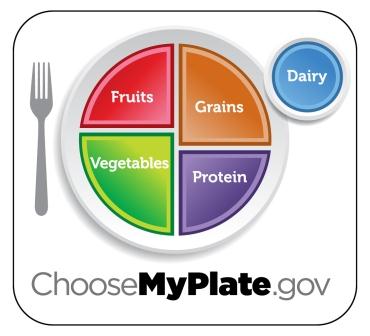
  5. Incorporate MyPlate.com to make sure every food group is represented in your main dish.
  6. Make moving part of the event: Make sure the music is on and that your guests are dancing!
  7. Experiment with healthy recipes: Make healthy recipes a mandatory part of your party-planning.
  8. Make the cleaning process fun: Get the kids involved! It’ll keep the moving and it’ll help you get the job done faster.
  9. Shop smart and eat smart: Healthy food can be expensive, try to buy products that are in season and fit your budget.
  10. Be a cheerleader for healthy habits: Children are like sponges; the more they see you maintain a healthy lifestyle, the more they’re likely to do the same.

Stay healthy this holiday season; go to http://www.choosemyplate.gov recipe ideas, nutrition facts and healthy tips. 


2016-05-31T19:32:18-07:00October 28th, 2014|
Go to Top