RESEARCH SHOWS RAW MILK IS HAZARDOUS

Raw Milk a Hazard for Children and Pregnant Women
In a new policy statement, the American Academy of Pediatrics has advised children, infants and pregnant women not to consume any raw milk or raw milk products from cows, goats or sheep.

Although the sale of unpasteurized milk products is legal in 30 states, the academy says that the evidence of the benefits of pasteurization to food safety is overwhelming, and that the benefits of any elements in raw milk that are inactivated by pasteurization have not been scientifically demonstrated.


California allows raw milk sales in retail stores and requires a permit which also allows for sales on/off farms and at farmers’ markets.

The report, published in the January 2014 Pediatrics, released TODAY, notes that many species of harmful bacteria have been found in unpasteurized milk products, including Listeria, Salmonella, Escherichia coli and Cryptosporidium, among others.

In a study published last week in Emerging Infectious Diseases, researchers estimated that over the past 10 years in Minnesota, where raw milk is legally sold, more than 17 percent of those who consumed it became ill.

“There are no proven nutritional advantages of raw milk,” said a lead author, Dr. Jatinder Bhatia, the chief of neonatology at Georgia Regent University in Augusta. “Further, raw milk and milk products account for a significant proportion of food borne illnesses in Americans. There is no reason to risk consuming raw milk.”

Are cheeses made from raw milk less likely to be contaminated? “No,” Dr. Bhatia said. “They have the same potential.”

Sources: Nicholas Bakalar, New York Times; Western United Dairymen; Real Raw Milk Facts; American Academy of Pediatrics, Farm-to-Consumer Legal Defense Fund

2016-05-31T19:42:27-07:00December 17th, 2013|

GOVERNER URGES 2013 FARM BILL PASSAGE

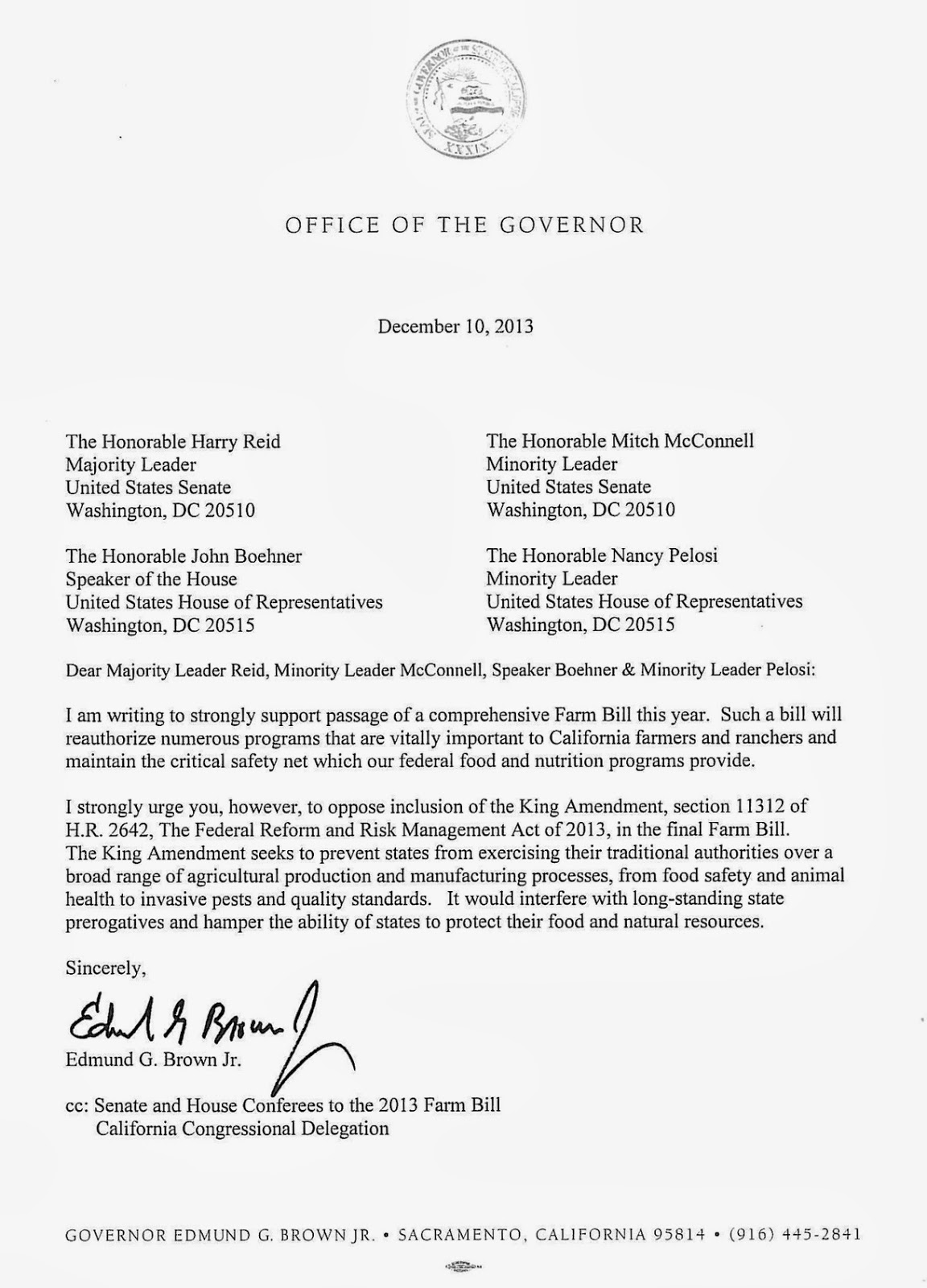
Governor Brown Urges Congress to Pass Farm Bill and Exclude King Amendment

Posted by the CDFA TODAY, California Governor Edmund G. Brown Jr. has sent the following letter about the Farm Bill to Congressional leadership in Washington D.C.

2016-05-31T19:42:28-07:00December 17th, 2013|

Almond Conf. Was Best Yet

Almond Industry Conf. Was Best Conference Yet


(From the Almond Board of California)
Roger Duncan UC Pomology Farm Advisor, Stanislaus
visits with attendees during the poster session of Meeting.
A quick survey of attendees reveals a general opinion that the 41st Annual Almond Conference, held Dec. 3–5, was the best ever, thanks largely to the spacious Sacramento Convention Center with its roomy trade show floor, banquet hall and meeting rooms, and the wide-open gathering spots for meeting and greeting. Add to that the stellar downtown Sacramento location, with a plenitude of hotels and restaurant choices, and you have the perfect setting for a successful event. 
But the venue tells only half the story. What went on within the walls is the other half. This year, the program was expanded to include workshops all afternoon on Tuesday, and again on Thursday during lunch. 
Guest speakers covered everything from the water situation to financial modeling, with irrigation strategies, nitrogen budgeting, marketing programs and a host of other topics eagerly received by growers, handlers and allied industry members. The “speed dating” six-minute research updates followed by the poster session both Wednesday and Thursday were well attended.

The Conference went out with a bang on Thursday evening, with a trio of master comedians provoking nonstop laughter from the record crowd at the Gala Dinner.

As one member of the audience said, “The comedians were talented, witty and kept you so engaged that I never found myself looking at my phone to see what time it was. Everyone I spoke with following the dinner said they enjoyed it immensely. Driving home, we recounted the jokes line after line and laughed all the way home!”

Polaris RANGER Side x Side Delivered to Turlock
 Thursday, Dec. 5, was a lucky day for Pat Wilkey of Turlock. Her entry was drawn from hundreds deposited in the back of a Polaris RANGER 400 UTV at The Almond Conference, where Polaris Industries Inc., and the Almond Board teamed up to provide the versatile UTV giveaway.

Pat and her husband, Jack, grow almonds in Turlock, and are also owners of Wilkey Industries, which provides processing equipment to handlers. The company was one of many exhibitors at the trade show that ran concurrently at The Almond Conference, which has grown substantially since the event was moved to the Sacramento Convention Center with its larger facilities.

2016-05-31T19:42:28-07:00December 17th, 2013|

STOP CRISIS FOR CALIF. DAIRY FAMILIES

Assemblyman Adam Gray:

Need to Stem the Tide of Dairies Going Under


(From Western United Dairymen)

The economic multiplier effect of the dairy industry is not just a statistic to Assemblyman Adam Gray (D-Merced). His grandfather started Merced Dairy Supply and his father Robert continued the business. Gray’s first job at the dairy supply store was washing storage barrels and loading feed bags, an experience that helped him learn about the local economy from the ground up.

Assemblyman Adam Gray (D-Merced


Discussing the economic crisis facing California dairy families, Gray told Western United Dairymen in an interview this week, “Dairy families are continuing to struggle and go out of business. As someone who represents a large dairy area, I am very concerned about the industry’s future.  We need to stem the tide of all these dairies folding and going under.”


Economic reports show that California’s dairy industry contributed $63 billion in economic activity to the state. According to the California Milk Advisory Board, in 2008, the latest year for which figures are available, the dairy industry created a total of 443,574 jobs in California, approximately 3 percent of the total overall job production for the year. The 2008 report shows that for every single “on-the-farm” job, 22 additional “beyond-the-farm” jobs are created.


Gray testified at a CDFA hearing held in September in support a petition filed by WUD and other dairy producer groups for emergency price relief. His remarks focused on the economic impact to the communities that surround dairies. “I spoke about the economics of the issue and I spoke from the heart,” said Gray. “I know from growing up and working at a dairy supply business how many small businesses are supported by dairy. There are so many related businesses that depend on the success of dairies. In the absence of these dairies, you are going to see these businesses go under as well.”


When the CDFA issued its decision to extend the current temporary price relief for all classes of milk, there was disappointment expressed by dairy producers. Gray shares that sentiment. “My expectation was that they would take some action to create additional equity and stem the tide of all these dairies folding and going under.”


The task ahead is to educate legislators about the dairy industry and its economic factors, said Gray.  “I’m not sure there is clear path forward but I am going to be a tireless advocate for the dairy industry,” he said. “I am constantly educating my colleagues about the dairy industry and its complex pricing issues. There are so many who do not understand the industry and I am talking to them about the industry and its needs. But the need remains for additional education of state elected officials and dairy producers have an important role to play,” points out Gray.


“My best advice is for WUD members to help in educating legislators. WUD does a great job of advocating for its members. You have to be even more determined and more persistent but not just with valley legislators. We have put in whatever extra effort is needed to advocate for why we need a solution.”


Gray said he “absolutely” sees a need for Governor Brown to be involved in finding a solution to the industry’s pricing crisis. “Ultimately, he is the top executive and it is important that the governor be part of the solution.”


“Because of his family’s background in the dairy supply business, the personal nature of the dairy crisis hits him constantly,” said Gray. “Each and every month, people are on the brink of losing their family farm. Whole communities are being hurt. This is a real crisis with broad implications and we have to figure out a way to find a solution, either administratively or through legislation.”

2016-05-31T19:42:28-07:00December 17th, 2013|

Citrus Freeze Damage High

Citrus Freeze Damage Could be

30 Percent-Plus!

Tom Wollenman, Vice President of LoBue Brothers Citrus in Lindsay, told California Ag Today that it was a very hard freeze for a substantial amount of time, and it appears that we will definitely have 30 percent damage or more on 80 percent of the fruit that is hanging.

“In early December, we had four or five cold nights across a large area of the industry with 27 degrees or below from midnight to about 6 am,” Wollenman said.

“Everyday, we are getting closer to a more accurate assessment of the damage,” he noted

Wollenman said that there has been conjecture that the cold weather may have killed Asian Citrus Psyllid populations in the Central Valley. “We do not know for sure, but   hopefully it will put a dent on any resident populations,” he said.

2016-05-31T19:42:28-07:00December 16th, 2013|

BIG WATER MEETING TOMORROW

California Legislators to Hold Drought and Environmental Regulation Press Conference 


Westlands Water District announced TODAYthat Congressman Valadao and Senator Fuller will hold a press conference in Bakersfield TOMORROW to discuss the severe consequences related to the drought.
Following the release of a letter to Governor Brown and President Obama led by Valadao and Fuller, lawmakers will gather to highlight affects the drought, made worse by environmental regulations, is having on California’s Central Valley and to call on President Barack Obama and Governor Jerry Brown to take immediate action to address the water shortage.
Event Details: 

Event:     Californian Water Press Conference

Date:       Tuesday, December 17, 2013
Time:      11:30 AM PT – 12:15 PM PT

Where:    Kern County Water Association
                3200 Rio Mirada Drive, Bakersfield, CA  93308
Who:       Congressman David G. Valadao (CA-21)
                Senator Jean Fuller (SD-18)
                Jim Beck; General Manager, Kern County Water Association
                Ron Jacobsma; General Manager, Friant Water Users Authority

                David Vink; General Manager, Lower Tule River and Pixley Irrigation Districts
                Jason Peltier; Chief Deputy General Manager, Westlands Water District

For more information regarding the press conference, please contact Anna Better at (202) 815-1685.

Congressman David G. Valadao represents the 21st Congressional District, which includes Kings County and portions of Fresno, Tulare and Kern Counties.  Senator Fuller represents the 18thSenate District which includes Kern and Tulare Counties and parts of Inyo and San Bernardino Counties.

2016-05-31T19:42:28-07:00December 16th, 2013|

Video Highlights Cropping Systems

Conservation Agricultural System Innovations

Video Highlights Recent Workshops

A video has been released by the UC Davis Conservation Agricultural System Innovations (CASI) that offers great information on two workshops that took place at a recent workshop in Five Points, Calif.

In the video Jay Fuhrer of the USDA NRCS office in Bismarck, ND and Brendon Rockey, a farmer from Center, Co. explained some intriguing work with their cropping systems that could be of interest to California growers.

These workshops attracted over 150 participants and generated many good ideas and interactions between attendees.

CASI thanks all who took part and also extend our warm CASI gratitude to Jay and Brendon for taking the time to share their experiences with us. 

2016-05-31T19:42:28-07:00December 16th, 2013|

Fight For Water Film Awarded Best Documentary

Fight For Water Film Wins Best Documentary

Recognition Comes From Monarch Film Festival


The award winning, Fight for Water Film: A Farm Worker Struggle, was shown Dec. 11 in Pacific Grove at the Lighthouse Cinemas, 525 Lighthouse Ave. 

The Fight For Water Film documents the struggle of two farmers, and thousands of farm workers on the Westside, Fresno County, in 2009 when there was only a 10 percent water allocation.

Filmmaker/ Director Juan Carlos Oseguera

Filmmaker/Director Juan Carlos Oseguera focuses on the 50-mile historic water march in his film, the only film that documents this journey that brought more than 1,000 farmers and farm workers from all over the state.

The film also records the many food lines that became necessary in towns such as Firebaugh, Mendota, San Joaquin and Huron. Farmworkers, though humiliated, were forced to resort to these food lines due to the high unemployment that reached in excess of 40 percent as a consequence of the non-irrigated fields.

Ironically, though The Fight For Water Film documents this event in 2009 and 2010, nothing has changed. In fact, farmers in the Westside Federal Water Districts are currently facing what could be an even worse year in 2014. The Bureau of Reclamation has warned that if there is not significantly more than average rain and snowfall this winter, there could be an unprecedented zero allocation.

No water allocation may force many farmers out of business and cause massive unemployment in the Westside communities already suffering from severely reduced water allocations. This season, farmers received only 20 percent of what they needed and paid for.

Oseguera said, “I have found that Californians outside of the Central Valley, and Americans out of state, are unaware of the plight of farmers and farmworkers here. So, we need to expand distribution of the film to educate everybody.”

“There is growing interest from film distributors to advance the film to wider audiences,” said Oseguera. “A good way to tell the distributors that the film needs to be seen by others outside of California is to like the Fight For Water Facebook page,” he noted.

2016-05-31T19:42:28-07:00December 14th, 2013|

Growing Numbers to Stop Ethanol Mandate

Western Dairymen Praises Bill To Stop Corn Ethanol Mandate

Legislation introduced this week by Senators Dianne Feinstein, Tom Coburn (R-Okla.) and eight cosponsors to eliminate the corn ethanol mandate has won strong support from Western United Dairymen. “We are pleased to support Senator Feinstein’s continued efforts on eliminating the mandate for corn ethanol. She was instrumental in seeing the ethanol subsidies expire and we believe that she will be just as successful with this effort,” said Western United Dairymen CEO Michael Marsh.

“This legislation provides a simple, effective solution to the problems caused by corn diverted to ethanol, driving up feed costs and consumer prices for meat, milk and energy,” continued Marsh. “California dairy families who are suffering from continued high feed prices support this effort to eliminate the federal corn ethanol mandate from the Renewable Fuels Standard (RFS), while maintaining provisions designed to grow the low-carbon biofuel industry.”


The Renewable Fuels Standard (RFS), created in the Energy Policy Act of 2005 and revised in 2007, requires refiners and blenders to use 16.55 billion gallons of renewable fuel in 2013. More than 13 billion gallons of this total will be met by the use of corn ethanol, a level that will increase in subsequent years.


The RFS also sets a target for 36 billion gallons of renewable fuels blended into gasoline by 2022 with the corn ethanol mandate scheduled to reach 15 billion gallons by 2015. Each year, EPA issues RFS rules with increasing volumes of renewable fuel blending that also include cellulosic and advanced biofuels that do not compete as feed sources.


Feinstein said the bill supports development of advanced biofuels, including those made from soybean oil, grasses and trees. But it would eliminate the mandate for corn-based ethanol, which currently represents the vast majority of biofuels produced in the United States. She said the corn mandate diverts a large proportion of the U.S. corn crop towards making fuel, raising animal feed and food prices.


In introducing the bill, Senator Feinstein said, “Under the corn ethanol mandate in the RFS, roughly 44 percent of U.S. corn is diverted from food to fuel, pushing up the cost of food and animal feed and damaging the environment. Oil companies are also unable to blend more corn ethanol into gasoline without causing problems for automobiles, boats and other vehicles. I strongly support requiring a shift to low-carbon advanced biofuels.” Feinstein added, “But a corn ethanol mandate is simply bad policy.”


Senator Coburn said, “The time to end the corn ethanol mandate has arrived. This misguided policy has cost taxpayers billions of dollars, increased fuel prices and made our food more expensive. Eliminating this mandate will let market forces, rather than political and parochial forces, determine how to diversify fuel supplies in an ever-changing marketplace. I’m grateful my colleagues on both sides on the aisle are prepared to take this long-overdue step to protect consumers and taxpayers from artificially high fuel and food prices.”


Cosponsors of the bill are Richard Burr(R-N.C.), Susan Collins (R-Maine), Bob Corker, (R-Tenn.), Kay Hagan (D-N.C.), Jeff Flake (R-Ariz.), Joe Manchin (D-W.Va.), Jim Risch (R-Idaho) and Patrick Toomey (R-Pa.).


This action eliminates the unnecessary pressure on corn prices, allowing the multi-billion dollar corn ethanol industry to compete directly with oil based on price and quality, not mandates.


Refiners will continue to blend corn ethanol into the fuel supply in the absence of a mandate, as ethanol is the preferred octane booster used to increase the efficiency of gasoline. Even without a mandate for its use, the economic benefits of mixing ethanol into gasoline would remain.


This proposal has strong support from dairy; beef; poultry; the prepared food industry; oil and gas; engine manufacturers; boaters; hunger relief organizations; and environmental groups. A list of endorsing organizations can be found here.


Sources:

2016-05-31T19:42:28-07:00December 14th, 2013|

ARB Meeting Shows Industry Concerns

ARB holds Truck and Bus Regulation Workshop;

WAPA’s Roger Isom Testifies

Western Agricultural Processors Association (WAPA) attended ARB’s presentation TODAYregarding their proposed amendments to the Truck and Bus Regulation. Agenda items included overview of the current rule, the new proposed amendments, and a chance for stakeholders to voice their concerns.

The meeting was extremely well attended with over 70 concerned individuals in attendance. WAPA’s President, Roger Isom testified at the workshop noting troubles with the diesel particulate filters and proposed several changes to the current regulation.

Isom’s proposed changes to ARB staff included extending the sign up period for compliance extension, extending compliance dates for Ag categories, and extending the trade up program from 2014 to 2018.


In conjunction with the meeting was the deadline for Prop 1B funding through the SJV Air Pollution Control District that helps owners by replacing older trucks or engines.

More information about the Truck and Bus Regulation is available on ARB’s website: www.arb.ca.gov/dieseltruck. Questions regarding reporting can be directed to trucrs@arb.ca.gov. Lastly, questions regarding the regulation and compliance can be answer at ARB’s hotline at 866-6-DIESEL or through email at 8666diesel@arb.ca.gov.

2016-05-31T19:42:29-07:00December 13th, 2013|
Go to Top