RAISIN INDUSTRY LOSES A LEADER

The Raisin Industry Mourns the Passing of Ernie Bedrosian
Linda Kay Abdulian, President/CEO, National Raisin Company issued the following message:
It is with great regret and sadness I inform you that early morning January 1st, Raisin Industry Icon, Family Patriarch and Co-Founder of National Raisin Company, Ernest Bedrosian passed away. 
As all of you know, Ernie was an exceptionally gifted leader whose boundless energy galvanized the Raisin Industry and led to so many accomplishments and contributions including the formation of the Raisin Bargaining Association.  Throughout his life, Ernie genuinely cared about the industry as a whole, from grower to handler to customer.  Uncle worked tirelessly to develop new markets and establish the California Raisin as the Premier Dried Fruit globally.  We all knew Ernie as a dynamic and charismatic person, who many called a “tiger” but whose work ethic benefitted us all. 
From the entire Bedrosian Family we thank you for your thoughts and prayers.  Funeral arrangements will be announced shortly.

Gary Schulz, President and General Manager California Raisin Marketing Board
2016-05-31T19:42:22-07:00January 4th, 2014|

Earl Williams Noted as a Uniter

California Cotton Ginners and Growers Associations Announce the Retirement of President/CEO Earl P. Williams

It was announced TODAY, that after an incredible career that has spanned two decades at the California Cotton Ginners and Growers Associations, Earl P. Williams has retired effective December 31st.  For more than twenty years Earl has seen many successes, not the least of which was achieving 100% membership in both the Ginners and Growers Associations on a voluntary basis.  

When Earl started at the Associations in 1993, only 60% of the cotton growers in the state were members and only 85% of the cotton gins were members.  Unheard of with organizations that aren’t mandatory check-off programs, the 100% membership in the two associations is a testament to the success the Associations have enjoyed under Earl’s leadership. 

Preparing and submitting numerous Section 18’s for critical crop protection chemicals, the passage of several industry related legislative bills (module truck axle weights, truck tractor/trailer type vehicles as implements of husbandry, etc.), getting the gins on agricultural rates in the PG&E and SCE territories, and the passage of the partial sales tax exemption for tractors, parts and fuel for agriculture are just a few of the critical highlights that occurred during his storied career.  

Earl had the uncanny ability to bring diverging opinions together and unite them towards a common goal. 


This characteristic was evidenced in the opening of the one variety law, and dealing with tough issues like sticky cotton, pima prep and seed coat fragments.  At a special event celebrating his retirement, Williams was recognized for his outstanding career with the first ever California Cotton Ginners and Growers Associations’ Lifetime Achievement Award! 

On behalf of the entire membership, staff and Boards of Directors of these Associations, we wish to thank Earl for all that he has done for the California Cotton Industry and wish him the very best in his future!   He will truly be missed!

Effective January 1, 2014, Executive Vice President Roger A. Isom will assume the duties of President/CEO of the California Cotton Ginners and Growers Associations. 

2016-05-31T19:42:22-07:00January 4th, 2014|

Bare Ground and Very Little Snow Found

First Snow Survey of 2014 Shows Dry Conditions California Braces for Possible Third Dry Year


SACRAMENTO – As California’s dry weather pushes into the new year, the Department of Water Resources (DWR) today announced that its first snow survey of the winter found more bare ground than snow.


Manual and electronic readings record the snowpack’s statewide water content at about 20 percent of average for this time of year. That is a mere 7 percent of the average April 1 measurement, when the snowpack normally is at its peak before melting into streams and reservoirs to provide a third of the water used by California’s cities and farms.


“While we hope conditions improve, we are fully mobilized to streamline water transfers and take every action possible to ease the effects of dry weather on farms, homes and businesses as we face a possible third consecutive dry year,” said DWR Director Mark Cowin. “And every Californian can help by making water conservation a daily habit.”


The last time California’s statewide snowpack was this dry was in 2012 when it also was 20 percent of the historical average. The readings today and in 2012 are the driest on record.


Today’s electronic readings indicate that water content in the northern mountains is 11 percent of normal for the date and 4 percent of the April 1 average. Electronic readings in the central Sierra show 21 percent of normal for the date and 8 percent of the April 1 average. The numbers for the southern Sierra are 30 percent of average for the date and 10 percent of the April 1 average.


In addition to the sparse snowpack, many areas of California ended calendar year 2013 with the lowest rainfall amounts on record. Normally one of California’s wettest spots with an average annual rainfall of nearly 100 inches, Gasquet Ranger Station in Del Norte County ended the year with only 43.46 inches. Sacramento, which normally gets about 18 inches, ended up with 5.74 inches of precipitation. And downtown Los Angeles, which since 1906 has averaged 14.74 inches of rain, ended the year with 3.4 inches, beating the previous low of 4.08 inches recorded in 1953.


DWR and cooperating agencies conduct manual snow surveys around the first of the month from January to May. The manual measurements supplement and check the accuracy of real-time electronic readings.

Results of today’s manual readings by DWR off Highway 50 near Echo Summit are as follows:

Location

Elevation

Snow Depth

Water Content

% of Long Term Average

Alpha

7,600 feet

7.9 inches

2 inches

15

Phillips Station

6,800 feet

9.3 inches

2.3 inches

20

Lyons Creek

6,700 feet

15.4 inches

3.6 inches

31

Tamarack Flat

6,500 feet

inches

inches

Missing


Historic Comparison

The average January 1 snowpack water content at Phillips Station is about 12 inches and the April 1 average 27.6 inches. Phillps had its lowest water content reading of 0.1 inch in 2012, in a snow depth of only 0.6 inches. On January 2 last year (2013) at Phillips there were 12.1 inches of water in 48.8 inches of snow. Besides 2012, the driest years at Phillips were 1987 (0.9 inches of snowpack water content), 1981 (2 inches), 1976 (2.7 inches) and 2000 (3 inches). 

Records at Phillips go back 50 years.

DWR currently estimates it will be able to deliver only 5 percent of the slightly more than 4 million acre-feet of State Water Project (SWP) water requested for calendar year 2014 by the 29 public agencies that collectively supply more than 25 million Californians and nearly a million acres of irrigated farmland. It is hoped the initial 5 percent delivery estimate – tied with calendar year 2010 for the lowest initial allocation ever — will increase as winter storms develop. The initial 2010 delivery estimate, made on the heels of the 2007-2009 drought, was eventually increased to 50 percent as winter storms developed.

The final SWP allocation for calendar year 2013 was 35 percent of the slightly more than 4 million acre-feet requested. In 2012, the final allocation was 65 percent. It was 80 percent in 2011, up dramatically from an initial allocation of 25 percent. The final allocation was 50 percent in 2010, 40 percent in 2009, 35 percent in 2008, and 60 percent in 2007. The last 100 percent allocation – difficult to achieve even in wet years because of Delta pumping restrictions to protect threatened and endangered fish – was in 2006.


DWR weather watchers note that it’s early in the season and this winter could still turn out wet. The concern, however, is that irrigation-dependent San Joaquin Valley farms and some other areas will be hard hit if we have another dry year without the cushion of reservoir storage that we had in calendar year 2013 due to the storms in late 2012 before California began sliding toward drought.


Lake Oroville in Butte County, the State Water Project’s (SWP) principal reservoir, today is at only 36 percent of its 3.5 million acre-foot capacity (57 percent of its historical average for the date). Shasta Lake north of Redding, California’s and the federal Central Valley Project’s (CVP) largest reservoir, is at 37 percent of its 4.5 million acre- foot capacity (57 percent of average for the date).


San Luis Reservoir, a critical south-of-Delta reservoir for both the SWP and CVP, is a mere 30 percent of its 2 million acre-foot capacity (43 percent of average for the date) due both to dry weather and Delta pumping restrictions last winter to protect salmon and Delta smelt. Delta water is pumped into the off-stream reservoir in winter and early spring for summer use in the Bay Area, San Joaquin Valley, Central Coast and Southern California.


The continuing dry weather prompted Director Cowin on December 13 to mobilize DWR’s drought management team “to offset potentially devastating impacts to citizen health, well-being and our economy.”

Governor Edmund G. Brown Jr. has united DWR and other agencies in an Interagency Drought Task Force.


DWR and other agencies will streamline transfers of water from areas of relative abundance to areas of critical need, monitor water supply impacts in small rural communities whose groundwater sources are stressed by prolonged dry conditions, and take other steps to mitigate the effects of dry weather.


Electronic snowpack readings are available on the Internet at:

http://cdec.water.ca.gov/cdecapp/snowapp/sweq.action

Electronic reservoir readings may be found at:

http://cdec.water.ca.gov/cdecapp/resapp/getResGraphsMain.action

2016-05-31T19:42:23-07:00January 3rd, 2014|

BIG WATER RALLY JAN. 16TH AT STATE CAPITOL

Thousands Needed to Voice Immediate Solutions


California Ag Today urges everyone to attend the huge Water Rally and Press Conference 11 am Thursday, January 16th at the Capitol Steps.


Bus transportation will be available from points throughout the Valley.


For further information, please contact:

Manuel Cunha at (559) 251-8468 or

Mario Santoyo msantoyo1@verizon.net
California Ag Today will be there!


2016-05-31T19:42:23-07:00January 3rd, 2014|

FACTORS INFLUENCING AVOCADO FRUIT SET AND YIELD

Guest Lecture on Avocado Fruit Set and Yield Factors


Iñaki Hormaza, Professor, La Mayora Research Station (CSIC) Malaga, Spain will guest lecture about Factors Influencing Avocado Fruit Set and Yield on Jan. 13th and Jan. 14th. 

Iñaki’s research is applicable to California Avocado growers since it is important to know why certain flowers produce fruit and others do not.


Hormaza’s research has examined the role of starch (energy) on fruit set and yield, pollen viability, pollen tube growth and ovule viability. He is also conducting research looking at pollinizers, new varieties and rootstocks. 


Pre-registration is required by Friday, Jan. 10th.  To register, contact John Cornell at 
avocadoguy@gmail.com or (360) 550 1965.


To view the full invitation, please click here.


Lecture Times and Locations: 


Monday, January 13, 2014 
9:00 a.m. – 12:00 p.m. 
Fallbrook Public Utility District (FPUD)990 E Mission Rd, Fallbrook, CA 92028 


Tuesday, January 14, 2014 
9:00 a.m. – 12:00 p.m. 
University of California Cooperative Extension Office669 County Square Dr., Suite 100, Ventura CA 93003


This event is sponsored by: California Avocado Society, California Avocado Commission, Del Rey Avocado Co., Eco Farms, Hofshi Foundation, Index Fresh, University of California

2016-05-31T19:42:23-07:00January 3rd, 2014|

GRAPE MARKET INSIGHTS

Domestic Grape Market Challenges Imports

Produce industry veteran Rick Eastes continues to have great insight on the evolving grape market.

Availability of heavier late-season grapes from California in early January could create some marketing tension between domestic and imported grape supplies, Eastes believes.

There are many newer and later season varieties from California still in the marketplace and will be there for weeks.

The heavy late season grapes could be in the way of product coming from Chile and other areas in the Southern Hemisphere. Whether or not the U.S. supply will cause tension is not known.

Consumers can help by buying an extra bunch and taking them home to eat.
2016-05-31T19:42:23-07:00January 3rd, 2014|

California Ag News on Ag Crime

Ag Crime Alert

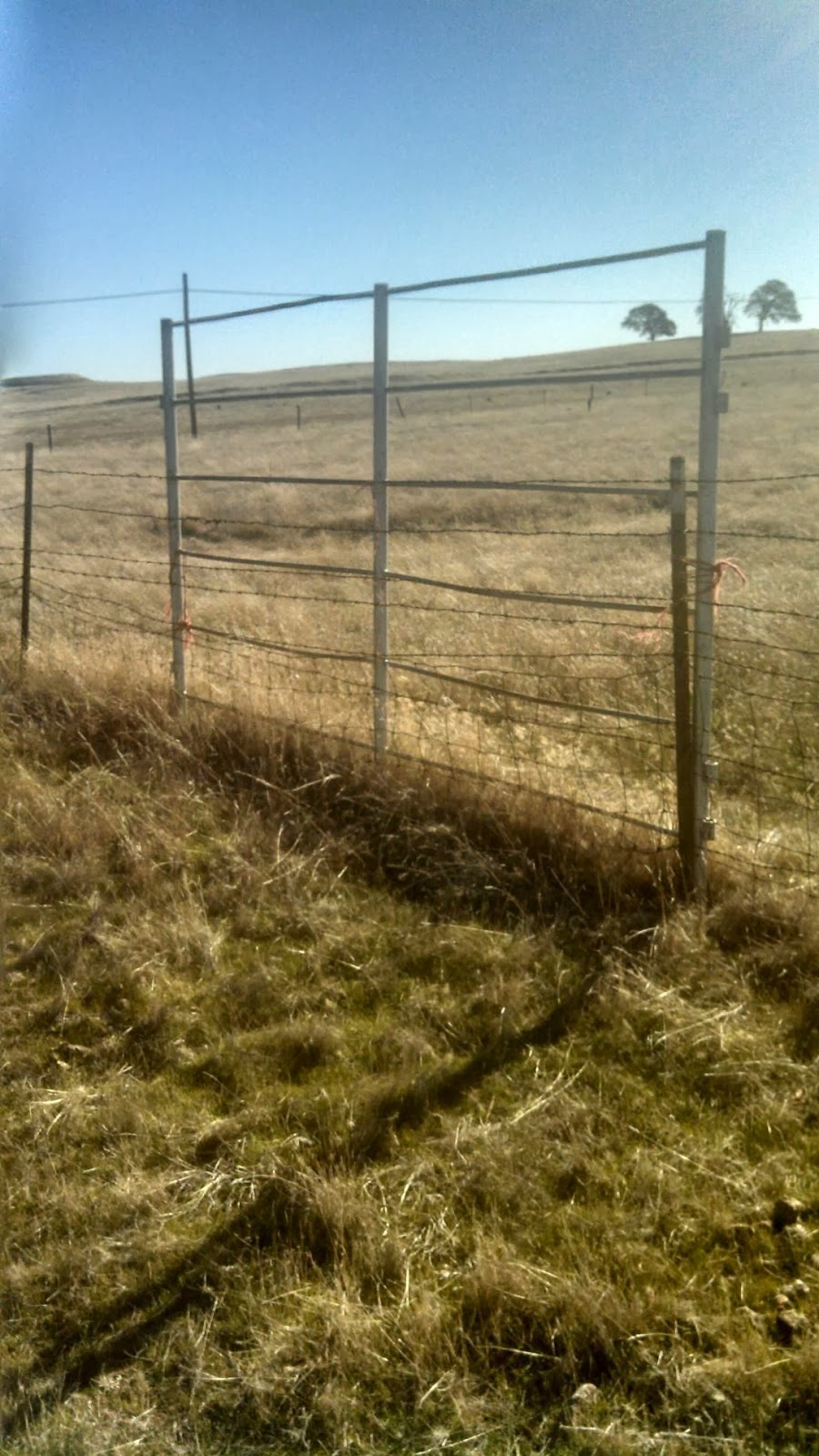
Image shows what Stolen Panels
look like.

Fence Panels Stolen in Yuba County

A Yuba County rancher has reported that 20 or more of his aluminum panels have been stolen. 

The panels were grabbed sometime last week in the Yuba Goldfields by Hammonton and Smartville Road.

If you have any information please contact the Yuba County Sheriff’s Department (530) 749-7777.

2016-05-31T19:42:23-07:00January 2nd, 2014|

APPLY FOR USDA EASEMENT PROGRAM

2014 Farm and Ranch Easement Program Applications Due February 14

Land trusts and other eligible entities interested in permanently protecting farm or ranchlands in California are encouraged to submit applications to the USDA Natural Resources Conservation Service (NRCS) Farm and Ranch Lands Protection Program (FRPP) by Feb. 14, 2014.
“We are excited to announce that we have significantly more funds available than in previous years to permanently protect farms and ranches for future generations,” said Carlos Suarez, NRCS state conservationist in California. Six million dollars are available to permanently protect farm and ranchlands throughout California.

FRPP is a voluntary easement program that helps farmers and ranchers keep their land in agricultural production. The program provides matching funds to State, Tribal, or local governments and nongovernmental organizations with existing farmland protection programs to purchase conservation easements.

Landowners interested in the FRPP must first work with one of these eligible entities with funds necessary to match the federal contribution from NRCS. The permanent conservation easements protect agricultural land and important farmland soils, by prohibiting conversion to non-agricultural uses.

While NRCS accepts FRPP applications throughout the year, the agency plans to make 2014 funding decisions from the pool of applications received by February 14. As with all NRCS easements, the landowner retains the title to the land and the right to control access and recreational use. The land remains on the tax rolls.

In 2013, NRCS funded $4.2 million in FRPP easements to protect eight agricultural properties, in six counties. In total, 3,000 agricultural acres were protected helping to sustain farming in California.

Since its inception in 1935, NRCS has worked in partnership with private landowners and a variety of local, state and federal conservation partners to deliver conservation based on specific, local needs.

2016-05-31T19:42:23-07:00January 2nd, 2014|

California Ag News: Eric Mussen to Retire

Eric Mussen: A Smokin’ Career at UC Davis
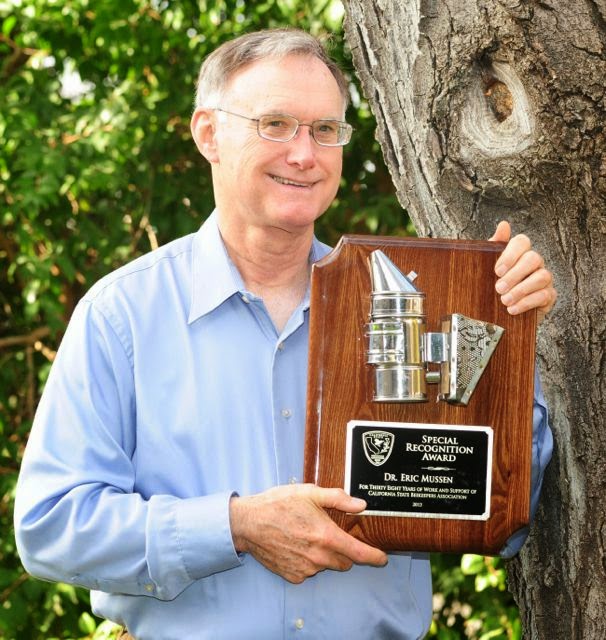
Honey bee guru Eric Mussen, Extension apiculturist at the UC Davis Department of Entomology and Nematology who will be retiring at the end of June, has seen and used many a smoker during his 38-year career.

Eric Mussen will be retiring in June 2014
Photo: Kathy Keatley Garvey

But this one is different.

In honor of his service, the California State Beekeepers’ Association recently presented him with a plaque decorated with a smoker “for 38 years of work and support.”

Throughout his career, Mussen has offered advice to scores of people and figuratively put out many a fire involving beekeeping and pollination issues.

A smoker, a device that beekeepers use to calm honey bees so they can open their hives, masks the smell of the alarm pheromones released by guard bees. It also prompts the bees to gorge on honey.

Considered by his peers as one of the most respected and influential professional apiculturists in the nation, Mussen presented a slide show of some of the highlights of his career during his two-hour presentation on “The Most Interesting Time in Beekeeping.”

“I got carried away,” Mussen said later.  “I was nearly at the end of the second hour when I was asked to wrap up my 45-minute presentation.  Many listeners said that they still hope to hear the ‘more current’ portion that had to be omitted.”

Mussen has given presentations to CSBA since joining the UC Davis faculty in 1976. He is also the organization’s apiculturist and parliamentarian and served as a delegate to the American Beekeeping Federation.

A native of Schenectady, N.Y., Mussen received his bachelor’s degree in entomology from the University of Massachusetts (after turning down an offer to play football at Harvard) and then received his master’s degree and doctorate in entomology from the University of Minnesota in 1969 and 1975, respectively.

His doctoral research focused on the epidemiology of a viral disease of larval honey bees, sacbrood virus. 

Mussen continues to tackle many new challenges regarding honey bee health and pollination concerns, including mites, diseases, pesticides, malnutrition, stress, Africanized honey bees and the successful pollination of California’s almond acreage. 

Mussen educates the beekeeping industry and general public with his bimonthly newsletter, from the UC Apiaries, which he launched in 1976. Since 1976, he has also written Bee Briefs, addressing such issues as diseases, pesticides and swarms.

The recipient of numerous state and national awards, Mussen is a worldwide authority on honey bees, said Jackie Park-Burris, a commercial queen breeder in Butte County and a past president of the California State Apiary Board.

Mussen is known for devoting his research and extension activities toward the improvement of honey bee health and honey bee colony management practices. He helps growers, consumers, UC Farm Advisors, agricultural commissioners, scientists, beekeepers, researchers, pesticide regulators, 4-H’ers, and state and national agricultural and apicultural organizations, among others.

“I am basically all pro-bee,” Mussen told the American Bee Journal in a two-part feature story published in the September of 2011. “Whatever I can do for bees, I do it…It doesn’t matter whether there is one hive in the backyard or 15,000 colonies. Bees are bees and the bees’ needs are the bees’ needs.”

Recruitment is underway for his successor, who will begin as an Extension assistant apiculturist.

2016-05-31T19:42:23-07:00January 2nd, 2014|

NOVEMBER 2013 MILK PRODUCTION STATISTICS

California Remains Top Milk Production State, Nov. 2013
Sources: 
USDA-NASS publication “Milk Production”

USDA-ERS publication: “Livestock, Dairy, and Poultry Outlook”

California Milk Advisory Board (CMAB)

CDFA

CDFA reported the top five milk production states in November 2013 were:

(Percent Change from Same Month/Previous Year)

1. California +0.6%

2. Wisconsin -0.6%

3. New York         +2.1%

4. Idaho                -1.8%

5. Pennsylvania      -0.2%

California has been the nation’s leading dairy state since 1993, when it surpassed Wisconsin in milk production. California is ranked first in the U.S. in the production of total milk, butter, ice cream, nonfat dry milk, and whey protein concentrate. California is second in cheese production.

USDA estimates overall monthly milk production across the U.S. was up by 0.1% in November 2013, compared to November 2012. California milk production increased 0.6% compared to November 2012 (on 1,000 more cows and 10 more pounds of milk per cow).

California accounts for 21% of the United States’ milk production. In 2012, California produced 42 billion pounds of milk – more than one-fifth of the nation’s total production. Approximately 40 percent of the total U.S. dairy product exports in 2012 came from California.
Dairy farming is a leading agricultural commodity in California, producing $7 billion in annual retail sales in 2012. Currently there are more than 1,500 California dairy families, whose farms house 1.82 million milk cows. Approximately one out of every five dairy cows in the U.S. lives in California.

California’s milk standards exceed federal standards because California processors add nonfat milk solids, which offer improved taste and nutritional benefits. California milk exceeds the federal guidelines for the amounts of calcium and protein in each serving.

2016-05-31T19:42:23-07:00January 1st, 2014|
Go to Top