UC Gets FAA Clearance to Research Drone Use in Ag

A UC laboratory at the former Castle Air Force Base in Atwater received clearance from the Federal Aviation Administration to fly dones at the Merced County Radio Control Club’s field, reported Thaddeus Miller in the Merced Sun-Star.

The unmanned aircraft are part of a project funded by the UC Division of Agriculture and Natural Resources that aims to study the possible use remote controlled aerial imaging to provide real-time information to farmers about water use and crop health.

The project leader, David Doll, UC Cooperative Extension advisor in Merced County, has put together a project team that includes UC Merced professors and graduate students, and UCCE advisors and staff.

Drones are also known as unmanned aerial vehicles (UAVs). Doll believes small, basic UAVs can provide a platform for imaging hardware that can vastly improve crop surveillance to enhance water usage and pest control.

Doll’s project will test the potential of UAVs for water management and pest monitoring. He also plans to write a curriculum to extend information to farmers and demonstrate the use of small, remote controlled aerial vehicles as imaging platforms.

UC Merced also has other plans for using drone technology in research. They are seeking FAA approval to fly the aircraft over the university’s protected land, which includes 6,500 acres of grassland and vernal pools.

Dan Hirleman, dean of UC Merced’s School of Engineering, said the university’s use of drones and development of new technology could set it apart from other schools.

“We’re kind of at the ground zero for a lot of what’s going on in those areas,” he said. “It’s just a perfect fit with our sustainability theme and the application area.”


2016-05-31T19:34:22-07:00June 25th, 2014|

Could more dryland farming be in California’s future?

By Todd Fitchette; Farm Press Blog 

Slate.com’s “Thirsty West: The No-Water Way” is the latest in a string of popular press articles to suggest that California might be better off relying less on irrigated agriculture and more on dryland farming.

Generations ago, California settlers and residents established a system of water conveyance that allowed great cities like Los Angeles and San Francisco to be built and agriculture to flourish.

Modern irrigation paved the way for greater crop yields and the ability to feed a growing society that left the farm starting with the industrial revolution.

What would an article in the popular press be without a few gross misstatements, such as the oft-repeated meme that California agriculture uses 80 percent of the state’s water supply in an average year?

This is far from an average year. Still, agriculture typically uses about 43 percent of the water allotted while 46 percent is consumed by the environment. For California, that means much of that 46 percent is allowed to flow unimpeded to the Pacific Ocean.

Urban users consume the remaining 11 percent, according to the State of California.

With no surface water allotted to much of California agriculture this year, and the ever-shrinking ground water supplies, California agriculture will have a fraction of its typical annual supply of irrigation water for the few crops farmers can maintain.

We really do not know how much remains in underground aquifers, though it’s a safe bet to suggest “not enough.”

The premise behind dryland farming comes at a time when drought awareness has increased, though not entirely in practice as California lawns remain watered and cars are washed in driveways.

While dryland farming has its challenges, maybe it’s time for modern agriculture to consider the benefits of the water-thrifty practice and tackle the challenges with all the fervor of a sergeant told by his lieutenant “that can’t be done!”

While dryland farming is utilized to a small extent in California, its close cousin could be the no-till practices recommended by researchers Jeff Mitchell of the University of California.

Mitchell continually promotes the benefits of no-till and strip-till conservation practices that help hold in soil moisture and provide a host of other benefits to growers. He’ll readily admit there are challenges under California’s current farming systems.

While farmers elsewhere in the U.S. successfully employ the practice, California farmers seem reluctant to do the same.

Still, Mitchell works with California growers to employ conservation tillage practices that work and to transform machinery used in standard farming practices to achieve results.

Since Mitchell works with UC Cooperative Extension, his efforts move beyond the purely academic to the practical.

As California agriculture continues to seek ways to be as water thrifty as possible, and new technologies are developed to meet those ends, we need not be so quick to say “that won’t work” and instead embrace ideas that right now might only be a “what-if” conversation between a third-year undergrad and her college Ag professor.

2016-05-31T19:35:22-07:00June 24th, 2014|

UC Davis Soil Symposium Showcases California Innovation

A big soil health symposium was held at UC Davis last week, and there was lot to learn for everyone in the industry.

Brian Leahy is Chief of the California Department  of Pesticide Regulation in Sacramento, which hosted the one day event. Leahy noted those in attendance were innovative and pioneering.

“In the room I think we had some of the most creative farmers, creative researchers, and creative private companies on the planet. These people are some the most amazing farmers that only California produces, and they were here I think as problem solvers. We know we need to understand soil better. What’s going on in the soil? And how do we work with it? said Leahy. “What we heard was a lot of  amazing activities that are taking place right now. Lot of great questions asked, its unbelievable the kind of research is going on. I think it was a very productive day.” he added.

Brian Leahy (left) speaking with Malcolm Ricci, of Bolthouse Farms of Bakersfield.

Brian Leahy (left) speaking with Malcolm Ricci, of Bolthouse Farms of Bakersfield.

In those attending the symposium, also learned some things they didn’t know.

“And that was the goal, we were trying to figure out, how do we build the support to get long term sustainable funding to better understand soil health. You know understanding soil and what’s going on in soil life, its one of the last frontiers in how were going to make incredible progress in how we feed people, how we take care of the planet, and how we take care of each other. Just layering all the other amazing research going on right in plant genetics. and plants on top of soil its going to be another revolution. I heard Warren Buffett’s son called it the “Brown Revolution”. said Leahy.

And think of that really important topsoil, 1 and half feet around the planet, that supports us all.

“We heard from the Noble Foundation and the soil renaissance, its a national movement as well, where people are realizing that we have to take care of the soil and work with soil, to really take care of the human race, to feed us, clothed us, all of that. So there is a lot of promise here.” said Leahy.

2016-05-31T19:35:23-07:00June 23rd, 2014|

Seven Central Valley Cooperative Extension Academics to Retire in June

Seven Valley UC Cooperative Extension Academics Retire at the end of June

Seven University of California academics will retire June 30 after decades of service to UC Cooperative Extension in the San Joaquin and Sacramento valleys.

The 2014 valley retirees are:

Gregorio Billikopf, labor management farm advisor, UC Cooperative Extension in San Joaquin, Stanislaus and Merced counties 33 years
Billikopf’s extension and teaching efforts focused on employee selection, wage structures, interpersonal negotiation skills, conflict resolution and mediation. He received the “best publication” award from the National Association for County Agricultural Agents for his book Labor Management in Agriculture: Cultivating Personnel Productivity, as well as awards from other professional organizations.

Billikopf said he cherishes his years as a farm advisor and now will return to his native Chile to provide community mediation and labor productivity training.

Alejandro Castillo, dairy farm advisor, UC Cooperative Extension in Merced County
12 years

Castillo served as dairy advisor for 12 years, having joined UC Cooperative Extension from a research and extension job in Santa Fe, Argentina. His work in California was focused on dairy cow nutrition and environmental concerns, nutrient balance and nutrient excretion, with special attention to nitrogen and minerals. During his tenure he published more than 100 articles (18 peer-reviewed papers, 30 scientific abstracts and technical articles, and more than 50 newsletter, newspaper and magazine articles).

“I do want to thank the many dairy producers in Merced County and my UC colleagues who have helped me with my extension and research program,” Castillo said. “Their help was critical to doing my part for the future of our dairy industry.”

Carol Frate, field crops farm advisor, UC Cooperative Extension in Tulare County
36 years

Frate has conducted extensive research on the production of alfalfa, dry beans, sugarbeets and corn. Among the highlights of her career were trials to identify blackeye bean varieties resistant to Fusarium wilt, early research on deficit irrigation of alfalfa and work on corn stunt disease.

“It has been a great gift to work with my UC colleagues and people in allied industries,” Frate said. “And I could not have done the work I did without the assistance and patience of farmers, farmworkers, custom applicators, custom harvesters and truckers who made on-farm research projects successful.”

Michelle Le Strange, vegetable crops and environmental horticulture advisor, UC Cooperative Extension in Tulare County
31 years

Le Strange is an accomplished advisor in vegetable crop production, turfgrass and ornamentals, and weed management. She also founded and organized the Tulare/Kings Master Gardener program, guiding volunteers as they reach out to home gardeners to encourage sustainable landscaping by “Gardening Central Valley Style.”

“In this career the more you get your hands dirty, the more you learn, and the more knowledge you have to share with others,” Le Strange said. “I was thrilled working with some of the largest vegetable producers in the state and simultaneously helping the home gardener. It was always a stimulating challenge.”

Yvonne Nicholson, nutrition, family and consumer sciences advisor, UC Cooperative Extension in Sacramento County
22 years

Throughout her career, Nicholson has been involved with UC faculty in conducting nutrition and health applied research focusing on the African-American, Latino, Russian and Vietnamese cultures.

Larry Schwankl, UC Cooperative Extension irrigation specialist in the Department of Land, Air and Water Resources at UC Davis, based at the UC Kearney Agricultural Research and Extension Center in Parlier
28 years

Schwankl’s research emphasis has been in drip, sprinkler, and flood irrigation. He has worked on irrigation system maintenance and chemigation, irrigation scheduling using soil moisture monitoring and evapotranspiration techniques.

Dorothy Smith, nutrition, family and consumer sciences advisor, UC Cooperative Extension in El Dorado, Amador, Calaveras and Tuolumne counties
12 years

Smith’s areas of expertise include human nutrition, food safety and human health and well-being. During the latter half of her tenure, Smith has focused on building a school garden program in the Central Sierra region because, she said, “growing something is a great way to make sure you are eating healthy.”

“I have really enjoyed the opportunity to work in the foothills with small, rural counties,” Smith said. “We have been able to make some significant changes that affect the whole community.”


2016-05-31T19:35:23-07:00June 19th, 2014|

Farming in Drought: Tomato Growers Embrace the Heat

By Sarah Trent; Pacific Coast Farmers’ Markets Association

In late May, UC Davis published a drought impact report projecting 410,000 acres of farmland left fallow, 14,500 jobs lost, and a $1.7 billion hit to our state’s agricultural economy.

Since tomatoes can be a water-intensive crop, I expected that when I set out to ask farmers about the drought’s effect on their tomatoes, I would hear they were planting less, anticipating smaller yields, making changes to their seed orders for next year, and worrying about the future of their farms.

The truth?

“To be honest,” said Phil Rhodes of Country Rhodes Family Farm in Visalia, “this is our best year ever.”

Like many farmers, Rhodes is very concerned about water — the water level in his well has dropped about a foot a year since the 1990s, to the point where he must invest upwards of $50,000 to drill it deeper in the next year — but for now, the heat accompanying the drought has been a boon to his tomato crop, which came in early and strong. Rhodes brought his first tomatoes to farmers’ markets in mid-May, several weeks earlier than normal.

As long as he has water in his well, Rhodes’ farm is not impacted by water rationing by local or federal water districts. Farmers who rely on water from those sources are facing more dire circumstances: Rhodes admits that in the southern Central Valley region where his farm is located, he sees other farmers leaving fields unplanted.

Those unplanted fields may mean that vegetable farmers who have ground water access, farm in areas less impacted by the drought, or whose infrastructure, climate, and soil conditions allow for less water usage will see increased demand for their crops. So while the drought has substantial implications for California agriculture on the whole, farmers like Rhodes are doing well in spite or even because of it.

Ron Enos, who owns certified organic Enos Family Farms in Brentwood, also expects he’ll have a good year with his tomatoes. In his region, many of his neighbors are larger-scale farms growing processing tomatoes, which means that demand for his fresh tomatoes is high.

While the high-heat conditions accompanying the drought spelled trouble for his winter and spring vegetables (which do best in cooler conditions), the hot dry summer bodes well for his summer crops.

He also uses less water than many farmers in his region: over the last few years, Enos has transitioned to using a black plastic mulch in combination with drip irrigation for many of his crops, which cut his water usage to about 30 percent of what he needed before.

Another method for using less water on fruiting crops like tomatoes and squash is dry farming: a method of cutting irrigation early in a plant’s life and forcing it to rely only on existing soil moisture. Some vegetable varieties do especially well in these conditions, which result in smaller, more flavorful fruit.

While it’s near impossible to dry farm in the extreme climate of the Central Valley, it works well in coastal regions where the soil retains some moisture through the summer.

2016-05-31T19:35:24-07:00June 19th, 2014|

Homeowners: Your Gardeners Need License to Apply Pesticides

Homeowners Urged To Make Sure Gardeners Who Apply Pesticides Have License

The California Department of Pesticide Regulation (DPR) is urging all homeowners to check that their maintenance gardener (landscaper) has a state maintenance gardening (MG) pest control business license from DPR if they are occasionally applying pesticides on their lawns. Homeowners can do so on the DPR website’s License and Certificate Holder List Page.

“Homeowners may not realize that maintenance gardeners are applying chemistry to their lawns,” says DPR director Brian Leahy. “We want to try and ensure they are doing so in a responsible manner.”

The license ensures that the person applying pesticides has been properly trained to use them on lawns and garden areas. If used properly, pesticides should not cause harm to humans or pets. However, improper use may result in illnesses or environmental problems.

Pesticides used on lawns and gardens may be washed to street storm drains and into local rivers, streams and even sensitive wetlands miles away. This may impact aquatic life.

“Your lawn may only be a small piece of land, but collectively, California lawns amount to many acres,” said Leahy. “Homeowners can play a significant role to reduce the amount of pesticide pollution (runoff) from lawns that are entering our waters through storm drains.”

Under California law, anyone who applies pesticides, even if it is only incidental to other maintenance gardening tasks, must have this DPR maintenance gardening pest control business license and be registered with the local county agricultural commissioner’s office.

In California, there are about 100,800 landscapers employed in the public and private sector who are responsible for maintaining homes, parks, golf courses, schools and plantings around malls, offices, restaurants and other locations.

Learn more about how your landscapers can obtain a certificate/ license at
 http://www.cdpr.ca.gov/docs/license/maintgardeners.htm


2016-05-31T19:35:24-07:00June 19th, 2014|

UPDATE: ACP Quarantine and Advocacy for Unimpeded Eradication

by Laurie Greene, Editor

CDFA filed a proposed emergency amendment TODAY to expand the ACP quarantine area in response to an “infestation” of the Asian citrus psyllid (ACP), Diaphorina citri, detected in the Farmersville/Visalia area (June 4, 2014), Tulare County. One adult female was found in the area. The proposed 14-mile expansion will include the Visalia area, and the state’s vast ACP quarantine will cover 46,544 sq. miles.

CDFA Secretary Karen Ross

CDFA Secretary Karen Ross

The regulation defines emergency as” a situation that calls for immediate action to avoid serious harm to the public peace, health, safety, or general welfare.” The government code provides,”if the emergency situation clearly poses such an immediate, serious harm that delaying action to allow public comment would be inconsistent with the public interest, an agency is not required to provide notice.”

CDFA Secretary Karen Ross believes that this emergency clearly poses such an immediate, serious harm that delaying action to give the notice would be inconsistent with the public interest. Therefore, Ross proposed that the CDFA Director may adopt reasonably necessary measures such as bypassing the mandatory notice five working days prior to emergency action in order to carry out emergency provisions. Additionally, she requested that the Director be permitted to establish, maintain, and enforce quarantine, eradication, and such other regulations necessary to circumscribe and exterminate or prevent the spread of any pest which is described in the code.

This comes after the California Citrus Industry’s recent backlash against the Executive Committee of the California Citrus Pest and Disease Prevention Committee’s proposed easing of the state’s ACP quarantine and eradication efforts.

Joel Nelsen, CA Citrus Mutual President

Joel Nelsen, CA Citrus Mutual President

And, while CDFA uses the word, “infestation”, Joel Nelsen, President of California Citrus Mutual, commented at the recent United Fresh Convention in Chicago, “There were two more ACP finds found in the northeast part of Tulare County. They were individual finds. Intensive trapping and tapping on the trees, looking for the ACP, hasn’t found any more. So one would argue that we’ve got a population—given the finds in the last year—but we’re still talking single digits.” Nelsen believes this demonstrates the eradication programs are working. “We’re supposed to find the ACP before finds a commercial citrus industry, and we’re doing that.”

Nelsen said the Executive Committee’s recent proposal to significantly modify the program was, “based upon some subjective analysis by a team of scientists who in fact believe that there’s more out there than what we can find.”

“So,” he continued, “we’re obligated to prove a negative; and as long as we do the intensive trapping program, as long as we continue the mandated treatment program, as long as we’re aggressively looking for the Asian citrus psyllid—I don’t see how, and industry doesn’t buy into the fact, you have an endemic population. We’re not finding them in volume; everything is isolated.”

“So, when the industry first became aware of this possible change in the treatment zones of the quarantine mandates, the industry challenged CDFA.”

Now, not only does the ACP program remain intact, but TODAY, CDFA Secretary Ross proposed measures for an unhindered and  immediate eradication response by CDFA to ACP discoveries.

Featured Photo Credit: Ted Batkin, Citrus Research Board, “Invasive Pests in California” 1/10.

2016-05-31T19:35:24-07:00June 18th, 2014|

From Service to Harvest – Military Veteran Deploys Aquaponics on the Farm

By: Blair Anthony Robertson; Sacramento Bee

Farming wasn’t Vonita Murray’s first choice, but after making a drastic career change, the 38-year-old Navy Veteran, former office manager and longtime fitness enthusiastic now believes digging in the dirt, growing food and being her own boss may be the dream job she has always wanted.

The transition to farming for Murray, 38, happened gradually over the past several years. She eventually took stock of her life, sized up her talents, sharpened the focus on her dreams and decided she was no longer cut out for a desk job.

For several years, Murray had been an office manager and a CAD, or computer-assisted design, technician for an architecture firm. Much of her work focused on remodeling floor plans for a major fast food chain’s Northern California stores. But when the economic downturn hit the architecture and design industry, Murray got laid off. She saw it as a chance to make a change in her life.

“It was the best thing that ever happened to me,” she said.

Using a $5,000 grant she received from the Davis-based Farmer Veteran Coalition, Murray bought some basic farm equipment and managed to launch her new career. She also enrolled in the first class of the California Farm Academy, a six-month farming course run by the Center for Land-based Learning in Winters.

Murray knows it will take hard work and several years before she can make a comfortable living as a farmer. But she has a long-term plan and says farming – including many 12-hour days – is exactly the lifestyle she was seeking.

“I’ve never been so tired, so broke and so happy,” she said with a laugh. “For the first time in my life, I have worth and a purpose. What I do has value in people’s lives.”

More and more veterans are turning to farming to connect in a similar way. “We’re all a family and we all try to help each other succeed,” Murray said.

When Michael O’Gorman founded the Farmer Veteran Coalition in 2009, he searched throughout the U.S. and found just nine veterans interested in going into farming. By the end of that year, the number was up to 30. These days, O’Gorman and his group have helped 3,000 veterans transition into farming.

“What’s really attracting veterans to agriculture is it offers a sense of purpose and a sense of mission,” said O’Gorman, who has farmed for 40 years. “It’s about feeding their country, offering food security and a better diet.”

O’Gorman is seeing more women get into farming and says Murray is a great role model.

“Vonita is dynamic, creative, energetic and smart. Whatever she does, she will do it well and take it places,” he said. “She’s a growing phenomenon. About 15 percent of those who serve in the military are women and that’s about the same percentage we hear from.

More and more women are going into agriculture. The military and farming are both male-dominated. The women who have taken on both of them just seem like a really exceptional group.”

Those who encounter Murray are often impressed by her energy and her holistic, lead-by-example approach to farming. Not only does she want to grow good food, she sees the work she does as a way to help people be healthy.

Indeed, Murray’s physical presence says plenty. Though she no longer trains as a bodybuilder, she remains noticeably lean and muscular. Her workouts these days focus on functional training and she is a big advocate of Crossfit, which combines classic weightlifting with mobility exercises.

“I’m doing all this because I want to get people healthy,” said Murray, noting that she hopes to someday build an obstacle course on the property so people can use it to work out.

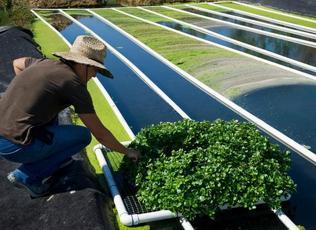
She also has a penchant for unorthodox and innovative approaches to growing food. Standing on a portion of the land she leases in rural Elverta next to the renowned Sterling Caviar facility, Murray watches water stream past. It’s runoff from the tanks where sturgeon are raised for their prized caviar. It’s also the key to what she will grow on her new “farm” site.

Murray essentially harnesses the water, 3 million gallons a day and loaded with nutrients, to create an innovative style of growing food called aquaponics, which combines modern hydroponics with forward-thinking environmental awareness.

The water goes through a settling pond to separate solids from liquids, travels through a moat and into small ponds where Murray is growing produce she sells to restaurants and to a growing number of customers at the Saturday farmers market in Oak Park.

The outgoing and optimistic Murray has put some of her energy into tapping resources that can help get her going in farming. She obtained a $35,000 low-interest loan from the U.S. Department of Agriculture.

Murray, whose produce operation is going to specialize in watercress, says she would have been at a loss as to how to proceed as a farmer without the education she got at the California Farm Academy. The program costs about $2,600 and various grants subsidize the tuition, according to Dawnie Andrak, director of development for the Center of Land-Based Learning.

Those who enroll run the gamut of age and work background. About 20 students graduate each year. To make it a real-world experience, they write a business plan and present it to a panel composed of people from the banking, business and farm community.

“There are more women like Vonita getting into farming,” Andrak said. “You will not find someone more dedicated and more clear about what it is she wants to do. She is certainly not one to give up.”

Jennifer Taylor, the director of the Farm Academy, is herself an example of a woman who made the career leap into farming. She was a research biologist who had no idea until well after college that a life in agriculture might appeal to her. She landed a four-month internship on a farm, was given four calves and eventually rented a barn and started dairy farming.

“If you have no connection to agriculture, it’s very difficult to imagine yourself doing it, Taylor said. “It’s a way many people want to live, an opportunity to be your own boss, work outside with your hands and be your own boss.”

But can you make a living?

“That depends,” said Taylor, noting that one young farmer from the program now sells to about 50 Bay Area restaurants and nets about $75,000 a year.

Back in Elverta, Murray is busy tending her crops and her chickens. She’s not making a profit yet, but she knows it takes time. More than anything, she loves the work, the lifestyle and the mission. She sometimes feels the stress of having debt and not knowing whether her crops will thrive.

But her farm is called Thrive Acres for a reason.

“You have to keep dreaming,” she said with a smile. “This is just the beginning.”


2016-05-31T19:35:25-07:00June 17th, 2014|

Chocolate Company Looks to California for Ingredients

A major candy company always looks to California for a major ingredient.

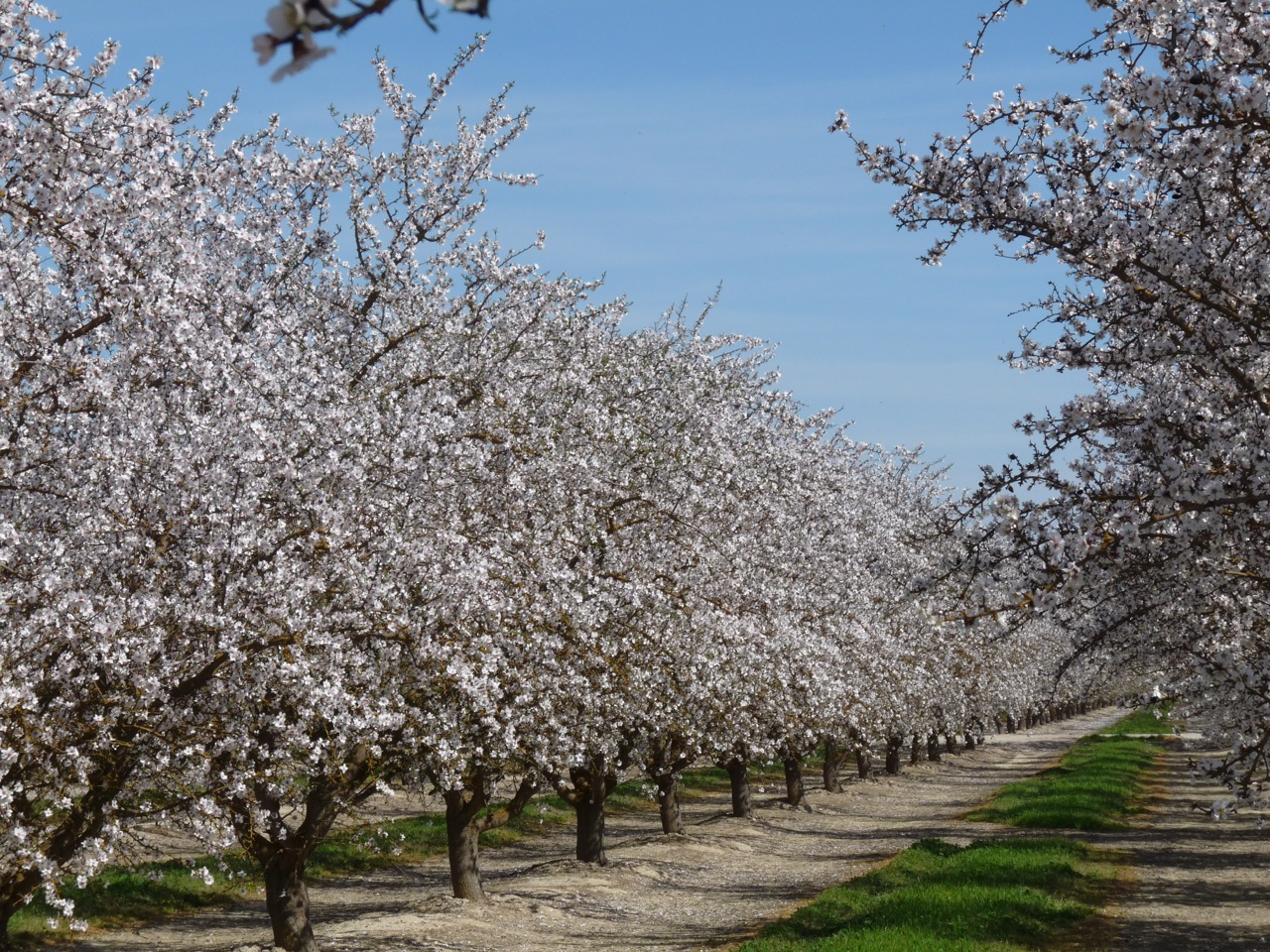
The Hershey Company looks to California almond growers’ for their most important ingredient for their products.

Jeff Beckman is the Director of Corporate Communications with the Hershey Company based in Hershey, Pennsylvania.

“In fact, they’re so important that the Hershey company is the number one purchaser of California almonds in the entire nation. It was Milton Hershey himself who in the early 20th century married almonds with chocolate and discovered something that was unbelievable and consumers today love that product and thats why we sell so many products that are a combination of delicious California almonds and chocolate.” said Beckman.

Beckman mentions the type of partnership that Hershey and the California almond industry have.

“We have a great, long relationship with the California almond industry. In fact in 2012 we opened the largest and most technologically advanced chocolate making factory in Hershey, its our new western Hershey plant,” said Beckman. “Representatives from the california almond industry came out and joined us for that opening ceremony as a sign of their commitment to our company and how important we are to the California almond industry as the number one purchaser.” he added.

Beckman said the California almonds are so important to the Hershey family, they have a team of people with a watchful eye on the state.

“California almonds are so important to us we have people on our sourcing team who are constantly keeping an eye on the California almond crop because really its such an important input to our product. he said. “Their watching the water conditions, their tracking how the pollination season is going, they are always looking at understanding what’s happening out in the Central Valley in California because thats so important to us to know that theres going to be a good almond crop each and every year.” added Beckman.

2016-05-31T19:35:25-07:00June 16th, 2014|

Ranchers Concerned About Invasion of Medusahead Weed on Foothill Rangeland

Source: Jeannette E. Warnert

One of the worst rangeland weeds in the West is aptly named after a monster in Greek mythology that has writhing snakes instead of hair.

Medusahead, an unwelcome transplant from Europe, is anathema to the cattle living off rangeland grass. The weed’s three-inch-long bristles poke and sometimes injure the animals’ mouths and eyes.

The weed is also low-quality forage for livestock. When medusahead takes over rangeland, it reduces the forage value by 80 percent.

When Fadzayi Mashiri, UC Cooperative Extension advisor in Mariposa, Merced and Madera counties, was appointed in 2013, she became the first natural resources and rangeland expert to hold the position since the retirement of Wain Johnson more than a decade before.

She polled local ranchers to determine their most pressing problems. They said weed management, and in particular, medusahead.

Medusahead is relatively easy to identify on the range. It has distinctive stiff awns and a seed head that does not break apart as seeds mature. Patches of medusahead are obvious when spring turns into summer.

“Medusahead stays green after most of the annual grasses have dried off,” Mashiri said.

Medusahead has high silica content, making it unpalatable to cattle. The silica also protects the plant from decomposition, so a thick thatch builds up on the rangeland, suppressing more desirable species, but not the germination of the next year’s medusahead seedlings.

Over the years, UC scientists have discovered a number of medusahead control strategies:

  •  Corral cows on medusahead before the plant heads out or employ sheep to graze medusahead patches. It’s not sheep’s favorite forage either, but they will eat if left with no other option.
  • Prescribed burning in late spring or early summer. However, this strategy poses air quality and liability issues.
  • Apply nitrogen fertilizer to medusahead to improve palatability before it flowers, which is showing promise for controlling the weed and boosting the value of infested rangeland.
  • Chemical control.

In spring 2014, Mashiri conducted a demonstration field trial in Mariposa County of medusahead control with the herbicide Milestone, which was developed by Dow AgroSciences mainly to control broadleaf weeds like yellow starthistle.

The trial followed rangeland weed control research done by scientists including Joe DiTomaso, UC Cooperative Extension specialist in the Department of Plant Sciences at UC Davis. DiTomaso found that the density of medusahead in treated areas declined and concluded that Milestone prevents medusahead seedlings from thriving.

Unfortunately, Milestone treatment of large rangeland areas is expensive.

“But if the value of forage declines, the productivity of livestock is compromised,” Mashiri said. “When you look at it that way, the chemical treatment might be useful.”

2016-05-31T19:35:27-07:00June 10th, 2014|
Go to Top