Netafim Rolls Out Portable Drip Irrigation Technology 

New PolyNet Flexible Piping System Provides Cost-Effective, 

Water-Saving Solution For Today’s Farms


Addressing the diverse operational and environmental needs of today’s modern growers, Netafim, the pioneers of drip irrigation, have unveiled PolyNet, a high-performance, flexible, lightweight, cost-effective, piping solution for above and below-ground agricultural drip irrigation systems.

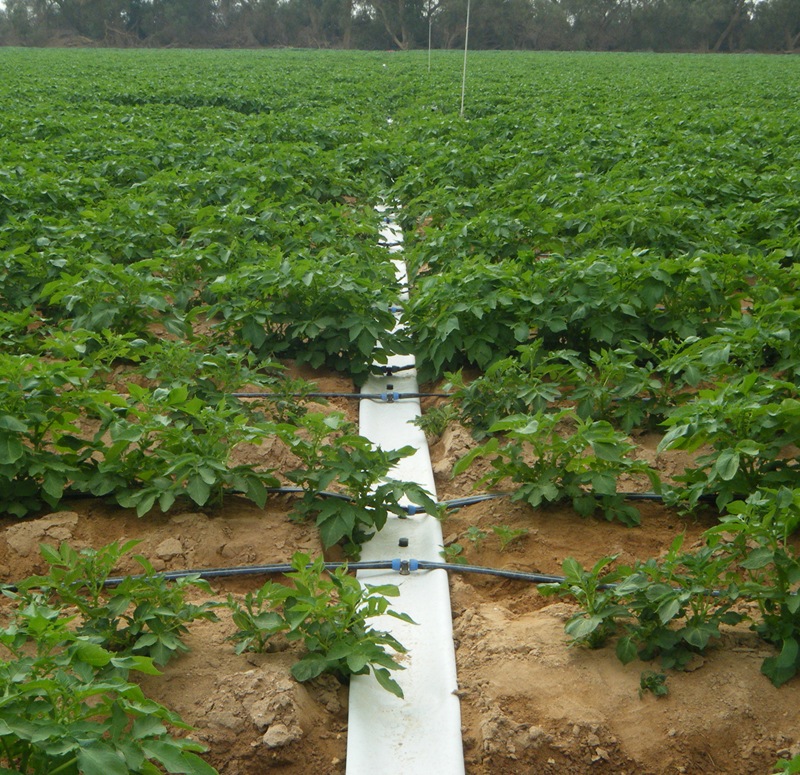
Utilizing an advanced, collapsible design, PolyNet is an innovative mainline and sub-mainline portable drip irrigation piping solution from Netafim that enables growers to easily install, recoil and relocate a drip irrigation system for use in an alternate field or different configuration.Netafim-PolyNet-Outlet

Featuring leakage-free lateral connectors and integrated welded outlets, spaced according to customer requirements, PolyNet’s advanced design provides growers with an easy-to-assemble, precise water delivery solution that lowers labor and maintenance costs, increases water savings and improves crop performance potential through enhanced system performance.

Additionally, the cost (per acre) of a PolyNet portable drip irrigation system is substantially less than a below-ground PVC system, giving producers more options when deciding on a system that is the right fit for their operation.

Netafim-PolyNet in field 2“A perfect complement to Netafim’s singular focus of providing reliable, simple and affordable irrigation solutions to help today’s farmers address the challenges of an increasingly complex industry, PolyNet enables farmers to reap the benefits of a drip irrigation system in areas where flexibility is essential,” said Ze’ev Barylka, Director of Marketing for Netafim USA. “Since first pioneering drip irrigation technology nearly 5 decades ago, the debut of PolyNet is a result of Netafim’s continued commitment to providing growers wit leading tools and technology needed to improve yield potential and productivity, while reducing costs, labor and water use.”

Available in a wide range of diameters, PolyNet’s thermostatic collapsible irigation pipe is constructed from rugged premium polyethylene materials that are designed to be versatile and durable enough to withstand the weight of heavy field machinery as well as the most stringent environmental conditions. Requiring no specialized installation tools, PolyNet is equipped with a connector kit and an array of branching and lateral fittings, making it compatible with any Netafim on-surface or subsurface (SDI) irrigation system.

For more information on PolyNet or the company’s industry leading drip irrigation products please visit www.NetafimUSA.com.

2016-05-31T19:34:18-07:00July 9th, 2014|

Proposed New Light Brown Apple Moth Quarantine Boundary – Mendocino County

Effective July 8, 2014, the Department is adding the Mendocino County Quarantine Boundary.  A map of the proposed boundary can be found at www.cdfa.ca.gov/plant/lbam/regulation.html.  The quarantine boundary is being added because a second adult Light Brown Apple Moth (LBAM) was found within three miles and one life cycle of a previous find. The new quarantine will add 14 square miles.

Regulated articles and conditions for intrastate movement under the quarantine can be found at Title 3 California Code of Regulations (CCR) section 3434.  Pursuant to Title 3 CCR section 3434 any interested party or local entity may appeal a quarantine area designation.

Process to Appeal the Proposed New Boundary

The appeal must be submitted to the Department in writing and supported by clear and convincing evidence. The appeal must be filed no later than ten (10) working days from the date of this notification.  During the pending of the appeal, the designated Quarantine Boundary under appeal shall remain in effect.

Mail Appeals to:

CDFA – Pest Exclusion
1220 N Street, Room 325
Sacramento, CA 95814

Electronic Notification of Boundary Changes

California Code of Regulation allows interested parties to be notified of quarantine area boundary changes, as well as the opportunity to submit quarantine boundary appeals.  If interested in receiving notifications, please sign up for regulatory updates through the email notification ListServ at: www.cdfa.ca.gov/subscriptions/index.html#planthealth.

For questions regarding the regulations or map, please email Dayna Napolillo (dayna.napolillo@cdfa.ca.gov) or Keith Okasaki (keith.okasaki@cdfa.ca.gov) or call (916) 654-0312.

Thank you for your attention to this timely matter.

2016-05-31T19:34:18-07:00July 9th, 2014|

California water bond: The burning questions

Source: Jeremy B. White; The Sacramento Bee

Having passed an on-time budget and concluded their committee hearings, California lawmakers have escaped Sacramento for a few weeks and retired to their districts for a July recess. When they return, much of the remaining legislative session will be devoted to trying to get a new water bond on the November ballot.

Water policy remains one of the most complex and potent topics to engulf the state Capitol. Here are some answers to the key questions in the water bond debate:

What happened to the other water bond they passed?

In the dwindling days of the 2009 legislative session, lawmakers and then-Gov. Arnold Schwarzenegger compromised on an $11.1 billion bond offering. That bond has been delayed twice and is now scheduled for the November 2014 ballot.

But the general Sacramento consensus now holds that the $11.1 billion bond is a goner: too large and too full of specific allocations redolent of pork. Gov. Jerry Brown has told lawmakers he is concerned about the 2009 proposal passing muster, and lawmakers argue it would be dead on arrival.

So what are they doing instead?

Even if they don’t like the existing bond proposal, many lawmakers still want something on the ballot. A historically intense drought can be a big motivator.

Several lawmakers have floated proposals for a new bond. Only one has made it as far as a floor vote. That measure, a $10.5 billion proposal by Sen. Lois Wolk, D-Davis, could not garner enough votes to get out of the Senate. On the day lawmakers adjourned for recess, senators announced a diminished $7.5 billion proposal.

Assembly members are hammering out their own compromise measure. They were close to introducing one earlier last week but had to go back to the drawing board. It now looks more likely they will unveil a pact once legislators return from summer recess.

What does the governor think?

For much of this year Brown declined to weigh in on a water bond. But he finally broke that silence recently and has begun meeting with lawmakers. Since the governor would need to sign any new bond, his opinion matters.

In keeping with his image as California’s responsible fiscal steward – a reputation he would like to burnish in an election year – Brown has advocated a bond that is smaller than both the $11.1 billion measure and the alternative bonds lawmakers are floating. These numbers are more starting points for negotiations than hard ceilings, but Brown suggested a bond worth $6 billion overall, with $2 billion for storage.

Surface Storage? What does that mean?

The term “surface storage” generally refers to big projects like dams and reservoirs. If California has more places to stash water in wet years, the thinking goes, it will be better equipped to survive the dry stretches. But storage could also encompass money to replenish or clean up supplies of groundwater, which California relies on more heavily in dry years.

Determining where storage dollars might go spurs fierce disputes over what types of projects could be eligible. Since all taxpayers are subsidizing them, bond-funded storage projects must carry broad public benefits.

Defining those benefits can be a problem. Bonds that list recreation as a benefit, for example, are a red flag for dam-averse environmentalists. As they note, you can’t take a boat out on groundwater.

Will a bond help with the drought?

One thing lawmakers can’t do is create more water. If rain is scarce and the Sierra snowpack is diminished, that means there’s less to go around. If big storage projects are advanced, it would still take years for construction to finish and yield results.

Other money could bolster access to drinking water. Proposals would offer grants to treat drinking water contaminated with nitrates or other chemicals, money for recycling and reusing wastewater, funding to repair water infrastructure in disadvantaged communities and support for capturing more stormwater.

What about the Delta tunnels? Will a bond pay for those?

This is a tricky one. Understanding the answer requires a brief explanation of the so-called “co-equal goals” of Brown’s Bay Delta Conservation Plan.

The centerpiece of Brown’s legacy water project would be a pair of massive water tunnels capable of funneling water to southern parts of the state without needing it to flow through the Delta. It’s very controversial. But the project isn’t just tunnels. It would also need to pay for sweeping environmental restoration to help the Delta’s teeming habitat, what’s known as “mitigation.”

That imperative of spending money on Delta habitat is affecting the water bond debate. None of the bonds would allocate money to build the tunnels. But they all offer money for the Delta. Senate President Pro Darrell Steinberg, D-Sacramento, and others point to polling suggesting that any bond that is not “BDCP-neutral” will rally the opposition and falter before voters. Brown also believes a bond must be divorced from the tunnels.

Would a bond with money for the Delta ecosystem help Brown build the tunnels? Depends who you ask. For now, Delta advocates and environmentalists believe Wolk’s bond is the most tunnel-neutral option. But some observers believe that Delta plan skeptics could frame any bond with Delta money as a boon to Brown’s tunnel dreams and hurt its chances for passage.

Are special interests involved?

Assuredly. With billions of dollars at stake, various interest groups have been making their priorities known to lawmakers. That includes environmentalists, agricultural interests, organizations like the Alliance of California Water Agencies, major urban water agencies like the Metropolitan Water District and prominent agricultural water providers like the Westlands Water District.

For the environmentalists, a key point of contention is what sort of projects a bond could fund. They don’t want to see preference given to new large-scale reservoirs, expressing skepticism that the new dams would be cost-effective and warning about environmental degradation.

Most pressing for many water districts and agencies is more money for storage. Their customers are thirsty, something they hope a bond can address. Since Brown’s tunnels have become bound up with the bond conversation, it’s worth noting that significant support for the Delta tunnels comes from exporters that would like to see a steadier flow of water.

When is the deadline?

The statutory deadline to get a new water bond on the ballot has come and gone (it was June 26). The Legislature can still waive various laws to put something before voters in November.

But elections are complex undertakings, and the civic machinery has already started whirring. The secretary of state’s office has begun assembling the voter guides that must go on public display by July 22 before being printed and mailed to voters. County election officials typically start ordering ballots to be printed in August. Those ballots have to be translated into nine other languages.

Lawmakers have options. Administrators are already allotting space for the $11.1 billion bond, so swapping out that language for a new bond would be simpler. If lawmakers take too long striking a new bond deal, they could end up having to print a second, separate voter guide. That would cost more money, potentially millions of dollars.

So the short answer is: there is no immutable deadline. But the longer lawmakers take, the more complicated and expensive it gets.

2016-05-31T19:34:19-07:00July 7th, 2014|

CDFA Official on California Farming Innovation

It is a big challenge to increase production for a hungry world.

CDFA Secretary Karen Ross spoke at a recent Soil Health symposium to discuss the critical need to increase production with less resources such as water.

“There’s a huge challenge for us to more than double our productivity and yet we are going to do it with less arable land, less available water on a global basis. So really understanding soil health and having the metrics to know what that is and what were doing is improves that as a way to maximize productivity and still get these environmental benefits that come with it. Its the demand of the time and I think California should be a leader,” said Ross.

Ross said that California has a good knowledge base to find answers.

“We’ve got some understanding world renowned Soil Microbiologists who are looking at this. But its not just going to come from academia its going to come from private companies, it’s going to come from  farmers and ranchers who are innovative themselves. And really bringing it all together, and creating that roadmap to prioritize what is it what we know? what are the gaps? How do we prioritize what needs to  happens next? and go out and seek the funding, the investment. This is a huge investment for the sustainability for our food supply and humankind,” said Ross.

Ross said that California growers are innovative in new systems of farming.

“And we see so many of our systems that are constantly adapting and seeking out the information,you know the early adopters who are willing to do some of those systems on their farm. One example is the just all the work on conservation tillage. and it usually takes a few who are willing to go first, kind of prove the concept and share it with their neighbors. Then all of a sudden it becomes the standard practice. It goes from best practices to standard practice,” said Ross.

Ross added: “But we can’t just stop with that, we have to be constantly looking at all those ways of adapting our systems.”

2016-05-31T19:34:19-07:00July 3rd, 2014|

CDFA Official on Success and Future of California Dairy

Karen Ross, Secretary for the California Department of Food and Agriculture, talks about the role of California Dairy has on the current global market, and what the future hold for the industry.

“So we really have seen a couple things going on. One is this huge constant demand for California milk-based products. the export markets looking for powders, they can’t get enough powders, they have huge confidence in the food safety of our milk production here, we‘re strategically located,” said Ross. “So that demand has really drive up prices, but at the same time fortunately for us our friends in the Midwest had great corn and soybean harvest and so those grain prices had moderated so that farmers are finally to the point where their realizing some margins and they need to rebuild their equity,” she added.

Ross mentions that industry leaders are already looking towards the future.

“We also to the credit of the leaders and the producers and processor community, are still meeting as part of their California Dairy Futures Task Force, and we actually have a couple different proposals for some reform to of our pricing system going forward, that we are taking a deeper dive in. We have some economists that are doing some analytics on that and concurrently the cooperative continues to work on the petition and we will find out people are willing to consider seriously going into a federally milk marketing order. ” said Ross.

Ross explains some aspects of the dairy industry need to change.

“So I think its healthy for the industry now that we have some margins in the business and to really think about our future and this almost 60-year old pricing system, and what works, and we want to retain and where we need to create some flexibility so that we can be very competitive  and maximize our opportunities in the export market.” said Ross.

2016-05-31T19:34:20-07:00July 3rd, 2014|

State Must Use Caution on Groundwater Management

By Danny Merkley; Ag Alert 

In the face of the California water crisis, many in the state Legislature appear to be rushing toward new groundwater management policy that could threaten certain property rights and the overlying groundwater rights of landowners.

Generally, legislation that has been introduced would require groundwater basins to be managed “sustainably” by local entities but would authorize the state government to step in if the local entities do not adopt management plans with certain components by a specified time.

Farm Bureau and other agricultural organizations continue to urge the Legislature to proceed with caution on the issue of groundwater management. Failure to take adequate time to address this complex issue could lead to huge, long-term impacts on farms and on state and local economies.

People’s livelihoods and jobs are definitely at stake. All involved in the effort to better manage groundwater need to focus on future ramifications of the various authorities and directives being considered.

Groundwater management is as diverse and complex as the 515 distinct basins and sub-basins in California. For that reason, Farm Bureau believes groundwater must be managed locally or regionally, while protecting overlying property rights. To their credit, most of the pending measures do provide for local management, but working out the details is certainly a challenge.

With members of the Legislature feel the need to do something about groundwater, Farm Bureau is working with other agricultural stakeholders and decision-makers to identify a path forward toward a reasonable and workable groundwater management system.

We have repeatedly stated that the reason we face groundwater challenges is not due to a lack of regulation, but because of lack of availability of surface water. It must be recognized that the state’s increased reliance on groundwater for growing food, fiber and other agricultural commodities has resulted not just from drought, but from restrictive environmental laws, court decisions, regulatory actions and “flashier” river systems, as watersheds receive rain instead of snow.

All of those factors have reduced availability of surface water—surface water that would help recharge groundwater basins and allow farmers to reduce their reliance on groundwater. Farm Bureau strongly believes groundwater recharge should be established as a beneficial use of water.

The reasonable and beneficial use of groundwater is a basic property right under California law. These rights must be recognized and respected under any groundwater-management framework. This does not mean that areas with significant overdraft issues should be ignored, but that in dealing with these areas, current groundwater rights must be protected.

It also needs to be recognized that restricting the use of groundwater has broad economic consequences for agricultural communities and the farm families, farmworkers and the related support, processing and supply enterprises in those communities. Drastic changes in groundwater policy will impact land values and the ability for farmers and ranchers to secure adequate financing, both for land acquisition and for operating expenses.

Appropriate protection of groundwater resources for future generations must be carefully thought out, not rushed through the legislative process to meet arbitrary deadlines. There’s no good time for hurried legislation, but during a critical drought year, when canals and ditches are dry and groundwater is the lifeline for farms, is absolutely the wrong time.

Please contact your representatives in the state Legislature to urge them to proceed carefully on new groundwater legislation, and to take the time necessary to adequately deliberate the issues and to identify and balance the benefits and risks going forward.

2016-05-31T19:34:20-07:00July 3rd, 2014|

Specialty Crop School July 14-17 to Tour SJV Crops

San Joaquin Valley Specialty Crop School is July 14-17.

A compelling line-up of tours and speakers has been planned for the July 14-17 San Joaquin Valley Specialty Crop School.

This session will provide outstanding opportunities to delve into California specialty crop agriculture with its unique challenges and rewards. Tours will include almond and pistachio operations, citrus packing, table grapes and university research sites. Speakers will include Westlands Water District Public Affairs Director Gayle Holman and Mary Lou Polek with the Citrus Research Board.

This three-day course, organized by Visalia-based AgBusiness Resources has been designed to equip participants with a broad understanding of intensive crop production in California’s San Joaquin Valley- home to more than 300 different agricultural crops.

The classes will be of value to those new to horticultural crop production as well as seasoned agri-business professionals.

Pest Control Advisors and Certified Crop Advisors in attendance will receive 15 PCA and 15 CCA continuing education units.

Class size will be limited and seats are available on a first come first served basis. Early bird registration deadline is June 20.

The Salinas Valley Specialty Crop School will be Oct. 6-9.

For information about both schools, go to www.specialtycropschool.com.

2016-05-31T19:34:20-07:00July 3rd, 2014|

California Leads Nation in Floriculture Production – From the USDA’s National Agricultural Statistics Service

California’s floriculture crop leads the nation with a value of $1.13 billion in sales, according to a new report from the USDA’s National Agricultural Statistics Service (NASS).

In 2013, California producers increased their sales from $1.10 billion to $1.13 billion, an increase of 3 percent, giving California 26.6 percent of the total U.S. wholesale value.

California cut flower production accounts for 78.2 percent of the total cut flower wholesale value. The $327 million value was down 2.7 percent from the 2012 value of $337 million.

California leads the nation in potted flowering plant values for 2013 with a total value of $297 million, a 17 percent increase in value from $253 million in 2012. California potted flowering production accounted for 38 percent of the 15-state wholesale value.

The top cut flowers in California are lilies, daisies, roses, chrysanthemums and snapdragons. The top potted flowers are orchids, roses, poinsettias, spring bulbs and chrysanthemums. The top garden plants are vegetable varieties, pansies/violas, petunias, impatiens and marigolds.

2016-05-31T19:34:21-07:00June 27th, 2014|

TV Campaign for ‘Grapes from California’ Kicks Off on Food Network

A new television campaign for ‘Grapes from California’ launched in June on the Food Network.

“These commercials showcase the natural beauty, easy versatility and great taste of California grapes while communicating the value of sharing life’s special moments with family and friends, and the care that growers put into growing,” said Kathleen Nave, president of the California Table Grape Commission.

One of the two new commercials has a grower theme and the other has a dinner party theme. Watch them here: www.grapesfromcalifornia.com.

These 30-second commercials, the first two of a planned series of six, are seen during shows like, “Trisha Yearwood’s Southern Kitchen,” “Sandra’s Money Saving Meals,” “Home for Dinner with Jamie Deen,” and “Diners, Drive-ins & Dives.”

The Grapes from California commercials will run through December and and will be used in future seasons.

2016-05-31T19:34:21-07:00June 26th, 2014|
Go to Top