Everyone Plays a Part in Protecting California Citrus

Protecting California Citrus

By Victoria Hornbaker; Ag Alert 

Recently, the U.S. Department of Agriculture released its final crop estimate for the Florida orange crop, reflecting a reduction of 30 million cartons in total production from the previous season. There is no denying the devastating impact that Huanglongbing has had on the Florida citrus industry since the disease was first discovered in 2005. A drive through Florida citrus country will offer vastly different scenery than that of California’s premier citrus-producing regions.

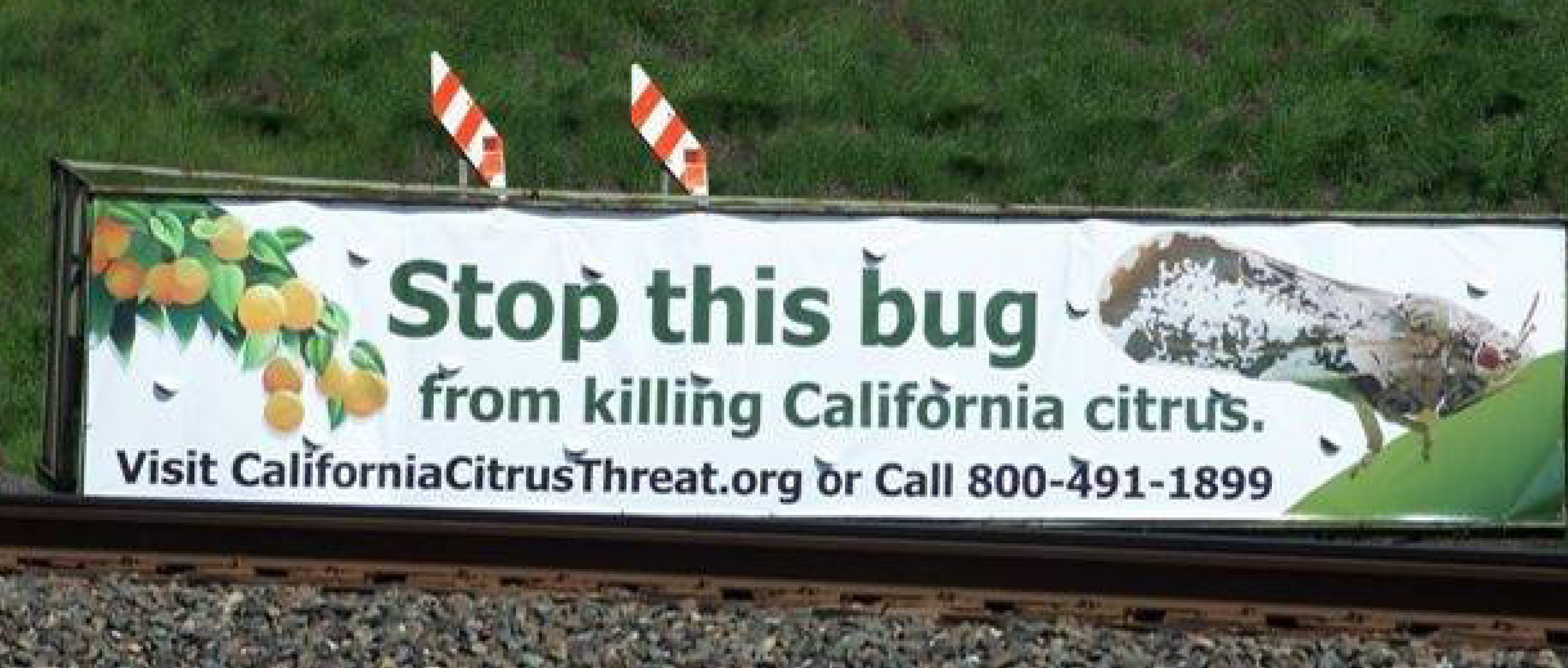
In some respects, the California citrus industry has been fortunate to learn from the situation in Florida and has taken a very proactive approach to protect itself from a similar fate. In 2009, the industry supported a mandatory self-assessment to fund a comprehensive treatment and trapping program to manage the insect carrier of HLB, the Asian citrus psyllid, and prevent HLB from taking hold.

The Asian citrus psyllid is now endemic throughout a majority of Southern California, particularly in dense, urban areas where citrus trees can be found in six out of every 10 backyards. In March 2012, HLB was discovered for the first time in a backyard citrus tree in Los Angeles County. Although there have not been any additional confirmed cases of HLB since then, as an industry we must remain vigilant statewide in order to protect our $2 billion citrus crop.

Currently, there are eight counties in California that are entirely quarantined for the Asian citrus psyllid: Imperial, Los Angeles, Orange, Riverside, Santa Barbara, San Bernardino, San Diego and Ventura. Additionally, portions of Fresno, Kern, San Luis Obispo and Tulare counties are also under quarantine for the Asian citrus psyllid.

The total quarantined area statewide is now 46,530 square miles. Maps are available online at www.cdfa.ca.gov/plant/go/acp-quarantine.

With a large portion of the state’s commercial citrus production now within quarantine zones, it is increasingly important that growers and packers are up to date on current regulations and protocols, to best manage psyllid populations and prevent the pest from spreading any further.

There are two approved options under the Bulk Fruit Movement Performance Standard available for commercial citrus growers and packers to comply with the quarantined regulations: Remove all leaves and stems/plant debris using a field cleaning machine, or apply a University of California integrated pest management-recommended material within 14 days prior to harvest.

There are no restrictions on moving fruit with leaves and stems if shipping to a packinghouse or processing facility located within the same quarantine boundary.

Asian citrus psyllids can easily “hitchhike” on citrus plant debris, so it’s important that we all do our part to minimize the movement of plant material between work sites. It is strongly recommended that growers and packers work with farm labor contractors, picking crews, pesticide applicators and hedging/topping services to ensure that all equipment, picking bags, field bins, clothing and gloves are free of stems and leaves before leaving the field.

We all have a commonality in agriculture and can understand the pressures posed by invasive insects and diseases. This is a fight that no commodity can win without the support of homeowners and consumers, which is why everyone with a backyard citrus tree should:

  • Not move citrus—Do not move citrus plants, plant material or fruit into or out of a quarantine area or across state or international borders.
  • Inspect your trees—Inspect your citrus trees for signs of the psyllid or HLB whenever watering, spraying, pruning or otherwise tending to trees.
  • Plant responsibly—Plant trees from reputable, licensed California nurseries.
  • Talk to your local nursery—Ask about products that are available to help stop the Asian citrus psyllid.
  • Graft with care—Use only registered budwood that comes with source documentation.
  • Be mindful of clippings—Dry or double-bag plant clippings prior to disposal.
  • Cooperate—Cooperate with agricultural officials who are trapping and treating for the Asian citrus psyllid.

By working together, we can help stop the Asian citrus psyllid and protect California citrus from Huanglongbing.

2016-10-14T21:15:31-07:00July 28th, 2014|

Global Food Safety Agreement Signed by China and UC Davis

Officials from China’s Northwest Agricultural and Forestry University in Shaanxi province, and the University of California, Davis, signed a memorandum of agreement on July 23, 2014 that lays the groundwork for establishing the Sino-U.S. Joint Research Center for Food Safety in China.

The signing ceremony was held in the city of Yingchuan, China, during a meeting between high-level officials of the U.S. Department of Agriculture and China’s Ministry of Science and Technology.

“Today’s agreement is a landmark event for UC Davis and for our World Food Center and serves as yet another indication of our worldwide leadership in food and health,” said UC Davis Chancellor Linda P.B. Katehi. “We are incredibly pleased to join forces with Northwest A&F University and look forward to making discoveries and realizing solutions that will promote food safety in China and around the world.”

Signing the agreement today were Harris Lewin, vice chancellor of research for UC Davis, and Wu Pute, professor and vice president of Northwest Agricultural and Forestry University. Also present were Catherine Woteki, undersecretary for research, education and economics at the U.S. Department of Agriculture; and Vice Minister Zhang Laiwu of China’s Ministry of Science and Technology.

The memorandum of agreement, which will extend over the next five years, calls for the center’s two lead universities to form a joint research team and research platform, carry out collaborative research projects and cooperate on other food safety-related projects. UC Davis’ World Food Center will identify a director to coordinate the research program. The Chinese partners will provide substantial funding for the new center, with details to be announced this fall.

“This is clear evidence that the entire UC system is fully committed to be front and center on the critical issues of food security, sustainability and health,” said UC President Janet Napolitano. She recently launched the UC Global Food Initiative as a systemwide collaboration to put the world on a path to feed itself nutritiously and sustainably.

Both the Sino-U.S. Joint Research Center and the UC Davis World Food Center will contribute to the UC Global Food Initiative.

“With UC Davis’ commitment to food safety research and China’s ever-increasing demand for food, the Joint Research Center is a natural partnership,” said Karen Ross, secretary of the California Department of Food and Agriculture. “Food safety will benefit from global scientific collaboration, and new findings will help the food and agriculture sector meet new challenges, improve the health of consumers and maintain the integrity of the global food supply chain.”

Roger Beachy, executive director of the UC Davis World Food Center, noted that the new food safety center is a logical outgrowth of many well-established research collaborations between scientists from UC Davis and China.

“Working closely with Chinese scientists and policymakers, the new center will have significant impacts on food safety in China and elsewhere around the globe,” he said.

Beachy said that the catalyst for the new collaborative effort was a visit to China last fall by Chancellor Katehi. During that visit, Chinese officials and UC Davis alumni identified food safety as a topic of key importance for China. Beachy, who has longstanding ties with China’s research community, became head of the World Food Center in January and has shepherded the collaborative agreement for UC Davis.

About the new food safety center

The Joint Research Center for Food Safety will promote international collaborative research and extension for food safety in China and the U.S. It will conduct research on global food safety-related policies; establish an international, high-level research platform for food safety research; propose solutions for hazards in the food-industry value chain; and develop models for implementation of international food safety standards and risk management. UC Davis and Northwest Agricultural and Forestry University will engage other research faculty from the U.S. and China in the new center.

Students from both UC Davis and China will be offered opportunities to study and train in each other’s countries. UC Davis faculty members currently have extensive collaborations with several Chinese universities, and the new joint research center is intended to expand these and initiate new activities.

On the September 12, 2014 celebration of the 80-year anniversary of the founding of China’s Northwest Agricultural and Forestry University, working details for the new center will be laid out.

“The food industry has become the largest industry in China; and food safety is a critical area for China and the U.S. to have creative cooperation and learn from each other,” said Zhang Laiwu, China’s vice minister of science and technology. “It not only involves technologies, but also policies and management. The fruitful cooperation will also be important to ensure food security.”

He added that the new cooperative agreement among UC Davis, Northwest Agricultural and Forestry University, Yangling National Agricultural High Tech Demonstration Zone, and Zhuhai Municipality of China is a creative platform for cooperation in improving food safety.

World Food Center at UC Davis and the UC Global Food Initiative

The World Food Center at UC Davis was established in 2013 to increase the economic benefit from campus research; influence national and international policy; and convene teams of scientists and innovators from industry, academia, government and nongovernmental organizations to tackle food-related challenges in California and around the world.

The UC Global Food Initiative is building on existing efforts such as the World Food Center and other endeavors at UC Davis, while creating new collaborations among the 10 UC campuses, affiliated national laboratories and the systemwide division of Agriculture and Natural Resources to support healthy eating, sustainable agriculture and food security. More information about the UC Global Food Initiative.

Other food-related collaborations with China

UC Davis faculty are currently involved in numerous collaborative research projects in China, including four food-safety efforts that specialize in the genomics of food-borne diseases, dairy safety, waterborne diseases and livestock, and environmental chemicals.

Additionally, the campus hosts the BGI@UC Davis Partnership, which focuses on genome sequencing, and the Confucius Institute, a cultural outreach program emphasizing food and beverages.


Graphic Source: Food Safety News

2016-05-31T19:34:13-07:00July 27th, 2014|

American Pistachio Growers Team Up with Anheuser-Busch

A Boon for APG Members and Michelob ULTRA

 By Patrick Cavanaugh, Editor

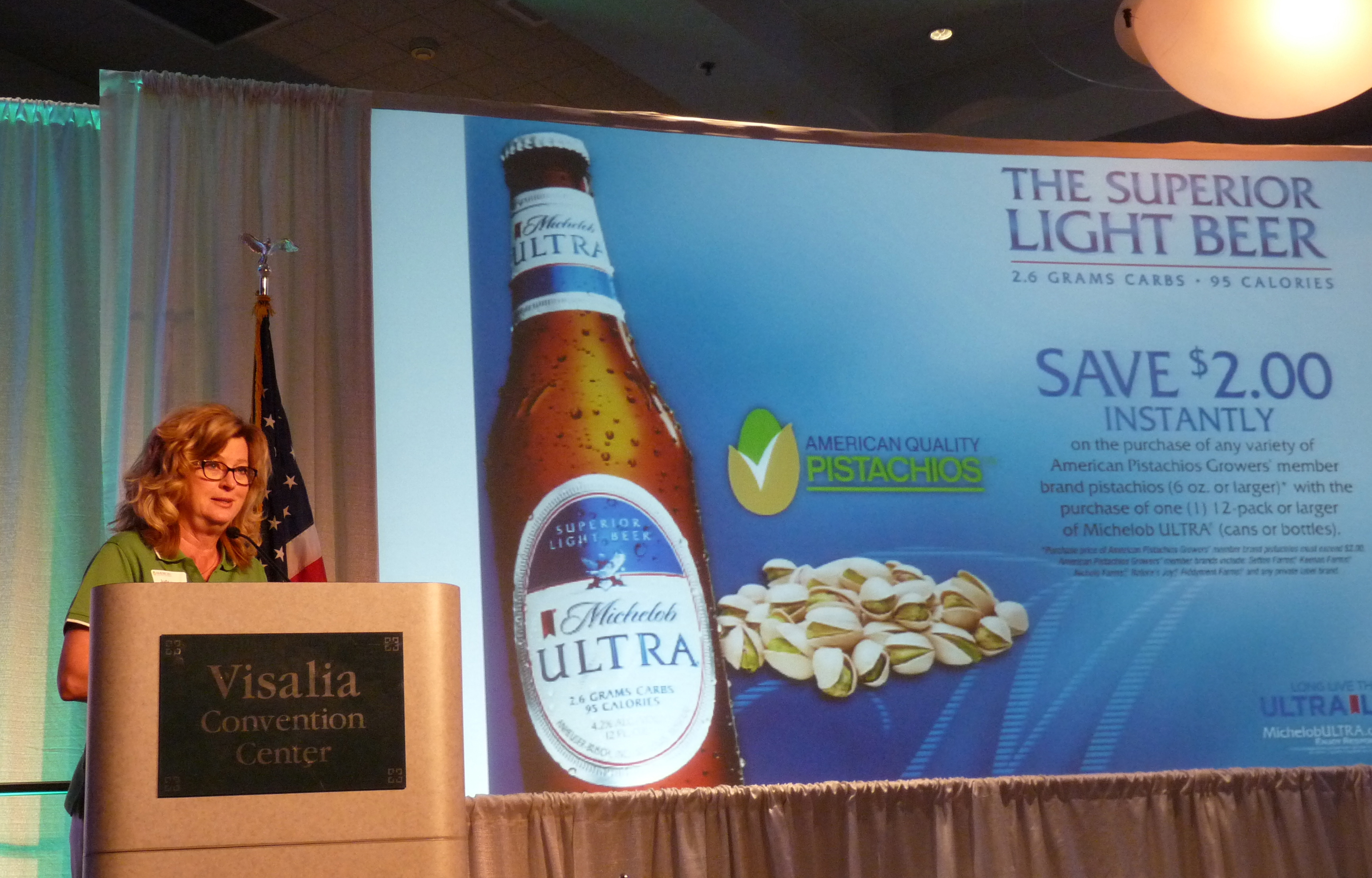
Move over peanuts. You’re not wanted anymore by active consumers who drink Michelob ULTRA. American Pistachio Growers’ pistachios will soon be marketed alongside the beer to adults with an active lifestyle.

“In 2015, the nationwide partnership with Michelob ULTRA Beer will roll out with a series of promotions throughout the year,” said Judy Hirigoyen, Director, Global Marketing for American Pistachio Growers.

“We worked with Anheuser-Busch this year in a pilot project in California, Arizona and Nevada. It offered a $2 off coupon for eight member brands within the American Pistachio Grower membership, or any store private label. Anheuser-Busch, not us, paid the retailer the $2,” said Hirigoyen. “The campaign went very well. So we have signed a contract to go nationwide with a series of promotions in 2015.

“In the future nation-wide promotion, consumers will get anywhere from $2.00 to $6.00 off their pistachios, making it a great boon to pistachios and beer lovers alike,” said Hirigoyen.

The discount coupon for pistachios will be available right where the beer is sold.

“What’s really exciting is the Michelob ULTRA shares the same target audience that pistachios do,” she said. “We look for active, fitness enthusiasts, and we want people who care about their nutrition and their health and who are looking for a lower fat, yet very delicious option. And that is true for both pistachios and Michelob ULTRA Beer.”

It’s a good fit as about 50 percent of all beer sold in the U.S. is an Anheuser-Busch brand. Furthermore, Michelob ULTRA was a big sponsor of the Amgen Bicycle Race Tour this year in California.

“Since everyone loves our product, Anheuser-Busch wanted to team up with us. They want to find ways to get out of the beer aisle, and we want to find ways to get into the beer aisle. They now can get their beer displays in the snack aisle, and in the produce aisle, and we can get our pistachios into the aisles where beer is promoted,” said Hirigoyen.

“We are promoting very actively on social networks to let people know that there is free money for pistachios,” said Hirigoyen. “So look for those coupons and purchase some great pistachios from members of the American Pistachio Growers.”


2016-05-31T19:34:14-07:00July 27th, 2014|

Can Pathogens Be Taken Up by Roots?

Research at UC Davis is looking at whether or not human pathogens, such as E-coli or Samonella could be transferred to roots and eventually into our produce.

“This is still a controversial topic, but it has to do whether the roots of the plants can uptake human pathogens if you have contaminated irrigation water. In a study done in California in our field production conditions their conclusion is that is highly unlikely to occur,” said Marita Cantwell, CE Vegetable and Postharvest Specialist at UC Davis.

Cantwell explained that the debate on the potential transmission of human pathogens  is due to the many different conditions under which produce could be grown.

“The details matter. Earlier research was in protected greenhouses and more artificial conditions, so this was a very good test in real field conditions, and this is why it’s an important study,” said Cantwell.

2016-05-31T19:34:14-07:00July 25th, 2014|

Young Women Changing the Face of California Farming

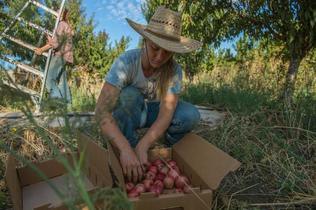
On most mornings, Katie Fyhrie, 25 and Emma Torbert, 35 meet at dawn at their Davis fruit farm.

As they scramble up ladders to pluck fruit and later sort it into delivery bins, they embody a demographic shift underway in agriculture: young, beginning farmers, many of them women, are entering the field at an increasing rate.

So far, the influx hasn’t been enough to offset the demographics of existing farmers, who are mostly older men. The median age of American farmers is 59, according to the last U.S. Department of Agriculture census in 2012.

But times are changing. The 2012 USDA census found that the number of new farmers between the ages of 25 and 34 had grown 11 percent since the previous census was taken in 2007.

The number of women farming in California has steadily increased over the past three decades. The 1978 USDA census counted 6,202 women who listed farming as their main occupation. By 2012, there were 13,984.

These new farmers are embracing different delivery methods that don’t involve bulk commodity sales to food processing companies. They’re peddling produce directly to consumers through farmers’ markets, farm stands and subscriptions for produce boxes. Those sales methods increased 8 percent from 2007.

Fyhrie and Torbert sell their peaches and other organic fruit directly to subscribers in Davis and also to stores such as the the Bi-Rite market in San Francisco’s Mission district.

Neither woman comes from a farm family, and neither inherited land. Both are college educated and found their way to farming from other pursuits. Torbert holds a Bachelor’s degree in physics from Princeton University, and Fyhrie recently graduated from the University of California, Berkeley, with a degree in biology.

Both are crazy about farming.

Upon graduation from UC Berkeley in 2012, Fyhrie returned home to Davis. “I didn’t want to jump into working in a lab,” she said.

Instead, Fyhrie took a job as a summer field worker at the Impossible Acres Farm in Davis. “I’ve always enjoyed jobs that kept me outside most of the time,” she said.

Fyhrie deepened her commitment to agriculture in February, when she enrolled in the California Farm Academy, a program run by the Center for Land Based Learning in Winters.

Twenty hopeful farmers are currently enrolled in the seven-month program, 14 of them women, said Jennifer Taylor director of the academy.

“Women getting into agriculture is a huge trend,” said Taylor, who herself began farming several years ago in a Wisconsin dairy operation. “In years past it was a very male-dominated profession.”

Taylor said the gender shift may be a result of societal changes.

“The idea that one can actually be a farmer without coming from a farming family is starting to feel like a reality to more people,” Taylor said.

One aspect that is appealing to women is how farming adds a sense of service to a community. “Some want to feed people, others want to see food justice happen. One way to do that is to be involved in growing food .”

At Princeton, Torbert studied fusion energy. However, it dawned on her that physics is not the kind of work where the tangible effects of one’s work is readily evident.

“I feel there are so many problems in the world that need to be changed sooner,” she said. “In my other jobs it felt like I was just monitoring. As a farmer, I feel like what I do can have an effect on the system.”

Torbert changed gears and pursued a graduate degree in horticulture at UC Davis. Fyhrie is following in her footsteps once she graduates from the farm academy program.

Torbert started her Cloverleaf farm four years ago when she leased 5 acres from Rich Collins, owner of the 200-acre Collins Farm.

Cloverleaf farm recently earned its organic certification, and is just now starting to show a profit, she said.

“Sometimes I feel less supported and find that there is more skepticism from older-generation farmers,” Torbert said. “People make assumptions that you do not know how to drive a tractor.”

Not all beginning farmers are under 35, said Michelle Stephens farmbudsman with Yolo and Solano counties. A lot of the women who she helps with farm permits are new farmers in the 40-year-old range.

“It’s less their full time business and more of an augmentation to what they are already doing,” said Stephens. “So, maybe they have some chickens and they decide they want to sell eggs.”

Some women entering the field hail from longtime farming families, like Kristy Levings, who co-owns Chowdown Farms, a livestock operation in the Capay Valley.

Levings, who is 35, defines herself as a third-generation farmer. At age 11, she was already in charge of a commercial sheep flock. But she has not handed the reins of her farm. She had to leave him and come back to the farming world by way of the big city.

“It was not a given that I would engage in farming,” said Levings, whose only sibling is a younger sister. Bias against females taking over a farm was a factor.

“If you grow up in a farming family, there are different expectations on you based on gender,” Levings said. “If you don’t grow up in a farming family, it is easier to think about farming without a gender filter.”

She left the farm after high school to pursue a degree in psychology and gerontology at San Francisco State University. After graduating she entered a career in social services.

When her mother grew sick in 2007, Levings moved back to the Capay Valley. A year later, an attractive parcel of property came on the market. Levings, then 28, bought it with her farming partner Brian Douglass. They sell lamb and other meat to such well-known local chefs as Randall Selland and Patrick Mulvaney.

Levings said she believes women farmers are bringing new talents to the field.

“Women bring to the table a certain way of thinking about things – from a multitasking perspective,” Levings said. “Like planning strategically.”

She likened farming to conducting a symphony. “There are a lot of moving parts all at once,” she said. “You have to be able to hear when the farm is out of tune.”

She said that with livestock it helps to be able to look at the field and see how the flock is interacting within it and how it interacting with what is growing on it

The only limitation Levings sees to being a woman farmer? Physical power. “I don’t have the same musculature as a male,” Levings said.

For her, that’s nothing more than a momentary drawback. “There’s nothing I cannot do – I’ll just do it in a different way,” Levings said. “If I have to lift something heavy, I’ll figure out how to use a machine instead of trying to muscle it myself.”

2016-05-31T19:34:14-07:00July 25th, 2014|

California Almond Board Blog Goes Live!

Richard Waycott, President and CEO of the Almond Board of California, launched its new Almond Board blog, almonds.com, TODAY, with the inaugural post (dated 7/22/14), “The Almond Board of California is a What? Understanding Federal Marketing Orders.”

Back in 1950, almond growers asked the United States Department of Agriculture to approve a Federal Marketing Order, so they could all work together to improve the quality and marketing of their crop.  The Almond Board of California was born. A lot has changed since our establishment 64 years ago, including a name change (we used to be called the Almond Control Board) and the broadening of our programs from what initially was just quality standards compliance. Today, we call ourselves an agricultural promotion group.

In their current form, agricultural promotion groups are made up of farmers – in our case growers and handlers – who work together to educate consumers and to research, innovate and promote what they produce.

While you may have never heard of us before, these groups are part of an American tradition and are ingrained in our culture. Whether it’s the dancing California raisins, “Got Milk?,” “Incredible Edible Egg,” “Pork: The Other White Meat” or “Beef: It’s What’s for Dinner,” agricultural promotion groups have created and funded these campaigns. (By the way, have you seen our own “Crunch On” ad campaign that was launched in 2013?)

Different ag promotion groups work in different ways, but essentially they are founded and funded by industry members. They are not funded by taxpayers, which is an occasional misconception. Each year almond handlers contribute money to fund Almond Board marketing and research programs. We develop our own programs and direct our own research, with the USDA providing oversight and review of all external messaging, to make sure they are accurate and comply with FDA and FTC regulations.

At the Almond Board of California, we have worked hard not only to help our favorite nut overcome certain negative perceptions due to their oil content, but more importantly to become the number one nut that surveyed North American consumers associate with being nutritious and heart healthy.*† By creating demand for almonds, we work to build global markets for California Almond growers and handlers.

In terms of research, we have funded $42 million in almond quality and food safety, nutrition, environmental, and production research since 1973.  From developing a new nutritional supplement for our pollinators – the honeybee – to improving water efficiency by 33 percent per pound of almonds produced over the last two decades, the Almond Board constantly strives to be a stellar guardian of the natural resources that almond growers and handlers employ to produce one of the finest foods in the world.

Click here to learn more about the Almond Board of California.

__________

*ABC North American Attitudes, Awareness and Usage Study, 2013

†Good news about almonds and heart health.  Scientific evidence suggests, but does not prove, that eating 1.5 ounces of almonds as part of a diet low in saturated fat and cholesterol may reduce the risk of heart disease.  One serving of almonds (28g) has 13g of unsaturated fat and 1g of saturated fat.

2016-05-31T19:34:14-07:00July 23rd, 2014|

Farmers Markets Try to Weather the Drought

Source: Ching Lee; Ag Alert

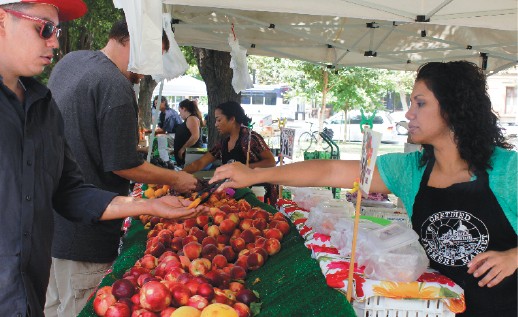
With summer harvest in full swing and farmers markets brimming with the usual variety of produce, the effects of the drought may not be immediately apparent to shoppers–but farmers who work those markets tell a different story.

Kern County farmer Greg Tesch, who works five farmers markets in his region and runs three of them, relies entirely on surface water to farm more than 70 different fruits, vegetables, herbs and cut flowers. Tesch said he’s not selling his usual array of products this year.

He said he couldn’t plant strawberries last fall because the canal that feeds his farm went dry in August. Half his cherry trees did not survive, so he had fewer cherries to sell. And because he did not have water deliveries until mid-March, he was unable to plant certain crops on time, missing an important early-season niche.

“We’re typically able to sell things that are slightly out of season,” he said. “The water wasn’t available, so we had to plant when a lot of other people planted, and so there is less demand for our product at farmers markets, as well as wholesale.”

He said the late start also forced him to lower his prices because he now faces “a glut of produce all at one time” and “competing against stores in the wrong time of year.”

Looking ahead, Tesch said he plans to scale back his vegetable production and plant more deep-rooted crops, most likely cherries on drought-tolerant rootstocks. He said he wants to grow crops that mature in the spring, which he acknowledged will affect his farmers-market business.

Some farmers who have better access to water were not necessarily spared from impacts of the drought. In San Diego County, Eli Hofshi, who uses mainly municipal water for irrigation, said he has stopped watering his winter vegetables and will not harvest them because his water bills have become unaffordable.

He said while certain crops such as tomatoes, squash and trees can handle some water stress, vegetables such as cauliflower, broccoli and Brussels sprouts become too bitter if not irrigated. In hindsight, he said he should not have planted the winter vegetables.

“We just didn’t realize it was going to be this costly,” he said. “We planted them last fall and they’ve just now started to produce. So it was a bad mistake. It’s been a double loss by putting the water in, doing the labor.”

With the loss of product, Hofshi said he’s had to buy from other farmers to fill in at his farm stand, but he’s not able to do that at the farmers market, where he’s taking a loss, despite raising prices.

“People are definitely balking at the prices right now,” he said. “They don’t like to pay (more). But we absolutely had to do it, with the cost of water and not to mention we’ve had a minimum-wage increase.”

Fresno County blueberry farmer Kim Sorensen, whose season ended earlier this month, said she also had to raise prices this year—by about 8 percent—to cover some of her higher production costs from having to pump water during the winter. While her customers noticed the price increase, she said most of them understood.

“We lost a little business I think, but not a tremendous amount just because most of what we do is in more affluent areas,” she said.

Farms in other parts of the state where there’s more water also reported increased production costs, with some having to reduce their production or not grow more thirsty crops in order to save water.

San Joaquin County farmer Beatriz Jimenez said she didn’t grow as much okra, eggplant and peppers. Cesar Cuebas, who works for Perry’s Garden Highway Gardens in Sacramento County, said the farm cut at least 30 percent of its production of crops such as sweet corn, tomatoes, peppers and watermelon. And El Dorado County farmer Patrick Hoover said he restricted water on some of his crops, such as apples, and may have smaller fruit this year.

“The drought is not just about water,” said Dan Best, general counsel of the California Federation of Certified Farmers Markets, noting that the warm winter did not give trees such as cherries enough chill hours to set fruit, leaving many growers with a very small crop or nothing to sell.

But for the most part, farmers-market managers reported little change in the amount and variety of products selling at their markets, and said any price increases have been minimal.

Joe Schirmer, who grows a variety of vegetables in Santa Cruz County, said warm, sunny winter weather increased patron attendance at farmers markets, which was good for business. With access to adequate groundwater supplies, he said he was able to extend his growing season during the winter.

“Things really were productive in the wintertime, so we actually did pretty well because of the drought,” he said.

And while having to irrigate through the winter definitely increased his costs, he said the extra production and sales probably resulted in a net gain for his farm.

2016-05-31T19:34:14-07:00July 23rd, 2014|

Almond Growers Are Reminded to Send Back Survey Regarding Green Waste Use

UC Researchers are reminding almond growers to fill out the survey that they received  in the mail more than a month ago regarding their use of organic amendments to their soil.

Daniel Schellenberg is a postdoctoral scholar in the department of Plant sciences at UC Davis and  part of the research team.

“Each of the cover letters came with the user ID and were hoping to hear back from all of the growers who would be interested in replying to the survey,” said Schellenberg

“We’re looking into the use of what is collectively called,“Organic Matter Amendments” which can include manures, composts, and green wastes. And this survey is really targeted to all growers even though its organic matter and amendments, its not exclusively a study just for organic growers,” said Schellenberg.

And its not just for almond growers either. “We were targeting all almond growers, but growers of all permanent crops, including walnuts and pistachios are welcomed to take the survey online,” said Schellenberg.

The survey can be found at www.growersurvey.ucdavis.edu

Schellenberg said the researchers have got a good response so far. “Out of the total amount of mailings, we got about 800 responses. A number of them filled out the survey and some of the people opted out.

“So, if people are just not interested in taking the survey or they just couldn’t because maybe they have someone who manages their property and do it for them, we still like to hear from them so that way we at least know we are getting all the responses that we can. We’ve heard response from people who manage more than 175,000 acre of almonds, which is  almost 20 percent of the total almond acreage,” said Schellenberg.

Schellenberg said the goal is not to change the way farmers farm. “Our goal here is not to try to constrain farming practices. Our goal is try to understand these materials and how they are being used that way we can target research that would benefit growers in terms of allowing them more freedom,access, and the ability to use these materials,” said Schellenberg.

2016-05-31T19:34:15-07:00July 21st, 2014|

Commentary: American Dream flourishes in state’s strawberry fields

Source: Lorena Chavez; Ag Alert

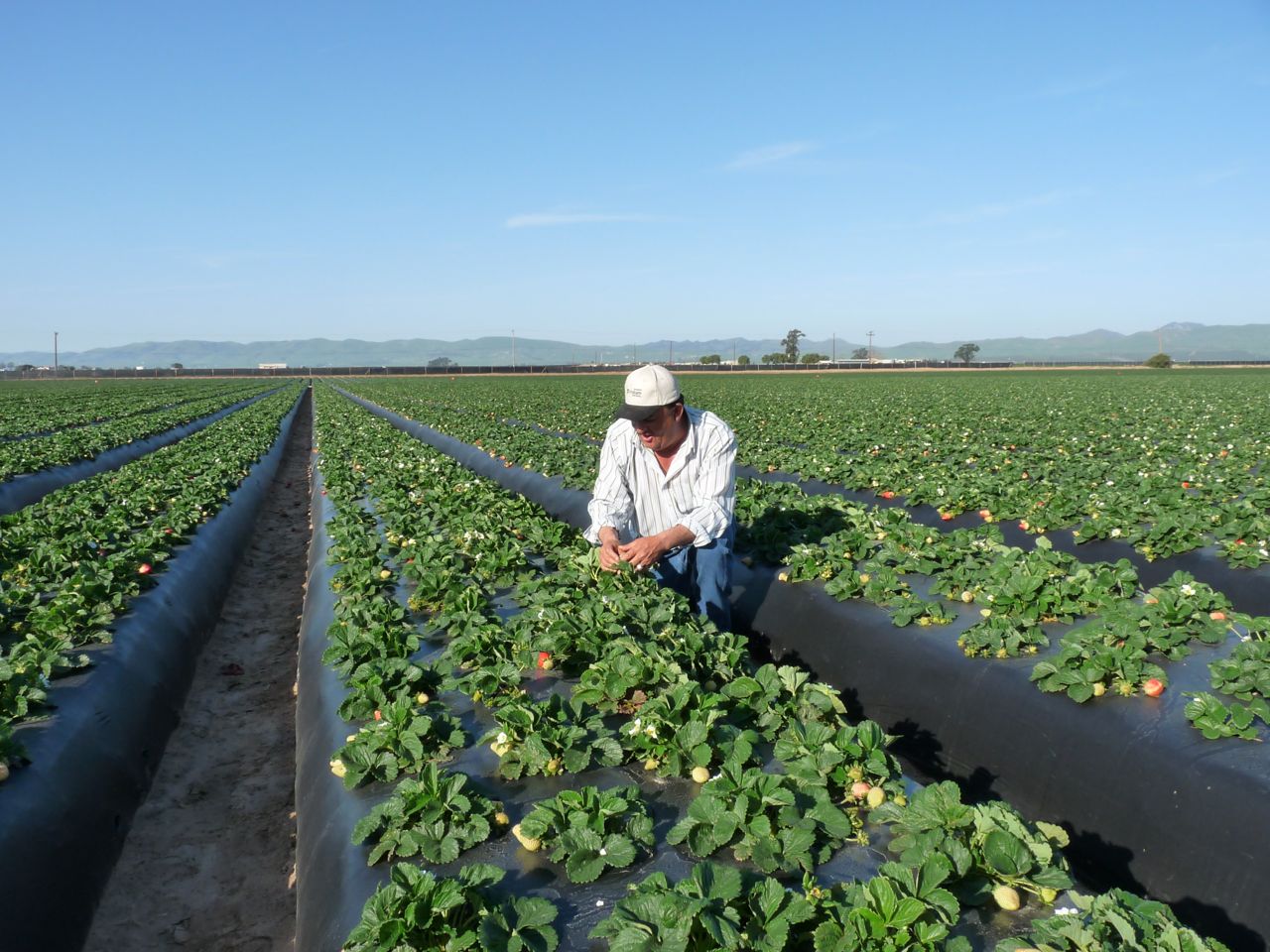
For thousands of immigrants to California, the path to the American Dream literally winds its way through the state’s strawberry fields. Perhaps more than any other crop, strawberries are defined by decades of immigrants from Europe, Asia and Mexico.

A report issued earlier this month by the California Strawberry Commission, titled “Growing the American Dream: California Strawberry Farming’s Rich History of Immigrants & Opportunity,” illustrates how many new Americans find that strawberries are a viable ladder to success.

According to the report—which can be found on the Strawberry Commission website at www.californiastrawberries.com—a diverse community of 400 family farmers dominates the state’s strawberry production, which accounts for nearly 90 percent of all the strawberries grown in the United States.

Sixty-five percent of these farmers are Latinos, a quarter of whom worked their way up from field workers to supervisors and eventually owners of their own farms. Another 20 percent are Asian Americans, primarily Japanese and, most recently, Laotians. The remaining 15 percent are comprised of European Americans, with some tracing their ancestry to Gold Rush pioneers.

The story of my father, Luis Chavez, illustrates this immigrant experience. He came to the United States from a small, rural town in Jalisco, Mexico. Born in 1934, he was raised in a home with no electricity or running water. He hasn’t attended a single day of school in his entire life. His family grew corn and beans to survive.

With no money in his pockets, he arrived in California in search of a better life in 1955, as part of the Bracero program. Like generations of immigrants, my father realized that the key to success was hard work. He first worked in a dairy, covering double shifts for 16 years until the family could scrape up enough money to lease an acre to plant strawberries.

While still working their regular jobs, my parents would get up at 4 a.m. every day to tend their plot, slowly building their business. Gradually, they expanded to become L&G Farms. My siblings and I now work side by side with my father to farm 300 acres in Santa Maria, where we employ several hundred people.

This story is not uncommon. But why are so many immigrants drawn to strawberry farming?

Due to their high yield, year-round harvesting and strong consumer demand, strawberries are able to sustain a family on a relatively small parcel of land. The barriers to entry are also favorable to immigrant farmers, because they can afford to lease and not buy their farmland.

With our deep and longstanding immigrant tradition, California strawberry farmers have been highly vocal in advocating for immigration reform. Certainly, we are concerned about the need for a pool of workers to harvest our crops. But more importantly, we share a desire to make sure that future generations of immigrants have the opportunity for the upward mobility that strawberries have provided for our family.

Along with other California strawberry farmers, and even Silicon Valley executives, I have made several trips to Capitol Hill to tell Congress about the critical need for meaningful immigration reform.

While recent election results have stalled efforts, immigration reform should not be postponed indefinitely. And it definitely should not be a partisan matter.

On one of our trips to Capitol Hill, one of my colleagues, a first-generation Mexican-American farmer from Salinas, eagerly sought out a statue of President Ronald Reagan, his hero, who granted amnesty to millions of immigrants. This simple act paved the way for my colleague to become an American citizen, gradually working his way to become a strawberry farmer employing nearly 100 workers. Another American Dream realized.

The commission’s report provides a strong reminder about the sacrifice, pride and contributions made by this nation’s immigrants throughout our history.

It also underscores the fact that immigration reform is as American as, well, strawberries.

2016-07-26T11:07:00-07:00July 17th, 2014|

California Water Feeds Our Communities Tackles Rural Hunger

California Water Feeds Our Communities, a grassroots effort consisting of local businesses, service organizations and farmers, has partnered to help our communities who are suffering from the lack of water. As the summer progresses and less water is available, the need for resources will increase.
Community Food Bank CEO Andy Souza explained, “Our rural communities are suffering, and as we are challenged to keep up with the food lines at distribution sites, the generosity of our community can help us bridge the gap with financial and food donations.”

Local grower Sarah Woolf said, “This event is an ideal opportunity for our community to participate in helping those who are hardest hit by the drought. These are people whose livelihood depends upon a vibrant agricultural industry.”

The current zero water allocation for most of the Central Valley and the severe statewide drought is the inspiration for this event. The success of our state is tied to water which produces not only food but jobs and spurs the economy.

Promoting the need for food donations brings necessary focus on water and demonstrates how our state’s future depends upon a reliable water supply. Those wishing to donate can do so by phoning the Community Food Bank at 559-237-3663 ext. 113 or online at their website at:  http://communityfoodbank.net/HowToHelp.aspx.

California Water Feeds Our Communities is a grassroots effort to raise the awareness of the important role that water plays in California agriculture and everyday life. The drought has directly impacted our communities, farm workers and farmers. Many are devastated by the lack of water. 

2016-05-31T19:34:16-07:00July 16th, 2014|
Go to Top