About Patrick Cavanaugh

This author has not yet filled in any details.
So far Patrick Cavanaugh has created 1490 blog entries.

REGISTER FOR 2014 RANGELAND COALITION 9TH ANNUAL SUMMIT

California’s Ranching and Related Ecology at Risk

California Rangeland Conservation Coalition will host the 2014 Rangeland Coalition 9th Annual Summit

, “Keeping Rangelands and Ranches Viable for Wildlife, Wetlands and Water” on Tuesday, January 21 and Wednesday, January 22.

The state’s largest rangeland stewardship forum will convene at the Oakdale Community Center, 110 South Second Avenue, where ranchers, researchers, land managers, conservationists and agency representatives will learn from one another and address how to keep California’s rangelands ecologically and economically sustainable.

For more information: www.CaRangeland.org or Pelayo Alvarez

For Sponsorship Inquiries: Karen Sweet
2016-05-31T19:41:14-07:00January 16th, 2014|

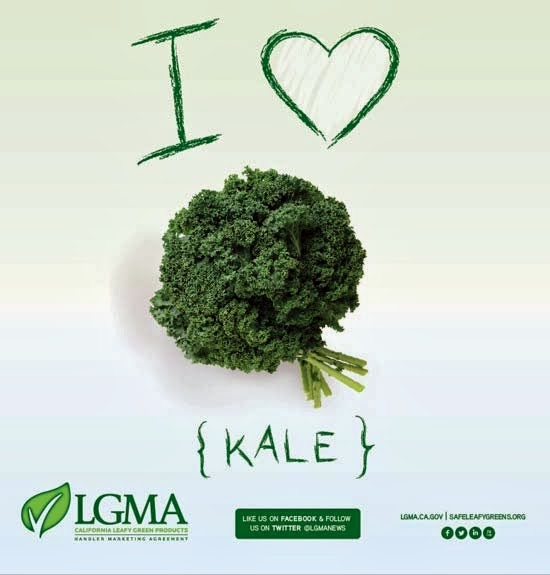
KALE – HEALTHY, NUTRITIOUS AND SAFE

Kale is Cool!

Source: April Ward, Calfornia Leafy Green Products

The growing popularity of the leafy green kale, historically used as a garnish or cooked beyond recognition, has been quite astounding.  Had you bought kale stock in 2011, you’d be a rich person today.  Now the proclaimed “super food” is often eaten raw in salads and used as a juicing ingredient. 


As people start adding kale to their diet, some might question its safety because, like other leafy greens eaten raw, there is no kill step for pathogens.  Consumers can be assured that kale coming from LGMA membersis subject to all the requirements of our rigorous science-based food safety practices and mandatory government inspections

Even with a rigorous farm food safety program in place, consumers should practice safe-handling methods in the kitchen to reduce the risk of foodborne illness and keep your family healthy.  Keep greens cool in the refrigerator and avoid cross-contamination with raw meats (or cutting boards!).  To answer a popular question, when you bring home bagged salads (including kale), the Partnership for Food Safety Education recommends that you do not wash bagged greens marked washed or ready to eat.

2016-05-31T19:41:14-07:00January 16th, 2014|

SUNDAY’S AFC CHAMPIONSHIP — NUTRITION EXPERTS TEAM-UP FOR PISTACHIO GROWERS

Broncos and Patriots Confront on the Field, Agree on Pistachios
The Broncos and Patriots will confront each other on Sunday’s AFC Championship Game, but their nutrition experts are in agreement that pistachios are a nutrient-rich snack. American Pistachio Growers (APG) TODAY announced the addition of two key ambassadors to their list of athletes and nutrition experts:  Bryan Snyder, Team Nutrition Manager for the Denver Broncos and Ted Harper, Team Sports Dietitian for the New England Patriots.

Both men are tasked with developing the year-round nutrition strategies designed to support the intense physical requirements of their players and ultimately, the world championship. These two ambassadors will reach millions of health-conscience sports enthusiasts and educate them on the health benefits of pistachios, a favorite snack.

While millions of Americans struggle with weight and weight-related health issues, nutritional solutions should include Pistachios, long known as a heart-healthy tree nut and the lowest calorie nut per serving, as an ideal snack, thanks to the recent and numerous studies revealing health benefits realized by people who eat nuts regularly, including pistachios.

Bryan Snyder, Denver Broncos and Ted Harper, New England Patriots
The New England Journal of Medicine (11/20/13) published a study that showed people who eat a handful of nuts (including pistachios) daily had a 20% lower death rate over the course of the 30-year research project, the largest study of its kind.  In addition, other supporting studies showed people who eat nuts regularly tend to remain leaner due to an association with reduced waist sizes and less weight gain throughout the course of life, compared to individuals who do not regularly eat nuts.

“This is good news for football fans who want to live to see their team win that “perfect season,” according to Judy Hirigoyen, Director of Global Marketing for American Pistachio Growers. Pistachios are an ideal snack, whether you’re a professional athlete or an armchair spectator.

The addition of Harper and Snyder follows APG’s announcement in October that British pro cyclist Mark Cavendish(the most stage wins at the Tour de France) is the newest APG Brand Ambassador and his dietitian, Nigel Mitchell, an expert nutrition ambassador for the growers’ association.  Says Hirigoyen, “In their roles, Mitchell, Harper and Snyder Both teams enjoy pistachios throughout the year for good health.

2016-05-31T19:41:14-07:00January 16th, 2014|

CENTER FOR PRODUCE SAFETY CALLS FOR RESEARCH PROPOSALS

2014 Food Safety Research Proposals Due March 14
The Center for Produce Safety (CPS) today announced TODAY its 2014 request for food safety research proposals. The center and its public and industry research partners are making $3 million available to fund general and commodity-specific research aimed at addressing the fresh produce industry’s food safety research needs.
                                                                                                                        
The 2014 Request for Proposals (RFP) seeks to fund both general produce food safety questions and commodity-specific questions to fill basic knowledge gaps. A complete list of research priorities is posted on the home page of the CPS website.
   
Proposals are due by March 14, 2014, 5 p.m. PST, and should be submitted through the CPS Grant System website. All qualified research professionals are eligible to apply for CPS funding.
CPS has compiled an impressive four-year body of work, awarding nearly $13.6 million and funding 85 one and two-year research projects at 27 universities and organizations.
2016-05-31T19:41:14-07:00January 16th, 2014|

USDA DESIGNATES CALIF. COUNTIES FOR DROUGHT DISASTER ASSISTANCE

Nearly Half of Calif. Counties Termed Natural Disasters Due to Drought
TODAY, 27 of California’s 58 counties have been designated by the USDA as natural disaster areas due to damages and losses caused by extreme drought.

Agricultural operators in all natural disaster designated counties may qualify for low interest emergency (EM) loans from USDA’s Farm Service Agency (FSA). Counties that are contiguous to the primary disaster counties also qualify for USDA natural disaster assistance. 


Farmers and ranchers in designated counties have eight months from the date of the declaration to apply for the EM loan to help cover part of their actual losses. To verify the deadline for application in your area, contact your county’s Farm Service Agency Office.

The agency will consider each loan application on its own merits, taking into account the extent of losses, security available and repayment ability. The maximum amount for an EM loan is $500,000.
“Just about everyone in California agriculture has been negatively affected by drought this year,” said Val Dolcini, FSA State Executive Director. “California’s diverse farmers and ranchers of all sizes and backgrounds have experienced drought conditions and water shortages and may find help at FSA offices.”
The Natural Resources Conservation Service (NRCS) has conservation-related disaster assistance to protect soil, water and habitat Small, non-farming businesses in USDA disaster-designated counties may be eligible for disaster assistance from the U.S. Small Business Administration (SBA)

The FFSA Emergency Conservation Program may also help restore conversation-related farm property and facilities. And the Noninsured Crop Disaster Assistance Program is available for producers who have enrolled in this annual protection program prior to the deadline earlier this year. For further information, contact your local USDAService Center.


The 27 designated counties include:

Alameda

Alpine

Amador

Calaveras

Contra Costa

El Dorado

Fresno

Inyo

Kern

Kings

Los Angeles

Madera

Mariposa

Merced

Mono

Monterey

Sacramento

Santa Clara

San Benito

San Bernardino

San Joaquin

San Luis Obispo

Santa Barbara

Stanislaus

Tulare

Tuolumne

Ventura
2016-05-31T19:41:15-07:00January 16th, 2014|

FARMERS TO APPLY FOR BAY DELTA INITIATIVE FUNDS

Bay Delta Initiative Adds New Funded Project Areas-Applications Due February 21
The USDA Natural Resources Conservation Service (NRCS) in California announced today it has approved four proposed project areas to be added to its three-year old Bay Delta Initiative, bringing the total number of project areas to 15. Farm and conservation groups in the approved areas work with farmers from Colusa to Bakersfield on voluntary projects to conserve and protect water and wildlife habitat. Farmers who wish to apply for contracts within these project areas must do so by Feb. 21, 2014, to ensure consideration for funding in 2014.

”California is seeing some of its most challenging times ever relative to conserving and protecting our vital water resources,” said Carlos Suarez, state conservationist for NRCS in California. “Every drop is precious, is valued, and must be used as efficiently as possible. The country and the world looks to our farmers to supply healthy produce, nuts, dairy and other commodities—and wildlife depend upon us for habitat as well. The Bay Delta Initiative helps to focus NRCS aid to farmers and conservation groups working to balance all these needs.”

Eighteen million dollars is available for farmers in the approved areas, through the Farm Bill-funded program, the Environmental Quality Incentives Program (EQIP). In addition, four of the continuing projects also received funding from the Bureau of Reclamation to improve water delivery infrastructure. NRCS funding then complements that investment by funding needed on-farm irrigation improvements. For example, pressurizing a system for more efficient delivery could be funded by the Bureau while delivering the newly pressurized water to fields with leak-resistant pipes and systems, may be funded by NRCS. The result is a more efficient water delivery system where all the opportunities for water savings are more fully realized.

Bay Delta Initiative Projects

New Projects in 2014

Sponsors

Award Amount

1. Ingram/Hospital

East and West Stanislaus Resource Conservation Districts (RCDs)

$690,000

2. Lower Colusa Basin Drain

Colusa Glenn Subwatershed Program

$416,000

3. Semitropic & Buena Vista Water Storage Districts

NW Kern RCD

$1,600,000

4. Tehama County- Sacramento River

Tehama RCD

$300,000

Continuing Projects

Sponsors

Award Amount

5. Cache Slough Complex

Dixon RCD

$750,000

6. East San Joaquin

Sustainable Conservation Western United Dairymen

$5,000,000

7. French Camp Slough

San Joaquin RCD

$1,500,000

8. Kings River

Kings River Conservation District

$2,000,000

9. Lower Snake River

Sutter RCD

$1,700,000

10. Walker Creek

Colusa Glenn Subwatershed Program

$720,000

11. Waterbirds

CA Rice Commission

$650,000

Continuing NRCS-Bureau of Reclamation Sponsored Projects

Award Amount

12. Firebaugh Canal Water District

$300,000

13. Henry Miller Reclamation District

$500,000

14. Central California Irrigation District

$600,000

15. Tulare Irrigation District

$750,000

2016-05-31T19:41:15-07:00January 16th, 2014|

REMINDER TO VOTE BY FRIDAY JAN. 17TH

Farm Service Agency County Committee Elections: Vote by January 17 Deadline

USDA Farm Service Agency (FSA) State Executive Director, Val Dolcini, is reminding farmers, ranchers and other agricultural producers that the deadline to return completed ballots for the Farm Service Agency County Committee Elections is this Friday, Jan. 17, 2014. Eligible voters who have not received a ballot can obtain one from their local USDA Service Center. Ballots returned by mail must be postmarked no later than Jan. 17.
To be an eligible voter, farmers and ranchers must participate or cooperate in an FSA program. A person who is not of legal voting age, but supervises and conducts the farming operations of an entire farm may also be eligible to vote. Agricultural producers in each county submitted candidate nominations during the nomination period, which ended on Aug. 1.

County committee members are an important component of the operations of FSA and provide a link between the agricultural community and USDA. Farmers and ranchers elected to county committees help deliver FSA programs at the local level, applying their knowledge and judgment to make decisions on commodity price support programs; conservation programs; incentive indemnity and disaster programs for some commodities; emergency programs and eligibility. FSA committees operate within official regulations designed to carry out federal laws.

Close to 7,700 FSA county committee members serve in the 2,124 FSA offices nationwide. Each committee consists of three to 11 members who serve three-year terms. Approximately one-third of county committee seats are up for election each year. More information on county committees, such as the 2013 fact sheet and brochures, can be found on the FSA website at www.fsa.usda.gov/elections or at a local USDA Service Center.

2016-05-31T19:41:15-07:00January 15th, 2014|

NITROGEN MANAGEMENT TRAINING FOR CERTIFIED CROP ADVISERS

CDFA Debuts CCA Nitrogen Management Training


CDFA’s Fertilizer Research and EducationProgram (FREP) is excited to announce the debut of the NitrogenManagement Training Program for California certified crop advisers (CCAs). Since October 2012, FREP has collaborated with the California Certified Crop Adviser Program and UC Agriculture and Natural Resources to develop and implement a voluntary nitrogen management curriculum specifically targeted for California Certified Crop Advisers.

The goal of the program is to facilitate CCAs’ understanding of sound nitrogen management practices and increase their ability to make informed recommendations to growers, thereby improving environmental performance relative to nitrogen management for crop production. Developed by subject matter experts, the curriculum will address the management of nitrates from plant nutrients to reduce unintentional emissions in waters throughout the state, while emphasizing the economic and environmental benefits achieved through improved management of agricultural use of nitrogen and irrigation water.

Each training session will occur over the course of two days. The first day will include presentations on course objectives, the nitrogen cycle in crop production systems, nitrogen sources, irrigation and nitrogen management, nitrogen budgeting, future resources, and a discussion of local and statewide considerations. The second day will feature concurrent sessions with emphasis on annual and perennial crops. Each session will address current practices, the use of best management practices, and will include a hands-on nitrogen management planning exercise, concluding with a synopsis from both the annual and perennial crops subject matter experts.

The first course is already underway this week in Modesto. Four other courses are scheduled to take place in February and March throughout the Central Valley and the Central Coast area; please see below for dates and locations. If you are a CCA interested in attending, please pre-register to attend one of the sessions through the CAPCA Ed website at or by using the links below. Due to the targeted nature of the curriculum for these courses, attendance is limited to CCAs only.

The nitrogen management training sessions are a part of FREP’s ongoing commitment to provide growers and CCAs with decision-support tools, technical education, and access to research to increase awareness of more agronomically sound use of fertilizing materials to minimize the environmental impacts resulting from their use.

Since 1990, FREP has funded more than 160 research projects focusing on California’s important and environmentally sensitive cropping systems. For more information about this project and other FREP initiatives, please contact FREP staff.

WOODLAND — February 18-19, 2014

Heidrick Ag History Museum – Event Hall


1962 Hays Ln, Woodland, CA 95776 
Register Online

FRESNO — February 25-26, 2014

Ramada Inn Fresno (University) – Shaw Rooms A, B, C


324 E Shaw Ave, Fresno, CA 93710 
Register Online

SALINAS — March 5-6, 2014

Salinas Elks Lodge #614 – Main Dining Room


614 Airport Blvd, Salinas, CA 93905 
Register Online

TULARE — March 11-12, 2014


International Agri-Center – Banquet Hall


4500 S Laspina St, Tulare, CA 93274 
Register Online

2016-05-31T19:41:15-07:00January 15th, 2014|

Solano County 4-H Clubs Win Big at Skills Day

When Life Gives you Lemons, Make Lemon Curd!
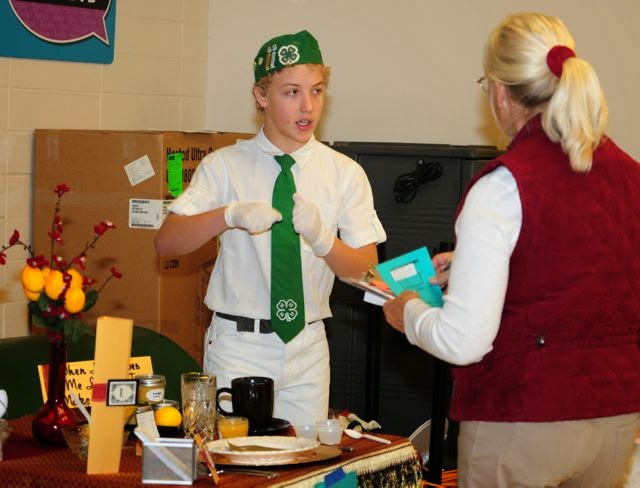
Showmanship winner Tyler Scott of the
Wolfskill 4-H Club
DIXON–Tyler Scott of the Wolfskill 4-H Club, Dixon, figures that “When Life Gives You Lemons, I Make Lemon Curd.”

And that’s exactly what he did when he showcased his project at the Solano County 4-H Project Skills Day, held Jan. 11 in the C. A. Jacobs School, Dixon.

Scott gathered lemons from his grandparents’ tree, figured out the cost and nutrition value, purchased a table cover from a thrift shop, and polished his presentation skills. For his efforts he won a showmanship award in the intermediate food preservation category for sixth through eighth graders.

Scott was one of 11 youths winning showmanship awards, the highest honor given at the annual Project Skills Day, which showcases what the youths have learned in their projects and provides an opportunity to share their knowledge with others. Judges score the 4-H’ers on their display, presentation, knowledge and interaction.

The event drew 40 projects. Youths showcased projects ranging from poultry, horses, dairy goats and swine to  gardening, Legos, candles and “the role of the 4-H treasurer.”

Other showmanship winners:

Lilya Gardner, Roving Clovers 4-H Club, Dixon, “Iced Pumpkin Cookies,” entered in the intermediate foods category, sixth through eighth grades.

Evelyn Young, Rio Vista 4-H Club, “Chickens: Easy Ways to Cook Eggs,” entered in the junior livestock/animals category, fourth through fifth grades

Sarah Bowen, Sherwood Forest 4-H Club, Vallejo, “Backing a Horse,” entered in the intermediate livestock/animals category, sixth through eighth grades

Makenna Caulfield, Roving Clovers 4-H Club, “Home-Grown Cookies,” entered in the intermediate livestock/animals category, sixth through eighth grades

Ivy Christensen, Sherwood Forest 4-Club, “Join Up With Your Horse,” entered in the intermediate livestock/animals category, sixth through eighth grades

Josephine Linan, Sherwood Forest 4-H Club, “The Bridle: English or Western,” entered in the senior livestock/animals category, ninth through 12 grades

Adilene Koelzer, Vaca Valley 4-H Club, Vacaville, “Gi’me Kumihimo,” entered in “all other projects,” junior division, fourth through fifth grades

Maya Miller, Suisun Valley 4-H Club, Fairfield-Suisun, “Stretching from your Health Officer,” entered in “all other projects,” junior division, fourth through fifth grades

Alec Merodio, Suisun Valley 4-H Club, “A Rube Goldberg Machine,” entered in “all other projects,” intermediate division, sixth through eighth grades

Carson Merodio, Suisun Valley 4-H Club, “The Role of the 4-H Treasurer,” entered in “all other projects,” senior division ninth through 12 grades

In addition to the showmanship winners, participation certificates went to:  

Foods (primary grades, kindergarten through third grade)  – Not Judged

Kaitlyn Westerhaus, Roving Clovers, Dixon, Baking Mixes


Kylie Westerhaus, Roving Clovers, Dixon, Baking Mixes

Foods Intermediate, sixth through eighth grades)

Katie Hurtado, Wolfskill, Dixon, “What’s up, Doc? Hoppin’ and Healthy Rabbit Meat”

Food Preservation (junior, fourth and fifth grades)

–Xavier Copeland, Suisun Valley, “What’s P J – How To Make Pomegranate Jelly”

Food Preservation (senior, ninth through 12th grades)

–Siera Giron, Wolfskill,  “Poppin’ Hot Pepper Jelly”

Livestock/Animals (junior, fourth and fifth grades)

–Jordan Burkett, Sherwood Forest, “Horsie Hair Cuts”
–Christopher Lang, Suisun Valley, “This Little Piggy Went to the Market”
–Savannah Torres, Sherwood Forest, “Good Hoof/ Good Horse”

Livestock/Animals (intermediate,sixth through eighth grade)

–Kasey Davis, Elmira 4-H Club, Elmira, “Got Combs?”
–Natalie Greene, Sherwood Forest, “One Size Does Not Fit All – Selecting the  Saddle for Your Horse”
–Amanda Kant, Sherwood Forest, “Trick or Treat – Decorating a Horse for  Halloween”
 –Luis Laffitte, Vaca Valley, “Nutrition Mission”
–Erica Lull, Elmira, “What’s a Good Egg”
–Julette Pierce,Vaca Valley, “Scoop on Chicken Combs”
–Daniela Setka, Wolfskill, “Dressing the Little Piggy” 
–Jack Strickland, Vaca Valley, “Nutrition for a Pregnant Dairy Goat”
–Emily Turner, Elmira, “Caring for Your HYPP Horse”

Livestock/Animals (senior, ninth through 12th grades)

–Nika Gardner, Roving Clovers, “No Horsin’ Around”
–Audrey Hennigan, Roving Clovers, “The Bunnies, The Birds and The Bees”
–Sarah Lull, Elmira, “A Fishy Home – Setting Up a Freshwater Aquarium”

All Other Projects (junior, fourth and fifth grades)


Natalie Frenkel, Suisun Valley, “Record Book Tips”
–Haley Scott, Wolfskill, “Haley’s Edible Flower Garden”
–Jason Williams, Roving Clovers, “Pi”
–Cheyenne Miller, Suisun Valley, “Recycle/Reuse”

All Other Projects (intermediate, sixth through eighth grade)

–Sam Forbes, Suisun Valley, “Fire and Ice: How To Make Ice Candles”
–Ethan Brown, Suisun Valley, “Lego Pieces, Parts, Bricks”


All Other Projects (senior, ninth through 12th grades)


–Megan Torres, Sherwood Forest, “Garden in a Jar”
–Emma Vogliano, Suisun Valley, “The Science of WORDS”

In addition, the Solano County 4-H Project Skills Day featured the annual 4-H Chili

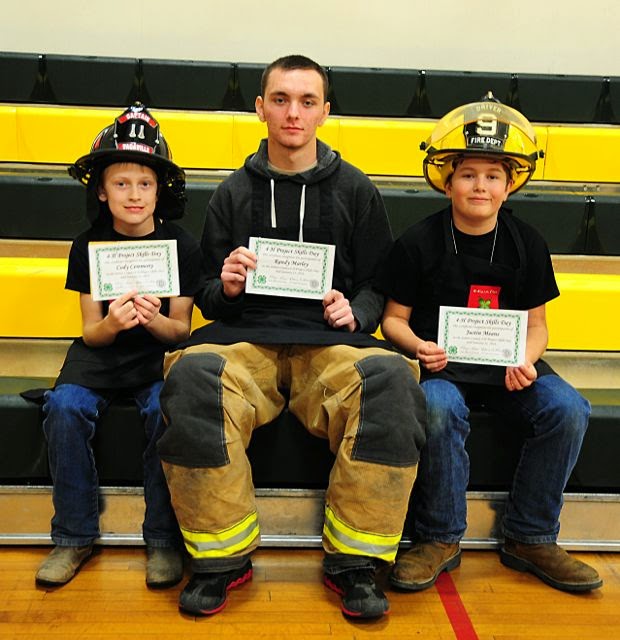
The 4-Alarm Team was comprised of (from left) Cody Ceremony,
Marley and Justin Means. 

Cook-Off, won by the 4-Alarm Chili team of Dixon Ridge/Pleasant Valley clubs. The winning team: Cody Ceremony, Randy Marley and Justin Means of the Pleasants Valley Club with advisor Chuck Means of Dixon Ridge.  Solano County Supervisor John Vasquez Jr. of Vacaville, Ed Coffelt of Dixon and Kathy Keatley Garvey of Vacaville judged the competition.

Receiving participation certificates were:

Want Quackers With Your Chili, Vaca Valley:  Makenzie Davi, Marissa Daviand Emma Ryder

Jeans n Beans, Pleasants Valley:  Sabrina Brown, Melanie Campilongo, Lillian Tudbury and David Witzel

The Persim-Monsters, Suisun Valley:  Alexis Taliafero, Clairese Wright and Robert Wright

The 2013-14 Solano County 4-H All-Star Lyle Glass of the Vaca Valley 4-H Club served as the emcee. Assisting him were Tyler Sasabuchi of the Roving Clovers 4-H Club, and Siera Giron of the Wolfskill 4-H Club,  the Dixon area representatives to the Solano County 4-H Leaders’ Council, and the 2012-2013 Solano County 4-H All-Star Julianne Payne of the Sherwood Forest 4-H Club.

In special presentation, Tractor Supply Company of Dixon received the 4-H Paper Clover Award. Receiving the award was the store’s representative, Kristen Clark-Webb. The company and its employees supported 4-H during the Paper Clover promotion, which raised $503 for the county 4-H program.

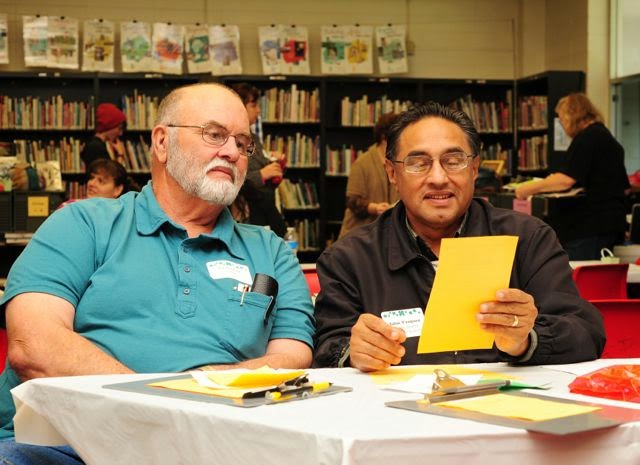
     Chili judges Ed Coffelt (left) of the Maine Prairie 4-H Club, Dixon, and Solano
       County Supervisor John Vasquez Jr. of Vacaville score the teams at the Solano
County 4-H Chili Cookoff.

Solano County 4-H representative Valerie Williams of Vacaville and her sister, Kelly Fletcher of Dixon, each received a bouquet of flowers for their work in organizing the event.

 Solano County has 12 4-H clubs with a total of 500 members
The clubs are:
 Dixon: Dixon Ridge, Maine Prairie, Roving Clovers, Tremont and Wolfskill


Fairfield-Suisun: Suisun Valley and Westwind
Rio Vista: Rio Vista 4-H Club

Vacaville: Elmira, Vaca Valley and Pleasants Valley

Vallejo: Sherwood Forest

More information about the 4-H program is available from Valerie Williams, Solano County 4-H program representative, Solano County Cooperative Extension, at  (707) 784-1319  or Valerie A Williams at vawilliams@ucanr.edu or by accessing the web site at  http://cesolano.ucdavis.edu.

2016-05-31T19:41:15-07:00January 14th, 2014|
Go to Top