About Patrick Cavanaugh

This author has not yet filled in any details.
So far Patrick Cavanaugh has created 1490 blog entries.

North Hollywood High School Ag Students Keep Tradition Alive and Will Make Future Bright

Source: Karen Ross, California Agriculture Secretary

Many decades ago, now-urban Los Angeles County was agrarian. In fact, it was once the largest Ag county in California. In that more pastoral time, North Hollywood High School had a 100-acre farm.

Since then, it has seen its footprint shrink to eight acres and is now surrounded by apartment buildings and other developments. However, that smaller plot of land is still very productive! I had a chance to see it for myself recently.

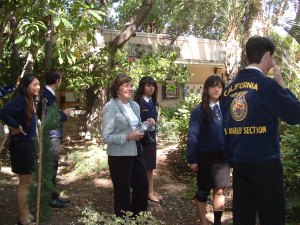
Ag students at North Hollywood High, including FFA members, work hard to maintain a farm that serves the community – including a flourishing community garden. The students raise money for the farm, themselves, without funding assistance from the school district.

When I visited, they had just completed their annual petting zoo fundraiser, which is widely supported by the community.  It was a special treat to see twins born earlier that morning to a pygmy goat!

As usual, I was impressed by the poised, confident, articulate students who are proud representatives of FFA.  I love spending time with them because they represent the promise of a future bright with possibilities.

Whether they go on to have careers in agriculture or not, they certainly will be better citizens and well informed consumers, which make for healthier communities!

There is no doubt in my mind that that North Hollywood FFA officers, Nicholas, Thomas, Jocelyn, Casey, Josh and Letitia have benefited from their FFA experience. Our future is in good hands with young people like them.
2016-05-31T19:35:34-07:00May 7th, 2014|

CDFA Announces Vacancies on the Fertilizer Research & Education Program’s Technical Advisory Committee

The California Department of Food and Agriculture is announcing four vacancies on the Fertilizer Research and Education Program’s Technical Advisory Subcommittee.

This subcommittee reviews and recommends fertilizer research and education projects for funding and implementation to the department’s Fertilizer Inspection Advisory Board.

The Fertilizer Research and Education Program funds and facilitates research to advance the environmentally safe use and handling of fertilizing materials within the agricultural sector.

The program serves growers, agricultural supply and service professionals, extension personnel, public agencies, consultants, and the public.

Applicants must demonstrate technical and scientific expertise in the fields of agronomy, plant physiology, production agriculture and environmental issues related to fertilizing materials use. This expertise can include, but is not limited to, issues related to nitrates in groundwater and greenhouse gas emissions associated with fertilizer use.

The term of office for subcommittee members is three years. Members receive no compensation but are entitled to payment of necessary traveling expenses. The subcommittee and research program are funded entirely through a mil assessment.

Individuals interested in being considered for appointment should send a resume to FREP staff at California Department of Food and Agriculture – FFLDRS Branch, 1220 N Street, Sacramento, CA 95814 or via e-mail at FREP@cdfa.ca.gov.

The application deadline is July 1, 2014.

For further information on the Fertilizer Research and Education Program, please contact FREP staff at (916) 900-5022 or visit http://cdfa.ca.gov/is/ffldrs/frep.

2016-05-31T19:37:58-07:00May 7th, 2014|

Massive Ant Hunt Launches Across 7 O.C. Cities

Source: Scott Martindale; Orange County Register

Susie Federico peered through her glasses at the dozens of ants swarming a tiny plastic trap she’d staked in the ground.

Federico, an agricultural technician for the state Department of Food and Agriculture, used a pair of tweezers to inspect all sides of the plastic basket, filled with one of ants’ favorite foods – Spam canned meat.

Unless they were big-headed ants, Federico let them go free.

“I’m looking for the larger head,” Federico said as she flicked off ants that had crawled up her hand and arm.

“There is not a sample as of now.”

Assigned to a residential neighborhood in northwestern Santa Ana, Federico was part of a team of state agricultural technicians that began setting ant traps Monday across a 79-square-mile swath of Orange County.

State officials are looking for the aggressive Pheidole megacephala species of big-headed ants, which were discovered last month in the front yard of a Costa Mesa home near the Santa Ana River.

“Knowing the extent of the infestation is an important consideration,” said Steve Lyle, a spokesman for the state Department of Food and Agriculture. “We’re still evaluating what this means. Is it something that needs to be taken care of? Is it something we can take care of?”

Named after their disproportionately large heads, big-headed ants are considered an agricultural pest and one of the world’s most invasive insects. They aren’t dangerous to humans.

In all, state officials plan to place Spam traps at 1,570 locations in seven Orange County cities in the coming days – the equivalent of 20 per square mile.

A team of up to eight state workers will spend at least a week systematically placing traps in neighborhoods up to 5 miles from where the original colony was discovered, Lyle said.

The study area encompasses all of Costa Mesa and parts of Huntington Beach, Fountain Valley, Westminster, Santa Ana, Irvine and Newport Beach.

Once officials know how far the ants have spread, they can decide whether to move forward with extermination, Lyle said.

Although California is home to native varieties of big-headed ants, the species discovered in mid April in Costa Mesa was the first documented sighting of the aggressive Pheidole megacephala species in its natural environment in California. It can displace other ants and eat beneficial insects, authorities say.

The Costa Mesa colony was first spotted by amateur entomologist Gordon C. Snelling of Apple Valley, who was visiting a friend in mid April.

The friend had been complaining about aggressive ants invading his house and winding up dead in his swimming pool, Snelling said.

Snelling said the big-headed ants had likely traveled to his friend’s home inside potted plants or sod, and that they had probably been there at least a year.

“I knew the state and the county would get in an uproar as soon as I let them know,” Snelling, 55, told the Register last week.

“It’s one of those things that gets the adrenaline pumping and your brain churning,” added Snelling, who runs the website armyants.org and has published scientific papers on ants. “It’s certainly caused more response than anything else I’ve done.”

2016-05-31T19:37:59-07:00May 6th, 2014|

‘Curtailments’ and other woes tighten supplies

Source: Kate Campbell; Ag Alert

Facing severe drought, California farmers and ranchers are bracing for an increasing flow of bad news about water supplies.

State officials said last week they’re preparing to curtail diversions to holders of certain water rights; federal authorities said they have no immediate plans to increase the “zero” allocation for most of their farm water customers; and a new report detailed the pressure surface-water shortages have placed on California groundwater basins.

The State Water Resources Control Board said it is preparing to curtail water diversions from watersheds that drain into the Sacramento and San Joaquin rivers, the Tulare Lake Basin, and the Russian and Eel rivers.

In times of shortage, state water law says if there’s not enough water for all water right holders, the most junior will be curtailed before restrictions are imposed on more senior water right holders. Seniority is determined by the type and age of the water right.

Riparian water rights are generally the most senior rights, followed by older appropriative rights and then newer rights. Any water supply remaining in the watershed after appropriative water rights are shut off must be shared on a “correlative basis among riparian users.”

In most watersheds where curtailment is likely, the water board said notices will go to post-1914 water rights holders beginning in May; thousands of individuals and water agencies hold such rights, although it is not clear how many will receive the curtailment notices.

Holders of pre-1914 rights are also expected to receive curtailment notices, later this year, and it’s anticipated that supply this summer and fall won’t meet all riparian demands, requiring riparian users also to reduce or stop using water.

Given the dire shortages expected in coming months, the water board said after curtailment, it expects to allow limited diversions for public health and safety needs where no other water supply is available.

“We encourage management of water supplies to protect public health and safety, but we also must emphasize the need for adequate food production,” said Danny Merkley, water resources director for the California Farm Bureau Federation. “Having healthful, local food available is a big part of ensuring human health and safety.”

Also last week, the state Department of Water Resources’ final snow survey of the year found more bare ground than snow, with snow water content at only 18 percent of average for the date.

Officials at the U.S. Bureau of Reclamation, which operates the Central Valley Project, said last week they don’t know “when or if we’ll be doing another (water) allocation announcement.”

Economic losses in the billions of dollars are anticipated due to the zero water allocation for CVP agricultural contractors. The Friant Water Authority said its contractors are preparing for a “financial and social calamity,” as they prepare for the first-ever call on Friant water to supply San Joaquin River exchange contractors and honor their historic river water rights. The agency said all-out efforts continue to seek an emergency solution to the water cutoff.

The state’s citrus belt—Fresno, Tulare and Kings counties, where the bulk of fresh-market citrus is grown on about 50,000 acres—faces estimated losses of $3 billion. Many farms do not have access to groundwater or other alternative water sources, and some orchards are being pushed out.

“It is incredible that a system created to preserve agricultural production in this state is being leveraged to service environmental needs at greater levels than are necessary, while agriculture is left to go dry,” said Joel Nelsen, president of Exeter-based California Citrus Mutual.

The groundwater report is available at www.water.ca.gov/waterconditions.

Curtailment information by watershed is available at www.swrcb.ca.gov/waterrights/water_issues/programs/drought/analysis/.

2016-05-31T19:37:59-07:00May 6th, 2014|

State Board of Food and Agriculture to Discuss Agricultural Careers, Innovation and Industry Advancements

The California State Board of Food and Agriculture will discuss issues related to innovations, advancements and careers within the agricultural sector at its upcoming meeting on Tuesday, May 6th at the World Food Center at UC Davis.

This meeting will be held from 10:00 a.m. to 3:00 p.m. at the Walter A. Buehler Alumni Center, University of California, Davis One Shields Avenue, Davis, CA, 95616.

“California is at the cutting edge of innovation within the agriculture sector from water use efficiency to research advancements and product development,” said CDFA Secretary Karen Ross. “The careers of the future can be found in the agricultural sector and our universities and businesses are leading the way in supporting a vibrant, high-skilled jobs market.”

On average, California agriculture supports approximately 400,000 on-farm jobs related to crop production, harvesting and overall farming. This does not include the non-farm jobs directly related to agriculture such as transportation, marketing and sales.

Nationally it is estimated that more than 16 million jobs are supported through farm and agricultural related activities. As global consumer preferences, food manufacturing and agricultural production continue to evolve, the employment needs of businesses and employee skill-sets will need to change as well.

Invited speakers include: Chancellor Linda P.B. Katehi, University of California, Davis; Roger Beachy and Josette Lewis, UC Davis World Food Center; Lance Donny, OnFarm; Helene Dillard, Dean of the College of Agricultural and Environmental Sciences, UC Davis; Chuck Nichols, Nichols Farms; Dave Dever, Sun World; Dr. Tim Conner, Monsanto; Shane MacKenzie, Superior Farms; Jacob Gomez, UC Davis Aggie Ambassadors; Vanessa Alexander, CalPoly Agricultural Ambassadors; and Katie Fyhrie, California Farm Academy participant.

“Technology is making rapid on-farm advances that benefit farmers and farm workers,” said Craig McNamara, president of the California State Board of Food and Agriculture. “We need to encourage more individuals to see that all facets of agricultural production support highly skilled and technical career paths.”

The California State Board of Food and Agriculture advises the governor and the CDFA secretary on agricultural issues and consumer needs.

The state board conducts forums that bring together local, state and federal government officials, agricultural representative and citizens to discuss current issues of concern to California agriculture.

Follow the board on Twitter at: www.twitter.com/Cafood_agboard

2016-05-31T19:37:59-07:00May 5th, 2014|

2012 Census of Agriculture Reveals New Trends in Farming

There are now 3.2 million farmers operating 2.1 million farms on 914.5 million acres of farmland across the United States, according to the 2012 Census of Agriculture, released today by the U.S. Department of Agriculture.

“Once every five years, farmers, ranchers and growers have the unique opportunity to let the world know how U.S. agriculture is changing, what is staying the same, what’s working and what we can do differently,” said Dr. Cynthia Clark, the retiring head of USDA’s National Agricultural Statistics Service, which administered the survey. “Today, we can start to delve into the details.”

Census data provide valuable insight into the U.S. farmer demographics, economics and production practices. Some of the key findings include:

  • Both sales and production expenses reached record highs in 2012. U.S. producers sold $394.6 billion worth of agricultural products, but it cost them $328.9 billion to produce these products.
  • Three quarters of all farms had sales of less than $50,000, producing only 3 percent of the total value of farm products sold while those with sales of more than $1 million – 4 percent of all farms – produced 66 percent.
  • California led the nation with 9 of the 10 top counties for value of sales. Fresno County was number one in the United States with nearly $5 billion in sales in 2012, which is greater than that of 23 states. Weld County, Colorado ranked 9th in the top 10 U.S. counties.
  • The top 5 states for agricultural sales were California ($42.6 billion); Iowa ($30.8 billion); Texas ($25.4 billion); Nebraska ($23.1 billion); and Minnesota ($21.3 billion).
  • Eighty-seven percent of all U.S. farms are operated by families or individuals.
  • Organic sales were growing, but accounted for just 0.8 percent of the total value of U.S. agricultural production. Organic farmers reported $3.12 billion in sales in 2012, up from $1.7 billion in 2007.
  • 57,299 farms produced on-farm renewable energy, more than double the 23,451 in 2007.
  • 474,028 farms covering 173.1 million acres were farmed with conservation tillage or no-till practices.
  • Corn and soybean acres topped 50 percent of all harvested acres for the first time.
  • The largest category of operations was beef cattle with 619,172 or 29 percent of all farms and ranches in 2012 specializing in cattle.

“This information is critical to understanding the conditions of U.S. agriculture and determining future policy,” said incoming NASS Administrator Dr. Joseph T. Reilly. “Today’s data release is the culmination of years’ worth of planning and work that NASS has made openly available for public use.”

Conducted since 1840, the Census of Agriculture accounts for all U.S. farms and ranches and the people who operate them.

For access to the complete data series and tools to analyze this information, visit www.agcensus.usda.gov. A link to census data will also be available on the USDA Open Data portal, www.usda.gov/data.

2016-05-31T19:37:59-07:00May 5th, 2014|

ALERT: Immediate Action Needed for Thrips/TSWR

Source: Neil McRoberts

For those who have water and tomatoes:


Thrips numbers have increased rapidly in the southern arm of the Central Valley and Tomato spotted wilt virus (TSWV) has been reported in all of the areas we monitor,” according to Neil McRoberts, Assistant Professor, Plant Pathology Department, UC Davis.

There are numerous reports of TSWV symptoms in crops from Stanislaus County down to Fresno and Kings County particularly around the Huron area.


The current risk in Fresno County is high and we are recommending that growers who plan to use an insecticide program against thrips/TSWV take immediate action. The current mini heat wave will accelerate thrips development slightly and further bump up thrips numbers.

If you are planning to use an insecticide program against thrips/TSWV this season, you should target the next generation of thrips (generation 3).  If it is not possible to arrange for treatment in time to catch generation 3, target generation 4. Delaying treatment until later in the season will be much less effective at preventing damage from TSWV.  Coordinated spraying across large areas has an additional effect on thrips populations because it makes it difficult for them to avoid treatment by migrating.

Generation 3 adults are projected to peak on May 17th.  Sprays applied in the 14-day period before this peak date will check generation 3 and delay further population build-up and TSWV spread.  This means you need to take immediate action.

Generation 4 adults are projected to peak on June 11th.  Sprays applied in the 14-day period before this peak date will check generation 4 and delay further population build up and TSWV spread.  Treatment in the 14 days immediately following the generation 3 peak date will also be effective.


The current risk in the Merced area is high and we are recommending that growers who plan to use an insecticide program against thrips/TSWV take immediate action. The current mini heat wave will accelerate thrips development slightly and further bump up thrips numbers.

Generation 3 adults are projected to peak on May 22nd.  Sprays applied in the 14-day period before this peak date will check generation 3 and delay further population build-up and TSWV spread.

Generation 4 adults are projected to peak on June 16th.  Sprays applied in the 14-day period before this peak date will check generation 4 and delay further population build up and TSWV spread.  Treatment in the 14 days immediately following the generation 3 peak date will also be effective.


The current risk in eastern San Joaquin County is lower than in other southern Counties, but we think a precautionary approach is best. The current mini heat wave will accelerate thrips development slightly and further bump up thrips numbers.

If you are planning to use an insecticide program against thrips/TSWV this season, you should target the next generation of thrips (generation 3).  If it is not possible to arrange for treatment in time to catch generation 3, target generation 4. Delaying treatment until later in the season will be much less effective at preventing damage from TSWV.  Coordinated spraying across large areas has an additional effect on thrips populations because it makes it difficult for them to avoid treatment by migrating.

Generation 3 adults are projected to peak on May 28th.  Sprays applied in the 14-day period before this peak date will check generation 3 and delay further population build-up and TSWV spread.

Generation 4 adults are projected to peak on June 22nd.  Sprays applied in the 14-day period before this peak date will check generation 4 and delay further population build up and TSWV spread.


The current risk in Kings County is high and we are recommending that growers who plan to use an insecticide program against thrips/TSWV take immediate action. The current mini heat wave will accelerate thrips development slightly and further bump up thrips numbers.

If you are planning to use an insecticide program against thrips/TSWV this season, you should target the next generation of thrips (generation 3).  If it is not possible to arrange for treatment in time to catch generation 3, target generation 4. Delaying treatment until later in the season will be much less effective at preventing damage from TSWV.  Coordinated spraying across large areas has an additional effect on thrips populations because it makes it difficult for them to avoid treatment by migrating.

Generation 3 adults are projected to peak on May 22nd.  Sprays applied in the 14-day period before this peak date will check generation 3 and delay further population build-up and TSWV spread.  This means you need to take immediate action.

Generation 4 adults are projected to peak on June 14th.  Sprays applied in the 14-day period before this peak date will check generation 4 and delay further population build up and TSWV spread.  Treatment in the 14 days immediately following the generation 3 peak date will also be effective.


The current risk in western San Joaquin County is lower than in other southern counties, but we think a precautionary approach is best. The current mini heat wave will accelerate thrips development slightly and further bump up thrips numbers.

If you are planning to use an insecticide program against thrips/TSWV this season, you should target the next generation of thrips (generation 3).  If it is not possible to arrange for treatment in time to catch generation 3, target generation 4.

Delaying treatment until later in the season will be much less effective at preventing damage from TSWV.  Coordinated spraying across large areas has an additional effect on thrips populations because it makes it difficult for them to avoid treatment by migrating.

Generation 3 adults are projected to peak on May 28th.  Sprays applied in the 14-day period before this peak date will check generation 3 and delay further population build-up and TSWV spread.

Generation 4 adults are projected to peak on June 22nd.  Sprays applied in the 14-day period before this peak date will check generation 4 and delay further population build up and TSWV spread.


The web resource for integrated management of Western Flower Thrips and Tomato Spotted Wilt Virus in the California Central Valley contains two tools to help in disease risk management:  

A Field Risk Index tool uses simple information about field locations, land use, and agronomy to calculate a risk category for tomato crops.  This tool can be used before planting or early in the season to get a heads up about the general risk to a crop from TSWV.

A thrips population projection model, driven by degree-day accumulation at several Central Valley locations, aids in projecting when thrips generations are hatching, developing, and adult numbers are peaking.  This information is used to issue regular updates and provide broad guidelines for timing insecticide sprays to keep thrips numbers low enough to prevent TSWV from spreading.

The research behind these tools was supported by the California Tomato Research Institute (CTRI)

The model was developed in Collaboration with Dr. Len Coop of Oregon State University’s Integrated Plant Protection Center (IPPC).  The IPPC developed and hosts the USPEST web service which is a multi pest multi model tool that provides information on pest development and disease risk for the Contiguous 48 US states using a network of weather stations.


2021-05-12T11:03:06-07:00May 4th, 2014|

Fresno County Residents Join Immense Statewide Citizen Science Project

The public is invited to join hundreds of elementary school students, Master Gardeners, 4-H members, farm advisors, scientists and nutrition educators at the Garden of the Sun in Fresno from 10 a.m. to 1 p.m. May 8 for UC’s largest-ever one-day citizen science project.

The Garden of the Sun is at 1750 N. Winery Ave.

The event is part of the University of California’s statewide Day of Science and Service. Californians throughout the state will take to their smart phones and computers on May 8 to participate in the unprecedented crowd-sourced data collection effort.

(See details at http://beascientist.ucanr.edu.)

Everyone in California is invited to take part by recording observations on three questions:

  • How many pollinators do you see?
  • How do you conserve water?
  • Where is food grown in your community?

The Day of Science and Service marks the 100th birthday of UC Cooperative Extension. In 1914, Congress and the president realized that, in order to feed a great nation, ag research advances from top universities had to reach farmers, so they created the Cooperative Extension.

For 100 years, Cooperative Extension academics have worked side-by-side with farmers to boost yields, battle pests, ensure food safety, protect the environment and make the best use of available irrigation water.

“There is probably no other county that has benefited more from Cooperative Extension than Fresno County,” said Shannon Mueller, director of Fresno County UCCE. “Over the years, our county has become the No. 1 ag county in the world. Agricultural research and teaching have played a tremendous role in achieving that milestone and will continue to do so in the future.”

Fresno County residents can be part of the Day of Science and Service while they enjoy birthday cake, spin a prize wheel, stroll the Garden of the Sun and learn about the UC services that touch their lives and the local economy.

During the opening ceremony at 10:30 a.m., Fresno County Supervisor, District 1, Phil Larson will present a county proclamation honoring Fresno County UC Cooperative Extension’s centennial.

University of California Division of Agriculture and Natural Resources is celebrating 100 years of UC Cooperative Extension researchers and educators drawing on local expertise to conduct agricultural, environmental, economic, youth development and nutrition research that helps California thrive.

2016-05-31T19:37:59-07:00May 2nd, 2014|

Kings River Water Quality Coalition: Last Chance Enrollment Sessions

The Kings River Water Quality Coalition will hold “Last Chance Enrollment Sessions” at the Fresno County Farm Bureau office, 1274 W. Hedges, Fresno, on Friday, May 9.  Sessions are scheduledfrom 1-2 p.m., 2-3 p.m., 3-4 p.m. and 4-5 p.m.

All commercially irrigated operations must take action by May 19, 2014, to avoid penalties from the Regional Board. To comply, growers can either join the Kings River Water Quality Coalition or apply for an Individual Order through the Regional Board.

To enroll acreage at a session, growers will need to have with them the physical address and Assessor Parcel Numbers (APN) for each property they will be enrolling. They will also need to bring a checkbook for payment of the enrollment fee. Coalition membership forms will be available at the workshop.

To find out more about the Coalition, go to www.kingsriverwqc.org or call 559-365-7958.  

2016-05-31T19:37:59-07:00May 2nd, 2014|

Friday’s ‘Fight for Water II’ Media Day will Include News Conference on Valley Crisis

Two big fights – one for water and the other in the ring – will be in the spotlight Friday afternoon in Fresno during a media day featuring valley boxer Jose Ramirez and a news conference in which Central California’s rapidly worsening water crisis will be the focus of California Latino Water Coalition leaders and several valley elected officials during a news conference.

The Latino Water Coalition is co-sponsoring the May 17 bout featuring U.S. Olympian Ramirez at Fresno’s Selland Arena as “Fight for Water II,” to help call national attention to the total lack of water supplies now threatening large portions of the San Joaquin Valley’s East Side and West Side. Ramirez is a Coalition member.

The news conference and Fight for Water media event will take place:

Friday, May 2 at 2 p.m.

Thrive Gym — 5161 North Blackstone Avenue

ON BLACKSTONE BETWEEN SHAW AND BARSTOW AVENUES.

“This news conference will include statements by some of our local elected officials whose constituents are most at risk from economic and social disaster this summer because of the zero water allocations still in place over millions of acres along the valley’s West Side and East Side,” said Mario Santoyo, Latino Water Coalition Executive Director. “Don’t be surprised if what these county supervisors and mayors have to say to the federal and state governments is strong. Aside from some drought relief and eased regulations, there really hasn’t been much movement toward getting growers at least some supply to keep permanent plantings alive. The bottom line is we still have no water, trees and vines are about to start dying and valley people – particularly Latinos – will be hurting.”

Among the confirmed speakers are Fresno County Supervisors Phil Larson and Judy Case McNairy. They represent portions of western Fresno County and along the county’s East Side that would be hardest hit by a zero allocation.

Mayor Gabriel Jiminez of Orange Cove, an East Side community in the heart of an incredibly productive citrus region that has very little groundwater to cushion the total lack of Central Valley Project surface water supplies, will discuss his community’s worsening dilemma.

The City of Orange Cove itself relies totally on Friant-Kern Canal deliveries for municipal supplies and is going to have make do with a much reduced emergency supply of health and safety water arranged by the Bureau of Reclamation and Fresno Irrigation District.

While the prospect of massive economic losses and social problems caused by a lack of water is confronting Orange Cove and the East Side, such difficulties are much too familiar to Mendota Mayor Robert Silva.

He will speak on how Mendota is grimly preparing for another year of extreme water curtailments in the CVP’s nearby San Luis Unit, including the Westlands Water District. Unemployment is growing rapidly, fields are being fallowed and businesses and residents are struggling financially.

Also speaking will be Kings County Supervisor Richard Valle, San Joaquin Mayor Amarpreet Dhaliwal (who chairs the Council of Fresno County Governments), Clovis Councilman Jose Flores and other local leaders.

Cannon Michael, who farms east of Los Banos, will represent the San Joaquin River Exchange Contractors. A representative of California Citrus Mutual will explain the problems being faced by citrus growers along the East Side.

2016-05-31T19:37:59-07:00May 1st, 2014|
Go to Top