About Patrick Cavanaugh

This author has not yet filled in any details.
So far Patrick Cavanaugh has created 1490 blog entries.

Ranchers Concerned About Invasion of Medusahead Weed on Foothill Rangeland

Source: Jeannette E. Warnert

One of the worst rangeland weeds in the West is aptly named after a monster in Greek mythology that has writhing snakes instead of hair.

Medusahead, an unwelcome transplant from Europe, is anathema to the cattle living off rangeland grass. The weed’s three-inch-long bristles poke and sometimes injure the animals’ mouths and eyes.

The weed is also low-quality forage for livestock. When medusahead takes over rangeland, it reduces the forage value by 80 percent.

When Fadzayi Mashiri, UC Cooperative Extension advisor in Mariposa, Merced and Madera counties, was appointed in 2013, she became the first natural resources and rangeland expert to hold the position since the retirement of Wain Johnson more than a decade before.

She polled local ranchers to determine their most pressing problems. They said weed management, and in particular, medusahead.

Medusahead is relatively easy to identify on the range. It has distinctive stiff awns and a seed head that does not break apart as seeds mature. Patches of medusahead are obvious when spring turns into summer.

“Medusahead stays green after most of the annual grasses have dried off,” Mashiri said.

Medusahead has high silica content, making it unpalatable to cattle. The silica also protects the plant from decomposition, so a thick thatch builds up on the rangeland, suppressing more desirable species, but not the germination of the next year’s medusahead seedlings.

Over the years, UC scientists have discovered a number of medusahead control strategies:

  •  Corral cows on medusahead before the plant heads out or employ sheep to graze medusahead patches. It’s not sheep’s favorite forage either, but they will eat if left with no other option.
  • Prescribed burning in late spring or early summer. However, this strategy poses air quality and liability issues.
  • Apply nitrogen fertilizer to medusahead to improve palatability before it flowers, which is showing promise for controlling the weed and boosting the value of infested rangeland.
  • Chemical control.

In spring 2014, Mashiri conducted a demonstration field trial in Mariposa County of medusahead control with the herbicide Milestone, which was developed by Dow AgroSciences mainly to control broadleaf weeds like yellow starthistle.

The trial followed rangeland weed control research done by scientists including Joe DiTomaso, UC Cooperative Extension specialist in the Department of Plant Sciences at UC Davis. DiTomaso found that the density of medusahead in treated areas declined and concluded that Milestone prevents medusahead seedlings from thriving.

Unfortunately, Milestone treatment of large rangeland areas is expensive.

“But if the value of forage declines, the productivity of livestock is compromised,” Mashiri said. “When you look at it that way, the chemical treatment might be useful.”

2016-05-31T19:35:27-07:00June 10th, 2014|

Crystal Creamery of Modesto Launches Campaign Against Theft of Milk Crates

Source: John Holland; Fresno Bee

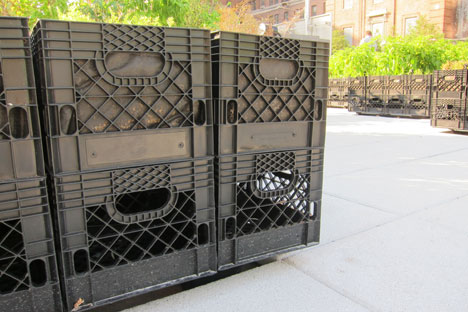
A Modesto-based dairy company has had enough of milk crate theft, which costs the U.S. industry an estimated $80 million a year.

Crystal Creamery, formerly known as Foster Farms Dairy, is working with law enforcement, grocers and other partners to combat the problem.

They are focusing mainly on large-scale thieves who try to sell the ground-up plastic to recyclers, although it’s also illegal to take a single crate for use as a toolbox or storage container.

“Milk crates have always disappeared, but in the last two or three years, the rate of disappearance is greater,” said Elliot Begoun, vice president of sales and marketing at Crystal.

He said the thefts have increased with the rising value of scrap plastic, which is based in part on the price of the petroleum used to make virgin plastic.

Begoun talked about the problem during an interview Tuesday at the Kansas Avenue headquarters of the company, still owned by the Foster family, which also is in the poultry business.

On a typical day, Crystal trucks haul about 60,000 crates filled with milk, sour cream and cottage cheese to grocery stores and food service customers from Bakersfield to the Oregon border. The drivers are supposed to bring back crates from previous deliveries, but they can be stolen if not secured at the customers’ locations, Begoun said.

Each time that happens, Crystal loses about $4, which is hard to take in an industry with tight profit margins, he said. Nationwide each year about 20 million crates are stolen, according to the International Dairy Foods Association.

Crystal is working with grocers on improved security, as well as with food banks, which sometimes get donations of dairy products in the crates.

The company also approached Stanislaus County Sheriff Adam Christianson. He said Tuesday that the crime is driven mainly by addicts looking for recycling income they can spend on drugs, similar to metal theft.

Christianson said he was surprised that the scrap value of plastic has risen so much. He noted other such commodities that are being stolen, such as used grease from restaurants, which rendering companies buy.

“Milk crates are no different,” the sheriff said. “It’s a material that can be recycled.”

Christianson said he is asking detectives to look into where the stolen crates are being ground up and recycled. They’re molded to include a warning against unauthorized use, and their distinctive appearance makes it hard to sell them intact.

The Institute of Scrap Recycling Industries warns member companies against accepting materials “that are clearly marked as property belonging to an entity other than the seller, such as beer kegs, milk crates and other marked materials.”

Crystal also is asking the public to resist the temptation to take a small number of crates for personal use. Begoun and Larry Diggory, director of food operations at the plant, said they have seen them used in retail displays, on the back of motorcycles and on plumbers’ trucks.

“What we’re trying to do is to create an awareness with the public that it’s theft and it’s a cost of business,” Begoun said.


2016-05-31T19:35:27-07:00June 10th, 2014|

U.S.: Limoneira Raises 2014 Income Guidance

U.S. lemon and avocado business Limoneira Company (NASDAQ: LMNR) recorded a sharp year-on-year rise in lemon sales in the second quarter, and buoyant prices for the fruit have led to a substantially higher income guidance for 2014.

The company’s lemon sales increased 17% during the period to reach US $18.1 million, and costs were only slightly up by US $700,000 amid acquisitions of Associated Citrus Packers and Lemons 400.

With the much higher sales and only a marginal increase in costs, operating income surged by 35% to US $3.2 million. EBITDA was down 2.3%, but it is important to note the company gained US $3.1 million in the second quarter last year by selling stock in Calavo Growers (NASDAQ: CVGW).

“Based on lemon prices we are currently enjoying, our results for the first six months of fiscal 2014 and our positive outlook for the back half of the year, we are raising our previously issued guidance for the full year results of operations,” said chief executive officer Harold Edwards.

“Importantly, even with the well-publicized drought in California, we continue to believe that our extensive water rights, usage rights and pumping rights will provide us with adequate supplies of water as we begin our seasonally strongest quarter of the year.”

The company said that with higher lemon prices expected, it has pushed up its previous operating income guidance from US $7 million to a range of US $10.6-11.8 million.

Limoneira said this approximately represented a 100% increase over its 2013 operating income of US $5.4 million.

“The expected increase in operating income is primarily due to the additional lemon revenue generated by the acquisitions of Associated and Lemons 400 and increased lemon prices, partially offset by lower expected avocado revenue,” the company said.

“Fiscal year 2014 pre-tax earnings are anticipated to be $11.3 million to $12.4 million compared to previous guidance of approximately $8.1 million, which is similar to fiscal year 2013 pretax income.”

After hours trading was strong for the stock, with shares up 3.54% at the time of writing.

2016-05-31T19:35:27-07:00June 10th, 2014|

Housing Market Recovery Helps Timber Producers

Source: Steve Adler; Ag Alert

Home construction in California is on the upswing as the housing sector slowly recovers from the dramatic downturn of the recession that saw home prices and new construction plummet.

Going hand in hand with the increase in home building is the demand for lumber for framing, moldings, doors, fences and other uses. California timber producers say they welcome the increased demand for lumber, but are held back by the regulatory climate in the state that cuts into their bottom line.

As a result of added costs and restrictions on timber harvest, California forestry owners say they have difficulty competing with their counterparts in Washington, Oregon and British Columbia who work in a more business-friendly climate.

An estimated two-thirds of the building materials utilized in California comes from the Pacific Northwest and Canada’s westernmost province.

“Lumber production in California has dramatically fallen off from where we were a couple decades ago,” said Mark Pawlicki, director of corporate affairs for Sierra Pacific Industries in Anderson. “We are harvesting around 1.4 billion board-feet of timber now in California, and that is less than half of what it used to be. A lot of the fallout has been because of the reduction in sales of timber in national forests. It is a combination of regulations involved and a philosophical change within the U.S. Forest Service that occurred back the 1990s.”

Timber owner Peter Bradford of Booneville, who serves as board liaison to the California Farm Bureau Federation Forestry Advisory Committee, said the high cost of regulations “adds a substantial amount” to the price of California timber.

“We are very over-regulated when compared to Washington, Oregon or British Columbia,” Bradford said. “There is a lot of material that comes in from Oregon and Washington because the cost to get a harvest plan to log the trees is easier and much less costly than it is here. It is time, paperwork and cost here in California.”

Despite these challenges, timber owners in California say they are more optimistic than they were a few years ago, when the market for timber had decreased significantly.

“Prices right now aren’t the greatest, but they are better than they were five years ago. For some of the redwood that we are selling this summer, we’ve been given a price of around $900 for 1,000 board-feet. Back in the heyday of the late 1990s, we were receiving $1,500 for that same amount of lumber,” Bradford said.

Pawlicki noted that lumber is a cyclical market.

“As everyone knows, housing construction has been way off in recent years, but it has been gradually coming back. We have seen improvements in U.S. housing construction and along with it improvements in lumber pricing,” he said.

There are currently about 30 lumber mills in California, a decline of 80 mills since the 1990s.

“With the downturn that we experienced in lumber demand, a lot of sawmills closed in California and we are roughly in balance now with supply and demand,” Pawlicki said. “As demand goes up, we expect to see some pricing increases for lumber—not dramatic, but nevertheless steady. And that helps us to maintain our industry here in California.”

Producing more lumber in California to meet the state’s demand, he said, would require “some significant changes in the regulatory world.”

“Folks are not too inclined to build a new sawmill in this state with the regulatory environment that we have,” he said.

Another concern is the tight labor supply, particularly for employees who are experienced in timber harvest and millwork.

“Labor is a tremendous issue in the timber industry right now, trying to get people who are able to do the work,” Bradford said. “This is frequently something you are born into and you know how to do it.”

The labor shortage is felt most acutely in the mills, according to Pawlicki.

“We are experiencing some difficulty filling jobs, particularly millwrights and technical folks in our mills. These mills now are very technical and computerized systems for sawing lumber. It requires a different skill-set than what was required in the past,” he said.

The California drought creates concerns for foresters for several reasons, including increased fire danger and a slowdown in tree growth that corresponds to the lack of water for the trees’ root systems.

“The drought stresses the trees and we will see some tree die-off. We are concerned that we may lose a lot of trees to drought—and when that happens, insect infestations occur and that kills even more trees, and this creates an increased concern for catastrophic wildfires,” Pawlicki said.

Bradford said wildfire concerns also build because of the problems that small landowners face in trying to harvest their timber.

“The amount of environmental review that they have to go through to get a timber harvest permit and the cost to get that review done, with the market value of timber now, makes it economically undesirable. As a result, some of these properties are being sold for home sites. With this increased population comes an increase in the fire danger,” he said.

Bradford said he has seen a buildup in understory in the forests—shrubs, bushes and grasses—that has created dangerous fire conditions.

“That is the worst part of it. The other thing, of course, is that without the normal amount of rainfall, the trees won’t grow as fast as usual. But that is something that is pretty hard to measure,” he said.

Despite the ongoing challenges facing the timber business, Pawlicki noted some positive signs.

“We are optimistic that the market is going to improve domestically. We are seeing some improvements in operating conditions in California, and we are seeing some improvements in the legislative and regulatory front that have helped us,” he said.

2016-05-31T19:35:27-07:00June 9th, 2014|

Key Agriculture Component Added to Governor’s Environmental and Economic Leadership Awards

For the first time in the history of the Governor’s Economic and Leadership Awards (GEELA), the category of Agricultural Ecosystem Services has been added for statewide recognition by the California Environmental Protection Agency.

The new category will spotlight the multiple benefits gained from farming and ranching, including innovative and sustainable approaches to water and energy conservation, food crop production efficiency, and management of working lands.

GEELA honors individuals, organizations and businesses that have demonstrated exceptional leadership and achievements in conservation, environmental protection, public-private partnerships, and strengthening the state’s economy.

Applications are due Friday, July 11, 2014 and may be obtained at www.calepa.ca.gov/Awards/GEELA/.

“Ecosystem services are an essential element in farming and ranching,” said CDFA Secretary Karen Ross. “They include waterfowl habitat in rice fields, pollinator support on farms, and the resolute commitment to conservation demonstrated throughout agriculture. I urge our farmers and ranchers to strongly consider this new category.”

More information about ecosystem services may be found at http://www.cdfa.ca.gov/EnvironmentalStewardship/EcosystemServices.html

Established in 1993, GEELA is administered by the California Environmental Protection Agency in collaboration with the Natural Resources Agency; the Department of Food and Agriculture; the State Transportation Agency; the Business, Consumer Services, and Housing Agency; the Labor and Workforce Development Agency; the Health and Human Services Agency; and the Governor’s Office.


2016-05-31T19:35:27-07:00June 9th, 2014|

Tree-killing bug invades Southern California

Source: Amina Khan; Los Angeles Times 

Akif Eskalen steps through the dense, damp leaves in a wooded neighborhood, scrutinizing the branches around him. He’s looking for evidence of an attack: tiny wounds piercing the bark and sap dried around them like bloodstains.

The victims are box elders, sycamores and coast live oaks, all in some state of suffering. Eskalen approaches a tree riddled with 1-millimeter holes, as if someone used it for miniature target practice. It’s time to nab a perp. He selects a hole, pulls out a large knife and expertly levers out a chunk of wood.

There, in his hand, is a glossy beetle no larger than a sesame seed: the polyphagous shot hole borer.

Though small and sluggish, its appetites are wide and its spread is relentless. It attacks forest trees, city trees and key agricultural trees. It has defied all conventional and chemical weapons. No one seems to have a way to stop it.

This cul-de-sac, in the foothill community of Pasadena Glen, has been particularly hard-hit. One giant tree was so weak that one of its trunks toppled from one resident’s yard across a creek and crashed into a neighbor’s. Another tree was filled with green jelly, its insides completely digested.

Anxious residents cluster around as Eskalen examines a wounded sycamore.

“We’ve got a canyon full of highly educated people who want answers,” said longtime resident Linda Williams, a retired business owner.

Eskalen, a plant pathologist at UC Riverside, wants to contain this invasive bug before it spreads throughout Southern California. Already the beetle has been sighted as far south as San Diego, as far west as Santa Monica, as far east as the Riverside County city of Eastvale.

Eskalen tips the beetle into a glass vial. He detaches a pink spray bottle from his backpack and administers a few lethal squirts of ethanol before twisting the vial shut.

These beetles have a strange M.O. They don’t eat wood, like termites; instead, they drill circular tunnels toward the heart of the tree. They carry fungal spores in their mouths and sow them like seeds as they go.

Then they harvest the fungus to feed their larvae. It’s a deadly partnership: The beetles attack, but the fungus also helps to kill, colonizing the wood tissue and spreading through the plant.

The beetles have easily evaded the authorities. Inside the tree, they’re well protected from pesticide sprays. The incestuous offspring mate with their siblings inside the trunk, so sex pheromones do not lure them out.

“If we can’t control them,” Eskalen said, “they are going to wipe out all our trees.”

Eskalen’s first contact with these devious bugs was in 2012, triggered by a desperate email from South Gate resident Chelo Ghaly. The real estate closer’s avocado tree had been oozing white spots all over its trunk.

Local gardening authorities were of no use. Suggestions to try fungal sprays failed. Frustrated, she scoured the UC Riverside website and found Eskalen, who studies avocado diseases. She sent him pictures of the damage.

Eskalen said he looked at the strange symptoms and grabbed his car keys.

After examining the fungus in Ghaly’s tree, he took his findings to the California Avocado Commission. To date, they’ve given UC Riverside scientists a total of $800,000 to broaden his investigation into this mysterious species of ambrosia beetle.

His survey came to a head when he reached the Los Angeles County Arboretum and the Huntington Botanical Gardens — two repositories of healthy, well-kept trees.

They’re not so healthy anymore.

At the Huntington in San Marino, Eskalen spied a diseased specimen. He hopped up, grabbed a high branch with both hands and bounced until it snapped off.

“Ach, Akif, really?” said Tim Thibault, the Huntington’s curator of woody collections. It didn’t matter: The plant was probably a goner.

Such pests typically feast on a small group of plants. But this one doesn’t seem to discriminate.

When Eskalen and his colleagues surveyed the 335 species at the Huntington and the Arboretum, in Arcadia, they found the beetle had attacked 207 of them and 54% of these victims were infected with fungus. Nearly two dozen of the trees were being used as reproductive hosts — places where the beetles can raise their brood.

The consequences of a wide-ranging infestation could be enormous. Common city trees, such as American sweetgum and maple, would become public branch-dropping hazards. Native trees such as the California sycamore and the coast live oak have started to succumb, creating a fire risk in the form of dead, dry tinder. Avocados and other crops could face huge financial losses.

Like any good forensic investigator, Eskalen is using DNA to crack the case. He started by sequencing the fungi from diseased trees and found there were three different species — two that may serve as food and one that may act as protection by fighting off competing plant pathogens.

He also enlisted UC Riverside entomologist Richard Stouthamer to examine the DNA of the beetles themselves. Stouthamer’s genetic analysis traced the bugs to Vietnam.

Experts aren’t sure how the beetle made its way to the U.S. Invasive species around the world are moved on human cargo, in clothes, in wooden shipping pallets and in boats’ ballast water.

The beetles are not as much of a pest in Asia — perhaps because some other critter keeps them in check. Maybe that natural enemy could be brought to California to fight the infestation, a practice known as biological control.

In March, Eskalen, Stouthamer and Thibault spent two weeks in Vietnam, searching forests and fields for these natural vigilantes. They collected a host of possible allies, whose DNA is being analyzed in the lab.

Thus far, what little is known about the polyphagous shot hole borer doesn’t place it in the alarm-raising category of the Mediterranean fruit fly or the Japanese beetle, which some say spread more quickly. The U.S. Department of Agriculture hasn’t imposed any restrictions to contain this beetle.

Still, Eskalen and others fear a worst-case scenario if not enough is done to contain the pest. The number of tree species attacked by the beetle now stands at 286.

Even as the Vietnam-related infestation spreads, Stouthamer’s genetic fingerprinting linked the incursion in San Diego to a different population in Taiwan.

While scientists try to get a handle on the situation, residents like Ghaly are struggling with the pest on their own.

Ghaly had been keeping the tree alive at Eskalen’s request. But as her tree worsened, she thought about her elderly mother cleaning up after the failing plant. There were also signs that the infestation in her neighborhood was spreading.


2016-05-31T19:35:27-07:00June 7th, 2014|

More Evidence of Damage From Drought/ Water Restrictions

The continual trend of water restrictions in regards to the drought on the Central Valley is affecting multiple facets of the Industry, and even exterior businesses as well.

Doug Thiel is the owner and operator of Thiel Air Care, Inc. located in Chowchilla. He provides aerial application service throughout the central Valley.  This season, his business is off  due to the drought and environmental regulations protecting fish and ducks.

“It’s tremendously slow, with zero water allocations in many areas of Merced County and throughout the West Side of Fresno and Kings County. It is  really hindering us. There’s nothing planted, there’s nothing to spray,” said Thiel.

2016-05-31T19:35:27-07:00June 6th, 2014|

New ACP Quarantine in Tulare

Big Effort in Place to Minimize ACP Spread

Too many local growers, its about eliminating and controlling the spread of the invasive insect which can carry a deadly disease on citrus known as citrus greening.

Gavin Iacono, a Deputy Ag Commissioner for Tulare County, where a new quarantine for asian citrus psyllid has been established.

“With this latest finds in the Ivanhoe area, the CDFA has expanded the quarantine which means now that it will connect the Dinuba area quarantine and then the rest of the county quarantine,” said Iacono. “So that realistically now the quarantine a goes from almost the Reedley area all the way down to just south of the Kern County line. Through the whole citrus belt area now.” He added.

Iacono notes that restrictions found in the quarantine.

“Well with the quarantine, it everything  thing will be the same as previously to move fruit outside the quarantine. It has to either has to be field cleaned or would to have to have a spray treatment on the orchard prior to picking and then moving. But any fruit that is staying within the quarantine it has no restrictions whatsoever, it can move freely within the quarantine.” said Iacono.

Iacono says the fruit is safe once it gets inside the packing house.

“Once the fruit has gone through the packing process, its no longer considered a host of the asian citrus psyllid, so then they’re free to be able to ship it anywhere they want to.” said Iacono.

And while the CDFA hasn’t made an official statement, it was reported yesterday that a new ACP has been discovered in a trap, west of Farmersville, in Tulare County.

We will keep you updated.

2016-05-31T19:35:27-07:00June 6th, 2014|

Merced Irrigation District Growers to Receive Increased Water Supply

Merced Irrigation District officials say growers in the district will receive additional surface water, after action taken Tuesday by MID’s board of directors.

The increased water supply is the direct result of regulatory relief MID received from the state after months of planning a multibenefit water management action for the Merced River, according to a press release from Mike Jensen, MID spokesman.

MID growers were most recently expecting 0.9 acre-feet of surface water supply this growing season. However, MID officials noted increased water supply would be available, and recommended increasing the allocation to 1.1 acre-feet of water per acre.

Class II growers will receive 0.55 acre-feet after Tuesday’s MID board action. Deliveries are expected to continue until Sept. 7, according to Jensen.

“This year still remains among the most challenging we have ever seen,” MID General Manager John Sweigard said in the release. “Nevertheless, we are extremely pleased there was some surface water supply relief for our growers.”

Additionally, the board voted to decrease the in-season agricultural water rate for growers from $100.67 per acre-foot to $75 per acre-foot. The new rate is retroactive and applicable to all surface-water use for the 2014 irrigation season.

The reduction in the 2014 water rates comes after MID growers recently approved a rate increase to $100 per acre-foot, ensuring the financial health of MID during the drought crisis. Since that time, MID implemented the multibenefit water management action for the Merced River after months of planning and receiving final approvals from the state.

It involved obtaining 25,000 additional acre-feet of water from Lake McClure for growers, and providing 5,000 acre-feet of water for a critical-year spring fish-flow in the Merced River. The spring fish-flow water was transferred to other water users after it served its environmental purpose in the river system. MID received $5 million in revenue to help the district recover lost revenue associated with the drought.

In addition to the surface water supply from Lake McClure, MID is again implementing its Supplemental Water Supply Pool Program. Growers have already elected to receive additional water that is made available from conjunctive groundwater pumping. The district expects to provide approximately 28,000 acre-feet of water through the program this year, the release said.

MID began deliveries April 21.

Facing a third dry year with unprecedented drought conditions, the board of directors earlier this year enacted penalties for any water theft this season. For a first offense, a grower will be fined $1,000 and be charged $500 for each acre-foot used. For a second offense, the grower would receive the same fines and penalties while losing access to MID water this year.


2016-05-31T19:35:28-07:00June 6th, 2014|

Turlock Irrigation District Will Rehab Reservoir

Source: John Holland

The board of the Turlock Irrigation District voted 5-0 Tuesday to fix up a small, abandoned reservoir near Hilmar to conserve canal water.

The $2.34 million project will catch water from the Highline Canal that now is released into the Merced River when flows are unexpectedly high. The water will go into Laterals 7 and 8, which serve farmland near the south end of TID’s territory.

A staff report said the project will save an average of 2,550 acre-feet of water per year, and a future expansion could boost that to about 9,000. TID delivers close to 360,000 acre-feet in a normal year throughout its service area, but the drought has cut 2014 supplies roughly in half.

The district, which gets its water from the Tuolumne River and wells, also faces a long-term reduction in the river supply because of state and federal efforts to protect fish.

The project is scheduled to be completed by the start of the 2015 irrigation season. The board also approved spending $960,000 on automated gates that will make flows on Lateral 8 more consistent.

The reservoir site is owned by the Hilmar County Water District, which provides water and sewer service to the town of Hilmar. The TID board appointed General Manager Casey Hashimoto to negotiate the purchase of the property.

Modesto Irrigation District, which also draws from the Tuolumne, also has been looking at building small reservoirs to catch canal water that now ends up in natural streams.


2016-05-31T19:35:28-07:00June 6th, 2014|
Go to Top