About Patrick Cavanaugh

This author has not yet filled in any details.
So far Patrick Cavanaugh has created 1490 blog entries.

California Water Feeds Our Communities Tackles Rural Hunger

California Water Feeds Our Communities, a grassroots effort consisting of local businesses, service organizations and farmers, has partnered to help our communities who are suffering from the lack of water. As the summer progresses and less water is available, the need for resources will increase.
Community Food Bank CEO Andy Souza explained, “Our rural communities are suffering, and as we are challenged to keep up with the food lines at distribution sites, the generosity of our community can help us bridge the gap with financial and food donations.”

Local grower Sarah Woolf said, “This event is an ideal opportunity for our community to participate in helping those who are hardest hit by the drought. These are people whose livelihood depends upon a vibrant agricultural industry.”

The current zero water allocation for most of the Central Valley and the severe statewide drought is the inspiration for this event. The success of our state is tied to water which produces not only food but jobs and spurs the economy.

Promoting the need for food donations brings necessary focus on water and demonstrates how our state’s future depends upon a reliable water supply. Those wishing to donate can do so by phoning the Community Food Bank at 559-237-3663 ext. 113 or online at their website at:  http://communityfoodbank.net/HowToHelp.aspx.

California Water Feeds Our Communities is a grassroots effort to raise the awareness of the important role that water plays in California agriculture and everyday life. The drought has directly impacted our communities, farm workers and farmers. Many are devastated by the lack of water. 
2016-05-31T19:34:16-07:00July 16th, 2014|

United Fresh Foundation Offers Produce Solutions to Schools at 2014 School Nutrition Conference

The United Fresh Foundation is providing expert assistance to schools seeking to serve more fresh produce with the first-ever Fresh Produce Pavilion at the School Nutrition Association Annual National Conference in Boston, July 13-16.

The 1600 sq. ft. pavilion features an “Ask the Experts: Produce Solutions Center” and produce exhibits that establish a destination area on the trade show floor focused exclusively on promoting fresh fruits and vegetables.

The “Ask the Experts: Produce Solutions Center,” sponsored by PRO*ACT, features produce distributors from around the country including, Costa Fruit & Produce, Inc.  (Charlestown, MA), Hardie’s Fruit & Vegetable Co. (Houston, TX), Muir Copper Canyon Farms (Salt Lake City, UT), Royal Food Service (Atlanta, GA) and Van Eerden Co. (Grand Rapids, MI).

The produce experts serve as consultants for schools to answer all their produce-related questions, share guidance and tips for writing produce RFPs, discuss how to establish collaborative business relationships between schools and produce distributors and showcase the wide variety of fresh and fresh-cut fruits and vegetables that are ideal for school foodservice.

The Pavilion also has a fresh vending machine stocked with single-serve fresh cut fruits and vegetable and salads that illustrates products ideal for meeting the new “Smart Snacks in Schools” nutrition standards.  United partnered with the National Automatic Merchandising Association to have the Fit Pick vending machine on display.

“Having a strong, face-to-face presence at the SNA conference allows United and the fresh produce industry to demonstrate their commitment to helping  school nutrition operators find the most efficient ways to provide a variety of fruits and vegetables that their students will enjoy,” said Dr. Lorelei DiSogra, vice president of nutrition & health at United Fresh.

“We are pleased with the industry support given to this first-ever pavilion designed to help schools maximize their success in serving a variety of fresh fruits and vegetables,” said United Fresh CEO Tom Stenzel. “This strategy connects us with hundreds of school foodservice directors from across the country, helping them understand the unique aspects of the fresh produce marketplace, as well as making sure they’re aware of the many fresh and fresh-cut produce items that that can appeal to the next generation of produce consumers.”

“We appreciate PRO*ACT’s assistance in staffing the ‘Ask the Experts’ area, where school foodservice directors will be able to consult with experts outside of their own procurement process. This affords a consultative environment in which buyers are not negotiating with their own vendors, but instead are learning from distributors who are not trying to win their business,” Stenzel added.

Exhibitors at United’s Fresh Produce Pavilion include:

  • Chiquita Brands International
  • Duda Farm Fresh Foods
  • Grimmway Farms
  • HMC Farms
  • Mushroom Council
  • National Watermelon Promotion Board
  • NatureSeal
  • Pear Bureau Northwest
  • PRO*ACT
  • Ready Pac Foods
  • San Miguel Produce

The Pavilion also features a salad bar to promote Let’s Move Salad Bars to Schools. School foodservice directors attending the SNA conference are invited to enter their names to win the salad bar.  United Fresh is a founding partner of Let’s Move Salad Bars to Schools, which has to-date donated salad bars to more than 3,400 schools nationwide.

Additionally, United has organized educational sessions at the SNA show. The programs, titled “Your Produce RFP: Achieving Variety, Quality and a Collaborative Relationship,” will include panel and roundtable discussions among school foodservice directors and produce distributors.

For more information about United’s Fresh Produce Pavilion and how you can participate in the 2015 SNA conference, contact Andrew Marshall at 202-303-3400.

2016-05-31T19:34:16-07:00July 15th, 2014|

Deadline Extended by Two Weeks for State Water Efficiency & Enhancement Program

The California Department of Food and Agriculture (CDFA) has extended its deadline for applications for the State Water Efficiency and Enhancement Program (SWEEP) by two weeks, until July 29, 2014.

An estimated $10 million in competitive grant funding, authorized by emergency drought legislation (Senate Bill 103), will be awarded to provide financial assistance to agricultural operations for implementation of water conservation measures that result in increased water efficiency and reduced greenhouse gas emissions.

Applications must be submitted electronically using FAAST by Tuesday, July 29, 2014 at 5:00 p.m. PST.

Applicants must access the Application Guidelines for detailed information and program requirements. To streamline and expedite the application process, CDFA is partnering with the State Water Resources Control Board, which hosts an online application using the Financial Assistance Application Submittal Tool (FAAST).

All applicants must register for a FAAST account at https://faast.waterboards.ca.gov.

Prospective applicants may contact CDFA’s Grants Office at grants@cdfa.ca.gov with general program questions.

Governor Brown has called on all Californians to reduce their water use by 20 percent and prevent water waste – visit  SaveOurH2O.org to find out how everyone can do their part, and visit  Drought.CA.Gov to learn more about how California is dealing with the effects of the drought.


2016-05-31T19:34:16-07:00July 15th, 2014|

Fresno County Crop Value Drops to $6.43 Billion

For the first time in history, Fresno County has two $1 billion crops, and for the first time in 11 years, grapes are not the #1 crop. Now almonds are the top crop produced in Fresno County with a value of $1.1 billion, with grapes coming in second at $1.03 billion. However, despite these highlights, Fresno County crop value in 2013  was $6.436 billion in gross production—a decrease of 2.28 percent of 2012.

Fresno Ag Commissioner Les Wright

Fresno Ag Commissioner Les Wright

As it stands now, Fresno County loses it’s #1 position as top agricultural county in the nation, dropping behind Tulare County, which recently announced a $7.8 billion 2013 crop year. It could get worse when Kern County releases their report in August.

“Much of the decrease can be attributed to the shortage of water,” said Les Wright, Fresno County Ag Commissioner. “The impacts of drought began to show on our 2012 crop report with decrease of 2.29 percent from 2011. Producers are feeling the affects of the water shortage more in 2014 than in the previous two yeas.”

Water shortages in Fresno County with a large part of the West Side dependent on both state and federal surface water deliveries have meant the annual crop report’s gross value of production has dropped three years in a row.

Details of the 2013 report include an increase of fresh vegetable production in 2013 by 3.8 percent in value led by garlic and fresh market tomatoes, while livestock and poultry decreased in value by more than 16 percent.

Field crops, representing barley, wheat, corn silage, cotton an alfalfa declined nearly 42 percent, while fruit and nut crops increased more than 8 percent.

Wright noted that Fresno County growers exported nearly 26,000 shipments to 99 different countries. “This tells us that we are still feeding the world,” said Wright.

“Once we get water back, we are going to see our ag economy rebound,” said Wright. “Just give the farmers water and they will do the rest.”


2016-05-31T19:34:16-07:00July 15th, 2014|

President/CEO Westside Produce on Food Safety

Stephen Patricio, President and CEO of Westside Produce, a grower, packer and shipper of cantaloupe for California and Arizona, talks about food safety of our locally grown foods.

“The Center for Produce Safety is a 7 year-old organization that facilitates science-based actionable research to improve the quality as well as the safety of the healthy fruits, vegetables and tree nuts we are so proud of,” said Patricio.

Patricio commented that in general, growers have a great understanding of food safety. “There’s been a tremendous awareness over the years I’ve been actively involved, and we’re maturing everyday. Realistically, the industry matures, the workers mature, because the elements of food safety don’t exist in an ivory tower or in an office, or in a tractor or in a shop; they exist everywhere on the farm,” said Patricio.

“From the absolute beginnings on the dirt all the way through the packing houses to the shipping docks to the sales offices; it’s a culture. Food Safety is a culture, not just an action,” he added.

And for those consumers worried about the nutrition and safety of their produce, Patricio reassures that everyone involved in produce cares just as much as they do. “What I continue to tell people is that there is not a farmer, producer, or grower anywhere who doesn’t eat the product that they produced themselves. And, they feed it to their family, their children, their grandchildren. And they’re proud of it, they’re happy with it.”

Patricio continued, “If that’s the approach that people simply take to their daily actions and activities, well, I don’t have to worry about the safety of food. We just have to use our heads and manage temperature and everything from spoilage to cross-contamination that can happen anywhere. But you do a good job of creating a safe product,” said Patricio.

The beauty of California produce, according to Patricio is that it is “not a sterile environment. Everything isn’t produced in a factory, taken off a shelf, or torn out of a plastic container. It’s all healthy and from nature. It’s in God’s container and we just have to do our job of not contaminating it.”

2016-05-31T19:34:17-07:00July 14th, 2014|

Ag Official on Asian Citrus Psyllid in Tulare County

Marilyn Kinoshita, Tulare County Ag Commissioner, talks about the Asian Citrus Psyllid and how its affecting growers in the area.

“Our growers have the heavy commercial production as opposed to the ranchettes in San Diego Count, so we got more emphasis on spray treatments immediately after a find. We’ve had really good success rate, and so our trapping program is top-notch, so if psyllids are found, we have the ability to eradicate immediately and keep it under control that way,” said Kinoshita.

The Asian Citrus Psyllid, or ACP, is a tiny insect that acts as a carrier of the citrus disease Huanglongbing, also known as citrus greening disease. this bacterial disease is transmitted by the ACP, after it feeds on affected plant tissue.

Without proactive measures such as quarantine and eradication treatments, ACP could have dire consequences for the entire California citrus industry.

“We always knew that we were going to be ground zero. Because we’ve got the most packing sheds in the state, and the most juice facilities, and we’re receiving products from Mexico, Texas, Arizona, and Southern California and our growers need to stay diligent. We got all but 13,000 acres of citrus within the quarantine area, and so that can cause some problems with not having the entire county included,” said Kinoshita.

Citrus Greening Disease has only recently become a problem for California. The first infected plant was discovered in March 2012. It has still caused a concern in that short period of time, as the California Department of Food and Agriculture has found that here is no physical, cultural, or biological methods to completely eradicate ACP.

“So far we are dealing with it, and I have heard that this fall would kind of be the ‘trigger point’ that the Southern California counties saw at the two and a half year point of having Psyllids in their county. So we will see,” said Kinoshita.

2016-05-31T19:34:17-07:00July 14th, 2014|

UC Research on Effects of Herbicide Milestone

Milestone, a herbicide from Dow AgroSciences, was registered about 9 years ago in California for mainly cattle ranged applications, targeting problem weeds.

Guy Kyser with the Department of Plant Sciences at UC Davis looked at how the herbicide was affecting good perennial grasses.

“Its used mostly for broadleaf weeds, its been a real help with the Yellow Starthistle. There was some concern about whether it might affect seedling grasses, especially the perennial native plants that we want to replant after controlling yellow star thistle, because it got a little bit of soil residual, which is good for thistles but we wanna make sure it wasn’t hurting our grasses, and that’s what this trial is. We treated several rates of Milestone, and replanted with several species of native California perennial grasses, to see if there was any impact on the seedlings.

Kyser found out that the important grass species are more tolerant to Milestone applied at the time of planting, then when milestone is applied to young seedlings. He noted that California Brome is the most tolerant grass to Milestone.

Kyser’s research was featured at the recent 58th annual UC Davis Weed Day.

2016-05-31T19:34:17-07:00July 14th, 2014|

Tips on Minimizing Herbicide Drift

Its critically important to minimize drift when applying crop protection materials.

Alan James is a Technical Services Agronomist with Mid Valley Agriculture Services, based in Linden, in Stanislaus County. James noted the usual drift issue.

“We get called out all the time by the growers themselves, ‘What are those spots on my leaves?’ and eight times out of ten, it’s drift from the herbicide application they put on, on their own. There is always a little bit, you can’t eliminated drift, you can minimize it,” said James.

James points out some practical strategies in minimizing drift, and not just the obvious of not spraying during heavy wind.

“They need to think about the type of nozzles, the 800 nozzle produce fewer finds than the 110 nozzles, and they came out a few years ago with an extended range, T-Jet extended range nozzle, which allowed you to work at lower pressure and still the coverage,” said James. “And since then there has been at least 2 types of air induction nozzle, where you draw air in, and produce droplets that are bigger because they are wrapped around a little bit of air, and they tend to settle quicker,” he added.

Low pressure is the key, says James.

“You get a good pattern with 15-20 PSI, which produces much fewer finds if you are up at 30-40 PSI. and sometimes they think the higher the pressure the better ill drive it down into the weed, and that has nothing to do with that, it just producing more finds.” said James.

James comments on the scenario of worn out or missing nozzles.

“Every year, you ought to start out with a new set of nozzles, and make sure they are all the same. That is the other thing, when they have weed sprayers got 8 nozzles across the boom, and one plugs up, they have to put in the that plugged one, whatever they got in their pocket. which may or may not be the right size.” said James.

2016-05-31T19:34:17-07:00July 14th, 2014|

Save Our Water Does Double Duty at State Fair, Hosts Exhibits Featuring Indoor and Outdoor Water Saving Tips

The drought is on and so is the California State Fair. This year, the Save Our Water campaign is doubling down its messaging on conservation by hosting two exhibits at the fair – one on indoor water conservation and the other on outdoor conservation.

Save Our Water is the water conservation campaign co-managed by ACWA and the California Department of Water Resources (DWR).  Staff from both organizations will be on hand this year to help attendees identify opportunities to conserve.

The outdoor garden area exhibit on outdoor water conservation tips is themed “It’s Easy as 1, 2, 3.” Its featured tips are:  1 – Get efficient– with your Irrigation system. 2 – Get smart with new technology. 3 – Get green with great plants, compost and mulch.

The indoor exhibit is set up to look like a home to inspire fairgoers to conserve water. It offers three islands that focus on saving water in the kitchen, laundry, and bathroom. Each island has an interactive component.

“Californians have a great resource in Save Our Water to help them combat this extraordinary drought,” said Tim Quinn, executive director of the Association of California Water Agencies. “We hope taking part in events like the State Fair will encourage even more of us to join the effort to save water.”

Mark Cowin,  director of DWR, added:  “The State Fair has always been a great opportunity to connect with Californians and spread the message of how important it is to save water. Now that the drought has brought the issue of conservation to the forefront, the Save Our Water displays are especially timely.”

Save Our Water has been connecting Californians to daily drought tips and news via its recently launched Don’t Waste Summer campaign. The campaign is devoted to providing daily tips and news on the new microsite –SaveOurWater.com– to help Californians find ways to conserve at home and at work every day. Save Our Water’s Facebook page, Twitter and Instagram are also great resources for Californians looking to join the effort to save water.

To learn more about the Save Our Water program, visit saveourh2o.org.

2016-05-31T19:34:17-07:00July 14th, 2014|

Legislation would help manage forests, prevent wildfire

By: Rayne Pegg and Erin Huston; Ag Alert

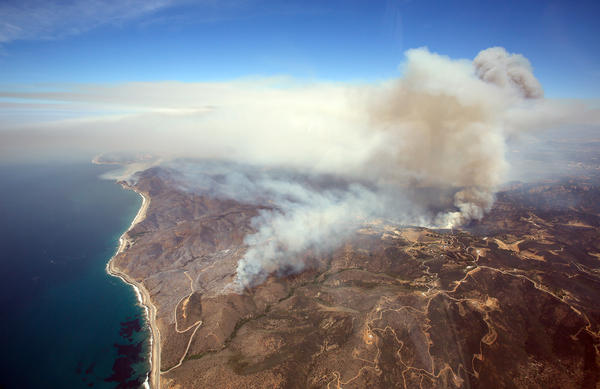
Last year’s Rim Fire, California’s third-largest fire, understandably garnered a lot of media attention. More than 250,000 acres burned, private property was lost and significant water resources were placed at risk of impairment.

As we enter the 2014 fire season after a winter of significant drought, it is timely to reflect on the series of events that place California at risk of extreme wildfire. It is also important to remember how costly the devastation from just one fire can be. Individually, the Rim Fire cost $130 million to suppress—and this does not include the damage to rural communities, the environment or economic activities that rely on the forest.

California has already experienced numerous fires this season and the outlook for 2014 shows significant wildland fire potential. Fires are historically common in California and can actually prompt a regrowth process for several species. However, we’ve reached a point where fires burn hotter and more frequently than ever. Fires of this intensity and size threaten our rural communities, environment, water supplies, and federal and state budgets.

Devastating wildfires represent a cost associated with not managing our forests. Fires that once burned every 10 to 15 years, naturally, allowed for new tree and vegetation growth and the release of regenerating seed. However, today’s fires are less frequent, cover larger acreage, burn hotter and pose a greater risk to life and property.

Forest management on federal lands to reduce dead trees, thin densely grown areas and remove brush is significantly backlogged and commonly subject to nonsensical litigation, resulting in overgrown tree canopies, increased presence of disease and diminished wildlife habitat. This backlog and inability to properly manage our forests results in a series of destructive wildfire seasons.

Just as homeowners maintain their private gardens to manage overgrowth, weeds and dead plants so healthy plants can thrive, our forests need to be managed. But timber harvesting and thinning of trees have become fraught with litigation, which has left forestland to become overgrown with trees and underbrush, making it perfect habitat for forest fires.

Timber harvesting is often depicted as clear cutting that results in our lush forests looking like vacant lots. But most forestry in California consists of selective harvest, limited to younger trees within a range of height and width. Older-growth trees are left to grow and stabilize the soil, while dry brush and dead trees are cleared from the forest floor. Thinning out only selected trees and clearing the forest floor of dead brush creates spacing for new, beneficial vegetation and reduces overgrown brush and dry vegetation.

We also need to recognize that rural towns rely on foresting jobs to survive. Though growing marijuana is becoming popular in these areas, the money generated from that activity does not stay in the community and support local schools, public services or roads.

Because not enough money has been set aside in the federal budget to fight wildfires, money for forest-management activities ends up being robbed. Here’s how: The U.S. Forest Service and the Department of the Interior are the two federal entities responsible for wildfire suppression. Suppression funding levels are based on the 10-year average of suppression costs; currently, that’s not enough to provide the necessary level for suppression activities nationwide. When suppression funding runs out, which happens regularly, both the USFS and DOI have the authority to transfer funds from within their budgets to make up for shortfalls. So money is usually taken away from non-suppression programs, including land management programs that decrease long-term wildfire risk and costs.

In the last two years, more than $1 billion was taken from 2013 and 2014 appropriations bills to repay the transfers from 2012 and 2013. It is estimated that the fiscal year 2014 wildfire season suppression is underfunded by $470 million, which will likely lead to another round of transfers that will again short-change forest management and other programs.

For this reason, the California Farm Bureau Federation is a member of the Partner Caucus on Fire Suppression Funding Solutions, a diverse coalition working to pass legislation known as the Wildfire Disaster Funding Act. The WDFA would change the approach to funding wildfire suppression by developing a wildfire emergency funding process for a portion of USFS and DOI suppression activities similar to funds for other natural disasters such as hurricanes, floods and tornadoes.

The legislation would treat catastrophic wildfires as the “predictable” emergencies that they are and provide a more reliable funding structure that does not harm land management and wildfire risk-reduction activities. In the rare case it should become necessary, USFS and DOI would retain their financial transfer authorities.

We must plan for catastrophic wildfires and manage our forests. Rather than relying on annual emergency appropriations to suppress fires we expect, this legislation provides a consistent, predictable funding stream that protects critical forest management activities that benefit the California economy and our forests.

2016-05-31T19:34:17-07:00July 14th, 2014|
Go to Top