About Patrick Cavanaugh

This author has not yet filled in any details.
So far Patrick Cavanaugh has created 1490 blog entries.

CA DPR to Regulate Rodenticide

CA DPR To Designate Rodenticide Products as Restricted Materials


By Laurie Greene, Associate Editor

The Department of Pesticide Regulation (DPR) proposes to amend and adopt sections of Title 3, California Code of Regulations. The proposed action would designate the active ingredients brodifacoum, bromadiolone, difenacoum, and difethialone as California-restricted materials, making all second-generation anticoagulant rodenticide (SGAR) products restricted materials.

Also, this proposed action would add additional use restrictions for SGARs and revise the definition of private applicator to refer to the federal definition of agricultural commodityfound in the Code of Federal Regulations section 171.2(5).


Any interested person may present comments in writing about the proposed action to the agency by emailing <dpr13002@cdpr.ca.gov> or faxing 916-324-1452no later than 5:00 p.m. on September 3, 2013.

A public hearing is not scheduled. However, one will be scheduled if any interested person submits a written request to DPR no later than 15 days prior to the close of the written comment period.

DPR has determined that the proposed regulatory action does affect small businesses.


As background, pesticides must be registered (licensed for sale and use) with the U.S. Environmental Protection Agency (U.S. EPA) before they can be registered in California. DPR’s preregistration evaluation is in addition to, and complements, U.S. EPA’s evaluation. Before a pesticide can be sold or used, both agencies require data on a product’s toxicology and chemistry, how it behaves in the environment, its effectiveness against targeted pests, the hazards it poses to non-target organisms, its effect on fish and wildlife, and its degree of worker exposure.

DPR’s current definition of private applicator refers to an individual who uses or supervises the use of a pesticide for the purpose of producing an agricultural commodity.

The term agricultural commoditymeans any plant, or part thereof, or animal, or animal product produced by a person (including farmers, ranchers, vineyardists, plant propagators, among others) primarily for sale, consumption, propagation, or other use by man or animals.

In addition, U.S. EPA specified as a term/condition of sale/distribution in the reregistration notices of all SGAR products that the registrant can only sell or distribute these products in a manner that results in sales in stores oriented towards agricultural consumers (i.e., farm, agricultural, tractor stores) and pest control operators.

DPR anticipates delaying the effective date of this regulation by as much as six months to ensure there is adequate time for entities impacted by these regulations to comply with the new certification requirements.

2016-05-31T19:47:09-07:00July 24th, 2013|

Practical Knowledge Leads to Good Jobs

Growing Demand for Ag Students

By Patrick Cavanaugh, Editor

Clint Cowden, an instructor at West Hills Community College in Coalinga, knows about the demand for specific jobs in agriculture.

A special program for training future Pest Control Advisors (PCAs) and Certified Crop Advisors (CCAs) is available at West Hills.

“Many of the large growers in our area came in and asked if we had students available who could help them on their operations. They were looking for on-the-farm PCAs and CCAs on the private side,” said Cowden. “They are also looking for welders, irrigation managers, and equipment operators.”

“In fact, PG&E has stated that they will need up to 5,000 welders over the next five years,” Cowden stated. “We have students coming in and training for this demand.”

Students get the text-book training along with practical hands-on experience in many areas in agriculture. “Students complete the programs with certificates stating that they meet all the rigorous demands that businesses will need,” Cowden said. “Our students typically get an average of 20 separate certificates that are backed by national professional associations and many industries.”

“Instead of the college professors teaching kids what they think they should learn, the industry got together and stated the true skills that students need to succeed in those industries,” Cowden said. “We want our students to clearly have the skills they need to succeed, and the certificates will state what skills they have,” he said.

Students earn an Associates Degree in Ag Science and Technology, and the credits are transferable to other colleges and universities such as Cal Poly San Luis Obispo, UC Davis, California State University Fresno, or others.

Cowden noted that the PCA/CCA program is taught with on-line lectures and face-to-face nine-hour labs across three weekends. “This enables students to stay employed where they are and work around their job to earn the new skills,” he said.

An update on the Bachelors Degree requirement for a PCA license:  “It’s known as Option 3 and approved by the Department of Pesticide Regulation. The requirement is 42 Science Units over 24 months, and the students can take the required PCA exam for a license. For the CCA license, five years of experience is required.

The next PCA/CCA class starts on August 19.

2016-05-31T19:47:09-07:00July 24th, 2013|

Protecting Citrus Genes in case of HLB Wipeout

Scientists Put Citrus in “Deep Freeze”

for Preservation

BY LAURIE GREENE, ASSOCIATE EDITOR

U.S. Department of Agriculture (USDA) scientists are creating a backup storage site or “genebank” for citrus germplasm in the form of small buds, called shoot tips, which have been cryopreserved, according to Jan Suszkiw, USDA Public Affairs Specialist.


Plant physiologist Gayle Volk of the Agricultural Research Service (ARS) is applying the procedure to create a long-term genebank for important citrus varieties, breeding lines and wild citrus species. These efforts coincide with concern over the spread of citrus greening, an insect-borne disease first detected in the U.S. in August 2005, has been found in California, and which now threatens the nation’s citrus crop, valued at $3.4 billion in 2011-12.


In cryopreservation—that is, the process of being plunged into liquid nitrogen—Volk saw a way to safeguard valuable germplasm without fear of losing it to insects or disease, as well as natural disasters such as freezes, droughts and hurricanes. Instead of safeguarding whole plants or trees, her approach involves cutting tiny shoot tips from new growth, called “flush,” and cryopreserving the material for long-term cold storage inside state-of the-art vaults.


To date, Volk, together with ARS colleagues Richard Lee, Robert Krueger and others, have cryopreserved the shoot tips of 30 cultivars acquired from citrus germplasm collections managed at Riverside, Calif., by ARS in collaboration with the University of California-Riverside.


In preliminary experiments, an average of 53 percent of shoot tips survived being cryopreserved and thawed for use in rootstock grafting procedures, which enable generation of whole citrus plants.

2016-05-31T19:47:09-07:00July 24th, 2013|

Tulare County Ag Value Just Behind Fresno!

Tulare County 2012 Crop Report Production Value Up 10 Percent

Tulare County’s total gross production value for 2012 is $6.22 billion. The report, released today, showed an increase of  $581 million, or 10 percent above the 2011 value of $5.6 billion.
Dairy products continue to be the leading agricultural commodity in the County, with a total gross value of $1.8 billion, a decrease of 12 percent.
“Milk represents 29 percent of the total crop and livestock value for 2012,” said Marilyn Kinoshita, Tulare County Agricultural Commissioner. “Total milk production in Tulare County remained relatively stable,” she said. 

Possibly, if milk prices were a little higher during the year, Tulare County would have beat Fresno County for the first time!
“Livestock and Poultry’s gross value of $661 million represents an increase of 5.8 percent above 2011, mostly due to an increase in value for turkeys, cattle and calves,” noted Kinoshita.
Fruit and nut commodities were valued at $2.8 billion representing an increase of 29 percent. “The majority of this gain was the result of an excellent year for our grape category,” Kinoshita noted.
The total value of all field crops was $776 million, an increase of 24 percent from 2011. “Local demand for dairy feed continues to keep high values for our field crops. Nursery products were valued at $67 million, representing an increase of 2.5 percent over last year. “This minor increase is a reflection of the continued uncertainties in both the housing and agricultural markets,” Kinoshita explained.
Vegetable crops were valued at $20 million in 2012, representing a less than one percent increase.
“The 2012 report covers more than 120 different commodities, 43 of which have a gross value in excess of $1 million. Although individual commodities may experience difficulties from year to year, Tulare County continues to produce high-quality crops that provide food and fiber to more than 84 countries throughout the world,” said Kinoshita.
Kinoshita expressed appreciation to her staff, particularly Lea Pereira, Jacqui Balderas, and Dennis Haines for their contributions to the report.
2016-08-31T13:28:59-07:00July 23rd, 2013|

Ag Education Pays

Students Awarded More Than $225,000

in Farm Bureau Scholarships


More than 70 students wishing to pursue careers as farmers, ranchers or in occupations related to agriculture earned $226,200 in scholarships from the California Farm Bureau Scholarship Foundation. The Foundation has distributed more than $2 million in scholarships since its inception in 1955.

The scholarships are awarded based on students’ academic achievements, leadership skills, career goals, extracurricular activities and other factors.

Following interviews with the applicants, the foundation awarded $2,500 in special scholarships to six students:

   Ryan Lundberg of Chico won the Howard P. Wackman II Perpetual Memorial Award, a scholarship named for the late California Farm Bureau Federation vice president. Lundberg will be a junior this fall at California State University, Chico, where he majors in agricultural business. He plans to become a pest control advisor and help on his family’s rice farm.

   Gavin Abraham of Livingston earned the Frederick J. Heringer Honorary Award, a scholarship named for the late CFBF president. Abraham will be a sophomore at California State University, Fresno, and after graduation hopes to return home to help run the family farm.

   Bronté Phillips of Ceres was granted the Carolyn Richardson Memorial Award. A senior at California State University, Stanislaus, Phillips plans to attend law school after graduation to pursue a career in agricultural law or lobbying. The scholarship is named for the late CFBF environmental advocate.

   Jacob Carlson of Elk Grove earned the John H. Wiechman Memorial Award, a scholarship given in memory of the late CFBF Leadership Development Manager. Carlson will be a sophomore at Fresno State, majoring in animal science, with plans to pursue a career as a large-animal veterinarian.

   Bethany Couchman of Modesto and Joshua Donnelly of Sacramento were awarded scholarships sponsored by the Agricultural Lenders Society of California. Couchman is a sophomore at California Polytechnic State University, San Luis Obispo, studying agribusiness. She plans to pursue a career as a production manager and eventually earn a master’s in business administration. Donnelly will be a junior at the University of California, Davis, and majors in managerial economics. He plans to become a beef cattle producer and commodity market analyst.

A sixth special scholarship category, the Rustici Livestock and Rangeland Scholarship Award, benefits rangeland-management students who plan careers in beef or sheep ranching or in range management. Thirty-six students earned Rustici scholarships for $2,500 or $5,000: Lindsey Affonso, Palo Cedro; Frank Arburua III, Stockton; Jessica Arndt, Inverness; Erica Bianchi, Gilroy; Bailey Bidwell, Hat Creek; Kendra Brennan, Sonora; Clayton Brown, San Luis Obispo; Emily Cehrs, Sanger; Hope Connolly, Tracy; Brandon Denier, Galt; Jaxon Fitzgerald, Palo Cedro; Sydney Fultz, Modesto; Kathleen Furtado, Bakersfield; Kristine Gomez, Philomath, Ore.; Bailey Hagata, Susanville; Tom Hardesty, Elk Grove; Jackie Hardesty, Elk Grove; Justine Henderson, Cottonwood; Natalie Holmberg-Douglas, Penn Valley; Alison King, Atwater; Leland McDonald, Galt; Cody McDougald, Friant; Stephen Miller, Tracy; Katie Olagaray, Lodi; Joshua Polich, Visalia; Weston Roberti, Loyalton; Jacob Rogers, Glennville; Jordan Sparrowk, Clements; Katie Stroud, Adin; Kaitlin Swickard, Susanville; John Thompson, Hollister; Grace Tobias, Tres Pinos; Kiah Twisselman, Santa Margarita; Dustin Wallis, Arcata; Austin Whittle, Susanville; and Lee Yantis, Bakersfield.

California Farm Bureau Scholarship awards of $1,000 to college seniors and $1,250 to enrolled college students were granted to 36 students: Collin Abraham, Livingston; Kristin Alamo, Modesto; Suzanne Amaral, Sonoma; Kerilyn Ambrosini, Ferndale; Hannah Beeler, Escalon; Adrienne Bradley, Grass Valley; Jana Colombini, Linden; Jason Colombini, Linden; Joshua Dowell, Coarsegold; Maddie Dunlap, Maxwell; Adelaide Dyer, Alpine; Maddison Easley, Nevada City; Brandon Emery, Winters; Casey Erickson, Porterville; Katerina Flores, Marina; Hannah Fortin, Janesville; Francesca Gambonini, Petaluma; Mackenzie Gomes, Willows; Ben Granholm, Grass Valley; Brea Haller, Imperial; Kimberly Macintosh, Sutter Creek; Corinne Madison, Acampo; Kellie Mancino, Hollister; Alex Marsh, Arbuckle; Natalie Massa, Willows; Amy McBirney, Morgan Hill; Jake Odello, Carmel; Taylor Pires, Los Banos; Katherine Roberti, Loyalton; Courtney Taylor, Yuba City; Gianna Toso, Hornitos; RaeAnne vanTol, Ramona; Jessica Vazquez, Cottonwood; Samantha Viano, Martinez; Danielle Wood, Susanville; and Taylor Zumstein, Fallbrook.

The California Farm Bureau Federation works to protect family farms and ranches on behalf of more than 74,000 members statewide and as part of a nationwide network of more than 6.2 million Farm Bureau members.

2016-05-31T19:47:09-07:00July 23rd, 2013|

Water Board Proposes Drought

Possible Drought?

State Water Board Thinks So

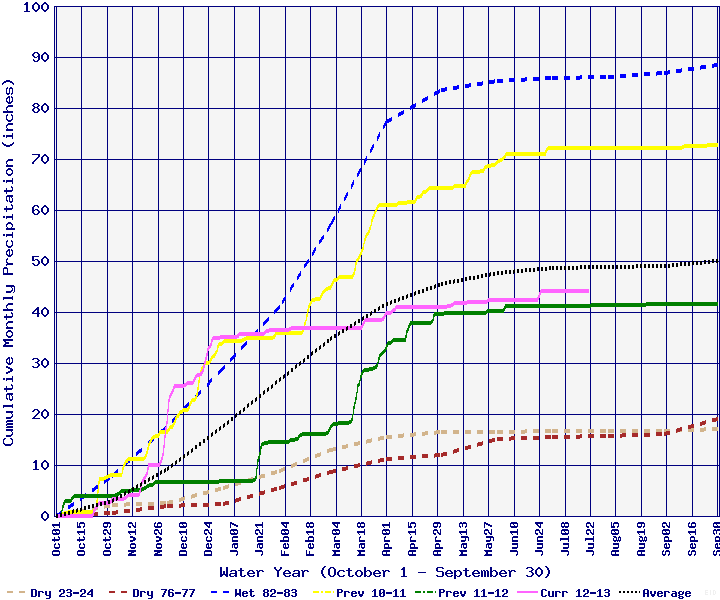
Yes, the reservoirs are slowly emptying and many crops are not getting enough water because of severely reduced allocations. But the reason is not due to a drought. The fact is that this year’s rain (pink line) is not that far off an average year (black dotted line).

The average of eight precipitation stations serves as a wetness index

for the Sacramento River hydrologic region, where most of the state’s rain occurs.


The eight-station index provides a representative sample of the region’s major watersheds, which are: the upper Sacramento, Feather, Yuba, and American Rivers, which produce inflow to some of California’s largest reservoirs

– the source of much of our water supply.  The eight stations are:

Blue Canyon, Brush Creek Ranger Station, Mineral, Mount Shasta City, Pacific House, Quincy Ranger Station, Shasta Dam, and Sierraville Ranger Station.

Seasonal runoff forecasts are based on many more measurements than

this index, including snowpack and prior streamflow. And yes, the seasonal forecasts are a more accurate measure of water supply, but great consideration must be made to the nearly one million acre-feet released to the ocean last winter for “flood control” instead of to storage. This is due to the biological opinion that restricts turning on the pumps that move the water to storage.


Again, there are many ways to characterize a drought. But the most accurate definition describing the situation in California this year can only be titled,  “A Congressional Drought!”

2016-05-31T19:47:09-07:00July 23rd, 2013|

Blue Card Program Program Discussed

Kern County Meeting Focuses on Immigration Reform

Congressman David Valadeo (R-CA) attended what could be characterized as a Town Hall meeting in Bakersfield over the weekend.  The meeting was organized by social welfare groups, along with members of United Farm Workers (UFW).

The big topic was how to manage the issues faced by undocumented farm workers, such as how to be humane with the workers, with the fairness they deserve, while negotiations continue on the Comprehensive Immigration Reform discussion.

Brian Little, who oversees labor relations for the California Farm Bureau Federation, attended the meeting and noted that it was about how to get undocumented farm workers, documented.

UFW, which supports Western Growers Association and Farm Bureau regarding the Blue Card program, would allow the vast majority of current farm workers to obtain legal status if they chose to remain in agriculture.

After a minimum of five years, workers who fulfill their Blue Card work requirements in U.S. agriculture would become eligible to apply for a Green Card, providing they have no outstanding taxes or convictions.  In addition, a new agricultural guest worker program would be established to guarantee a flow of agricultural workers in future years. 

The proposed agreement specifies wages for various agricultural work. There would be a visa cap for the first five years for current workers participating in the Blue Card program.  The U.S. Secretary of Agriculture would have a mandate to modify that cap as circumstances dictate in future years.

The take-home message, according to Little, was that the organizers wanted people in the Kern County community who have an interest in helping farm workers to speak with their Congressman about Immigration Reform, during the August recess.

2016-05-31T19:47:09-07:00July 23rd, 2013|

Navel Orangeworm Update

Joel Siegel, USDA ARS Reports
Navel Orangeworm is High This Season

Almond and pistachio growers appear to be more on top of Navel Orangeworm control this season compared to last year. “It’s human nature because all the people who got burned last year are paying a lot more attention this year,” said Joel Siegel, USDA ARS entomologist based in Parlier, Calif.

Siegel said that in the areas where he works, he is seeing the same type of population levels as he saw last year. These areas are normally under very high NOW pressure–where almonds, pistachios and figs are close together such as in Madera County–causing a perfect storm of pressure year after year.

Joel Siegel is USDA ARS Research
Entomologist based in Parlier
“I am also seeing growers with traps showing very low levels of populations, so NOW is bouncing around quite a bit this year,” Siegel said.

What causes a high pressure year? Siegel suggests three things:

  • Heat Unit Accumulation
  • Overwintering Populations
  • Nut Development Rate

This year, there were probably a lot of overwintering populations.

In terms of heat units,  from the NOW point of view, we are about 17 days ahead of last year,” Siegel noted. “But harvest is going to be much earlier this year than last year. “If we were going to have a late harvest with all these moths out there, there would be greater damage due to crop exposure,” he said.

“However, if everyone is harvesting two to three weeks earlier, growers may be able to dodge the late pressure,” he said.

If pistachios prices continue to hold and growers are committed to that second shake maybe deep into September, there could be a lot of NOW pressure. Pistachio harvest this year may start as early as the last week of August, and the early almond harvest may be starting this week.

Siegel said the Suttera BioLure has been very helpful this year. “It is every bit as good as my virgin female traps,” he said. “The advantage of BioLure is that if you are running live females in a trap and there is a spray operation, the moths would be killed, and those traps will not be attracting males. With BioLure, you will still be catching males,” Siegel said.

Adult Navel Orangeworm
This past spring, UC farm advisors and other researchers held an urgent meeting in Visalia to warn growers of the assured high NOW pressure this year. Researchers said that it would be very important for growers to apply a May spray to beat back the early NOW populations. “But the pressure is there, and I have not seen a real drop this year,” Siegel said.

Siegel noted that during the hot weather which occurred in late June and early July, male population numbers dropped. “But when the heat broke around July 6, the capture rate tripled. I had traps that were catching 30 per trap, and within three days, they were catching 149 per trap,” he said. “Most of the males hunkered down for days during the heavy heat and once daytime temperatures dropped, their normal nighttime activity picked up,” Siegel said. “Interestingly, gravid females were still laying eggs during the heatwave, and egg traps did not have the same level of depression.”

2016-05-31T19:47:10-07:00July 22nd, 2013|

Growers Prepare for Nitrogen Reporting

Water Coalitions Stand by Growers

Improving Surface and Ground Water Problems

By Patrick Cavanaugh, Editor

Parry Klassen is Executive Director and Board Chairman for the East San Joaquin Water Quality Coalition (ESJWQC), a watershed coalition with 3,950 grower members farming 706,336 acres in Stanislaus, Merced, Madera, Tuolumne and Mariposa Counties. Since 2003, Klassen has led coalition efforts to develop approaches for solving water quality problems from agriculture in the region.

Klassen noted that there are about 180,000 acres of unrepresented growers in the region he oversees. “These growers will need to sign up for an individual permit or the regional water board will round them up over the next six months with threats of fines,” he said.

Parry Klassen
“We operate with a group permit, representing our growers’ interests to the State Water Board,” Klassen said.  “We are more in the line of a cooperative because this group permit has specific things that are not covered by a commodity group or organization; there are simply no entities out there to do this. We fill this void. We represent the interests of our members to the State Water Board.”

Klassen said, “The third party approach of the coalition is good in that it has the flexibility to respond to what we find and then work on those problems. We can adjust solutions to meet local needs and provide the information to the Water Board to aid in their decision-making.”

The ESJWQC was the first group in the state to get waste discharge requirements (WDR), and were the first to go to battle with the State Water Board regarding mandates on surface and ground water regulations.  

“At the ESJWQC, we are all getting ready for the new waste discharge requirements,” Klassen said. He noted that the group has provided a service to growers who are not  accustomed to dealing with the Water Board. “The Water Board is not going away. They are here to stay. And their requirements are quite serious and will be around a lot longer than we are.”

Since 2004, the ESJWQC has spent about $50 million on surface water monitoring, negotiating with the State Water Board, writing reports and doing outreach. “This has all come out of the growers’ pockets because there is no grant money,” said Klassen, who also farms peaches in Fresno County.

And expanded story on the ESJWQC will appear in the September 2013 issue of Pacific Nut Producer magazine.


2016-05-31T19:47:10-07:00July 21st, 2013|

CAPCA Meetings Help with Nutrient Management

Nutrient Management Education

Seminars Scheduled

The California Association of Pest Control Advisers (CAPCA) has scheduled a series of nutrient management education seminars for Certified Crop Advisers (CCA), farm managers and growers. The seminars underwritten by CAPCA’s supporting members, Agro-Culture Liquid Fertilizers and Great Salt Lake Minerals Corporation will be coordinated by CAPCA ED, the continuing education division of CAPCA.

Topics will include macro, secondary and micronutrients, current agronomic practices, and improvements in fertilizer technology & application that will allow for the efficient use of fertilizer and protection of the environment. Terry Stark, CEO/President of CAPCA has stated “The increased awareness being placed on sound nutrient stewardship demands that agriculture become more informed and involved in identifying solutions to protect our drinking water and CAPCA wants to be a responsible partner with the growers and CCAs to accomplish this task.”

The seminars will provide the more difficult to acquire CEUs for Crop Adviser renewal requirements (nutrient management, soil/water, and crop management). The seminars, which will run from 7:30 am to 2:30 pm, are scheduled for:

            August 20th – Veterans Memorial Building, Exeter

            August 21st – Monterey UC Cooperative Extension, Salinas

            September 11th – Harris Ranch, Coalinga

            November 19th – Heidrick Ag History Center, Woodland

Registration cost: $60.00 Pre-registration, $80.00 at-the-door.

Registration and additional information will be available in the near future at  https://capcaed.com/

2016-05-31T19:47:10-07:00July 21st, 2013|
Go to Top